Sourcing guides for the Spanish-speaking market usually stop at the container door — how to import, how to size a unit, what customs paperwork to expect. Family Entertainment Centers (FECs) and fixed event venues across Latin America need a different set of answers: how many castle units a permanent floor plan actually needs, what duty-cycle rating survives 10+ operating hours a day, and how the numbers pencil out when the equipment isn't touring between weekend rentals but running continuously in one location. This guide covers the fixed-venue side of the decision.
A rental operator runs a castle 4-8 hours a weekend and packs it away between events — wear is spread thin. An FEC runs the same unit 8-12 hours a day, every day, with continuous blower operation and constant foot traffic. That difference changes what to specify at order time: heavier-gauge PVC (0.55mm+ commercial grade rather than 0.4-0.45mm rental-grade), continuous-duty blowers rated for all-day operation rather than intermittent-use models, and reinforced high-wear zones at entry ramps and landing areas where a rental unit would never see comparable cycle counts. Our full castle range, including commercial-duty configurations, is under Inflatable Castles.
Most Latin American FEC operators we work with start with 3-5 castle-format units zoned by age group rather than one large unit trying to serve every visitor — a toddler-scale bouncer near the entrance, one or two mid-size combo units (castle plus slide) for the 5-10 age range, and a larger obstacle-format unit for older kids and adults, each with its own queue space and a minimum 1.5m clearance perimeter. For venues building a broader activity mix rather than an all-castle floor, our Inflatable Funlands combine multiple activities into a single footprint, which several fixed-venue operators use to cover more age ranges without adding separate queue lines.
A rental operator prices around per-event revenue against a mobile fleet's utilization rate. An FEC prices around per-visit or session-pass revenue against a fixed installation's daily capacity — a 3-5 unit castle zone running 8 hours a day at a steady visitor flow generates far more cumulative sessions per month than the same units would see cycling through weekend rentals, which is exactly why the heavier commercial-grade spec pays for itself: the unit is earning revenue on more days per month, not sitting in storage between bookings. Amortization runs against daily operating hours instead of weekend-only usage, which is the core number that changes the buying decision between rental-grade and FEC-grade equipment.
Fixed-venue operation carries different supervision requirements than a rental event does — most Latin American FEC operators run dedicated floor staff assigned to specific zones rather than event-day temporary attendants, with shift-change inspection logs rather than a single pre-event check. EN 14960 and ASTM F2374 specs apply the same way regardless of venue type, but a fixed installation typically needs documented daily inspection records for insurance purposes, since continuous operation carries more cumulative liability exposure than an eight-hour weekend rental. Build your inspection log around opening/mid-day/closing checks rather than a single event-start check.
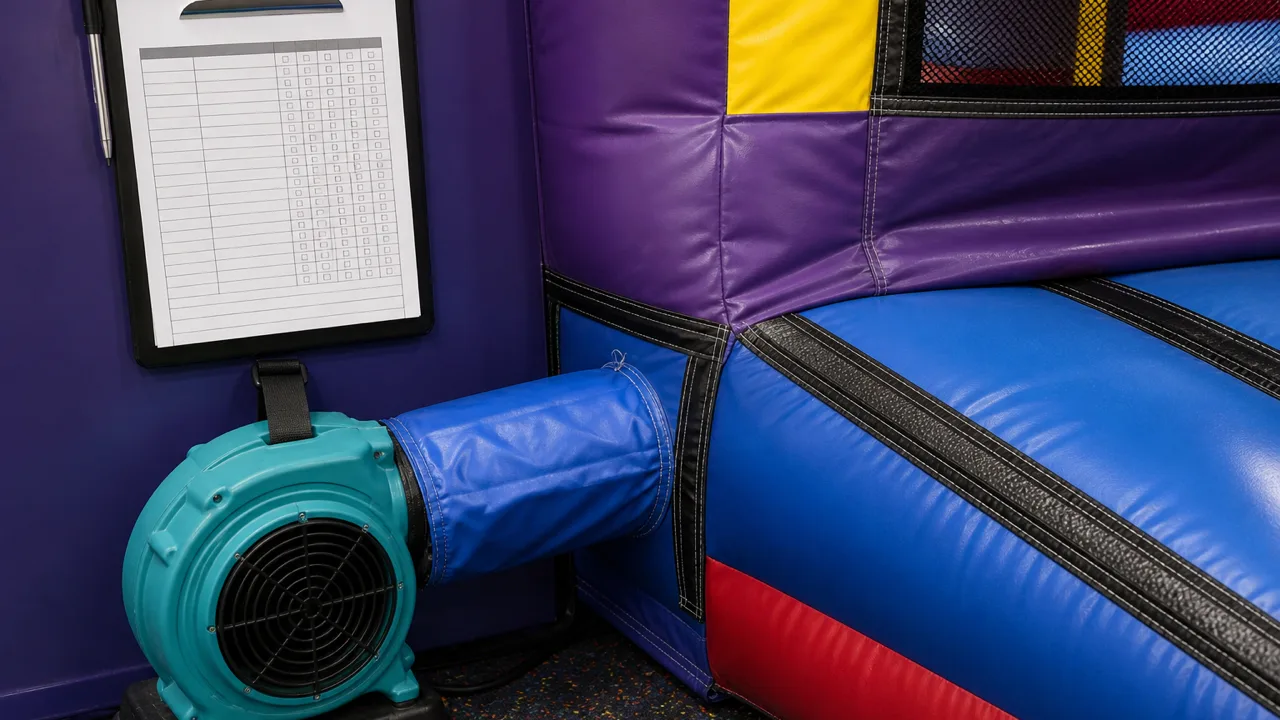
A rental unit gets a full inspection and clean-down between events almost by default — it's being packed up and moved anyway. A fixed FEC installation needs that same discipline built into a schedule instead, since the unit never comes down: a mid-day wipe-down of high-touch surfaces (entry ramps, handholds) during a slower visitor window, a full surface clean at closing covering the entire play area, and a weekly deep inspection of seams, anchor points, and blower filters that a daily wipe-down won't catch. PVC surfaces in continuous indoor use accumulate skin oils and dust faster than outdoor rental units exposed to open air, which is the main reason FEC operators clean more frequently even though the units aren't getting rained on or packed away. Blower filters in particular need a set replacement interval — running 8-12 hours a day pulls far more airborne dust through the intake than an 8-hour weekend rental cycle.
Rental units are usually generic — the same castle works for a birthday party this weekend and a corporate picnic the next. A fixed FEC installation is a permanent part of the venue's identity, and most operators we work with order custom digital-print artwork tied to the venue's branding or a specific theme (jungle, space, underwater) rather than a stock color scheme, since the units are on display every single day rather than rotating through different events. This is also where the FEC-grade material spec matters again: digital print on heavier-gauge PVC holds color and detail through years of continuous UV and indoor lighting exposure better than a lighter rental-grade panel would, so it's worth speccing custom artwork and commercial-duty material together rather than retrofitting one after the other.
A common configuration we see across mid-size Latin American FECs: one toddler bouncer (3m x 3m footprint), two castle-slide combos (5m x 6m each) for the core 5-10 age range, and one larger obstacle or multi-lane combo (8m x 10m) as the anchor attraction — roughly 150-180 sqm total floor space including queue clearance, sized for steady daily visitor counts rather than peak-weekend-only traffic. For operators sourcing this scale for the first time, our Castillos Inflables sizing and customs guide covers the import-side numbers, while our Juegos Inflables sourcing guide covers factory-direct purchasing for the broader Spanish-speaking market.
Unlike a US or European rental fleet with a single summer peak, Latin American FEC and event-venue demand follows region-specific calendars that a generic sourcing timeline doesn't account for: school holiday periods vary by country (Mexico's summer break runs mid-July through August, while several South American countries break for summer in December-February), and the Christmas-through-Reyes Magos (January 6) stretch drives a second, often larger, indoor-venue traffic spike across the region. A fixed-venue operator ordering equipment on a Northern Hemisphere seasonal assumption risks having new units arrive after the peak window they were meant to serve, rather than ahead of it — confirm your target market's specific school calendar and holiday season before finalizing an order timeline, rather than defaulting to a generic mid-year assumption.
Rainy season also matters more for LatAm buyers than the sourcing guides written for drier climates suggest: in markets with a pronounced wet season, indoor FEC traffic often rises as outdoor alternatives become less viable, which is the opposite seasonal pattern many first-time buyers assume when planning inventory levels against weather.
How is FEC-grade PVC different from rental-grade material?
FEC-grade typically runs 0.55mm+ coated PVC versus 0.4-0.45mm for rental-grade units, built to withstand continuous daily cycling rather than intermittent weekend use.
How many staff does a 3-5 unit castle zone need during operating hours?
Most operators run one floor staff member per 2 units during peak hours, with a minimum of one dedicated attendant per unit during any active play session per EN 14960 supervision guidance.
How often should blower filters be replaced in a continuous-duty FEC installation?
Most operators check filters weekly and replace on a monthly-to-quarterly cycle depending on how dusty the indoor environment is — significantly more often than a rental fleet unit, which mainly needs filter checks at the start of each season rather than a fixed monthly interval.
Whether you're planning a first castle zone for a new FEC or upgrading a rental fleet unit to a fixed installation, our team can help match commercial-duty specs and layout to your actual daily visitor flow.