Inflatable Archery Tag & Axe Throwing Arena Guide (OEM)
Inflatable archery tag and inflatable axe throwing are the two headline "combat-target" activation games driving new revenue for rental operators, family entertainment centers (FEC) and event companies. In archery tag, teams shoot foam-tipped arrows across an inflatable battlefield, using pressurized bunkers as cover to dodge, flank and eliminate opponents. In inflatable axe throwing, players toss soft, velcro-backed axes at a target face mounted on an inflatable frame. Both formats package an adrenaline sport into a safe, portable, quick-turnaround attraction — and both are strong candidates for OEM/ODM sourcing from China.
The two combat-target formats
These games look different on the field, but they solve the same commercial problem: high-engagement, low-risk competition that resets in seconds and runs all day.
Archery tag arena and bunkers. An inflatable boundary or a set of freestanding bunkers (cylinders, wedges and low walls) defines a battlefield. Players advance from cover to cover, firing foam-tipped arrows to tag opponents or knock target spots off a central rack. Formats scale from 5-a-side up to 10-a-side on a larger arena footprint.
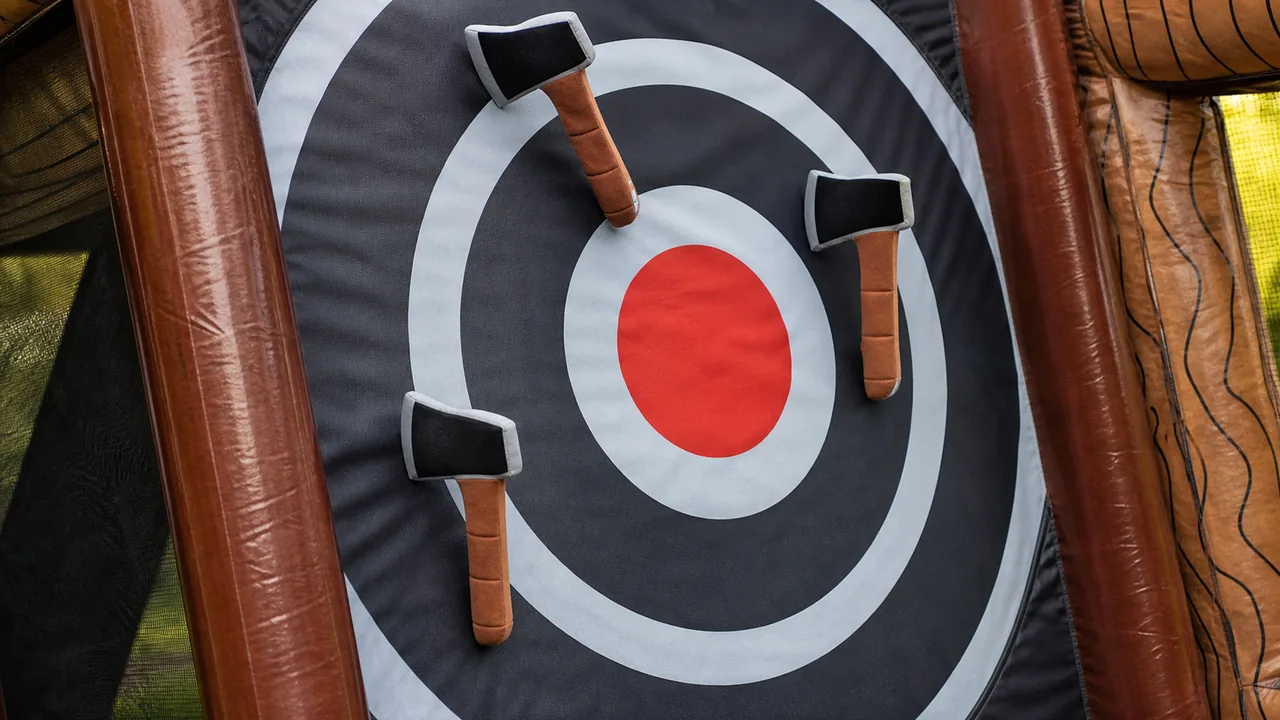
Inflatable axe-throwing target. A single inflatable frame holds a printed bullseye target face in velcro or magnetic-compatible fabric. Soft axes stick where they land, so scoring is instant and there is no rebound hazard. This format suits smaller footprints, bar activations and queue-side side-games at festivals.
Because both belong to the broader commercial inflatable sports range, operators frequently buy them alongside other attractions to build a modular event package rather than a single one-trick unit.
Construction and materials
The inflatable is the arena or the target — the bows, arrows and axes are separate consumables (more on that below). Build quality on the inflatable side is what determines lifespan and utilization, so the specifications matter:
0.9mm reinforced PVC bunkers — the standard for commercial combat inflatables. This weight resists arrow impact, scuffing and repeated drops far better than thin 0.55mm leisure-grade material.
Continuous-airflow (constant-air) design — bunkers and arenas run on a continuous blower so they self-recover instantly after a hit, holding shape through an entire session.
Velcro / magnetic target faces — the axe-throw board and archery target spots use a hook-compatible or magnetic fabric so soft projectiles catch and hold, giving clean, disputable-free scoring.
D-ring anchors — reinforced D-rings at the base take ground stakes (grass) or ballast/sandbags (hard courts and indoor), keeping bunkers stable during aggressive play.
Double- and quad-stitched seams at all stress points, with reinforced bases where bunkers meet the ground.
Ask your supplier for material certificates and confirm the blower voltage (110V/220V) and plug type for your destination market before the order ships.
Safety: non-negotiable rules
Combat-target games are safe only when the equipment and supervision are correct. Build these rules into your operating procedure and staff training:
Foam-tipped arrows and soft axes only. Never allow real, rigid or sharpened equipment. The projectiles are engineered to be dense enough to fly straight but soft enough to be harmless on impact.
Mandatory eye protection. Every archery tag player wears a face mask or protective eyewear for the full session — no exceptions, including spectators inside the boundary.
A trained referee supervises every game. The referee enforces the safe-distance rule, starts and stops rounds, and removes anyone using equipment incorrectly.
Inspect before every session — check blower operation, anchoring and target faces, and keep the arena pressurized throughout play.
If you already run inflatable battle arenas and combat bunkers in a paintball-style format, the referee protocol and anchoring discipline carry over directly — archery tag simply swaps the marker for a bow.
Who buys these games
Combat-target inflatables convert well because they sell an experience, not a product. Typical export buyers include:
Rental operators serving stag/hen parties, birthdays and corporate away-days — archery tag is a premium upsell over a standard bouncer.
Family entertainment centers adding a rotating combat-game zone to lift repeat visits and per-cap spend.
Event and activation agencies that need a photogenic, high-throughput game for brand activations and festivals.
Team-building providers pairing archery tag with other interactive competition games for structured corporate sessions.
For the corporate segment specifically, planners often bundle archery tag into a wider circuit of inflatable sports games for corporate events, rotating teams through several stations to keep large groups engaged.
How it compares to other combat games
Archery tag sits between two neighbors in the combat-inflatable family. Compared with paintball-style bunker battles, archery tag has no consumable paint, no staining and lower cleanup — a lower operating cost per session. Compared with contact games such as bubble football and human foosball, archery tag is a ranged, non-contact game, which broadens its age range and lowers collision risk. Many operators stock all three and rotate them by event type to maximize the return on a single storage and transport footprint.
MOQ, container loading and OEM
These games ship efficiently because they deflate compact. Sourcing terms to confirm with your factory:
MOQ — flexible on standard designs; low minimums on stock arenas and target boards, higher when you commission fully custom OEM tooling.
Container loading — a 20ft container suits smaller mixed orders, while a 40ft HQ container consolidates a full arena, bunker set and multiple axe-throw boards for the best freight economics per unit.
FOB / CIF — request both so you can compare landed cost against your own forwarder's rates.
OEM / ODM — brand the bunkers and target faces with your logo and house colors, or commission a bespoke arena layout and dimensions built to your venue.
One sourcing note: the game equipment — bows, foam-tipped arrows and soft axes — is a separate consumable line, not part of the inflatable itself. Confirm whether your supplier bundles a starter equipment set or whether you source projectiles independently, and budget for arrow and axe-face replacement as an ongoing utilization cost rather than a one-time spend.
The bottom line
Inflatable archery tag and axe throwing deliver high engagement, fast reset times and strong repeat demand — the ingredients of high utilization and quick payback. Built on 0.9mm reinforced PVC, run under a proper safety protocol and sourced with OEM branding, they turn a compact shipping footprint into a premium, all-day attraction across FEC, rental and event channels.