
Competitive team play has become one of the highest-turnover categories in the active-entertainment trade. Rental operators, event companies and corporate team-building suppliers all want assets that run back-to-back sessions, pack down for the next booking, and survive years of hard contact. An inflatable battle arena delivers exactly that: a contained combat field with soft cover that lets players duck, flank and score without the ground prep, fixed structures or liability headaches of permanent installations. This guide covers the product categories, the material grades that matter, bunker layout, safety, setup and how these units ship — so you buy a fleet that earns its keep.
"Battle arena" is an umbrella term for several distinct games. Knowing which one a client actually books changes what you order.
An archery tag arena pairs foam-tipped arrows with inflatable cover. The field is defined by a perimeter and dotted with mid-court bunkers players hide behind while advancing on the opposing team. Cover here is usually a mix of tall column bunkers and low wedge shapes, so a 5v5 field stays fast but readable. Because the projectiles are soft, arenas skew toward all-ages team building and school programs — a broad rental audience.
The inflatable paintball bunkers most operators know are the tournament-style "SUP air" shapes — snakes, dorados, temples and cans — laid out in a mirrored, competition-legal grid. These take real impact from paintball and low-impact reball, so seam and material specs matter more than on any other combat product. Bunkers are sold as full field sets sized to the player count you serve.
Laser tag needs no soft projectile at all, so the priority is cover density and a clean sightline-breaking layout. Many buyers pair bunkers with a fully enclosed inflatable battlefield — a walled arena that contains play, defines a premium bookable footprint, and works indoors or out. Whichever inflatable combat game you lead with, the arena and bunker hardware overlaps, which is why most operators build one modular fleet rather than three separate ones. You will find the full range within our commercial inflatable sports range.
Combat products fail at the material and seam long before they fail anywhere else, because they absorb thousands of direct hits per season. The baseline is 0.9mm PVC tarpaulin — heavier and more abrasion-resistant than the 0.55mm film used on bounce products — with double- or quadruple-stitched, high-frequency welded seams at every stress point. For a full breakdown of why coating weight and scrim count matter, see our guide to PVC tarpaulin grades.
There is also a real structural choice between two bunker types. Constant-air bunkers run off a small blower and self-recover instantly after impact — ideal for high-turnover rental where a deflated bunker mid-session is unacceptable. Sealed-air (drop-stitch) bunkers are pumped once to high pressure, need no running blower, and give the rigid, tournament-true shape paintball leagues expect — but a puncture ends the session until repaired. Match the type to the client: constant-air for casual events, sealed-air for competition.
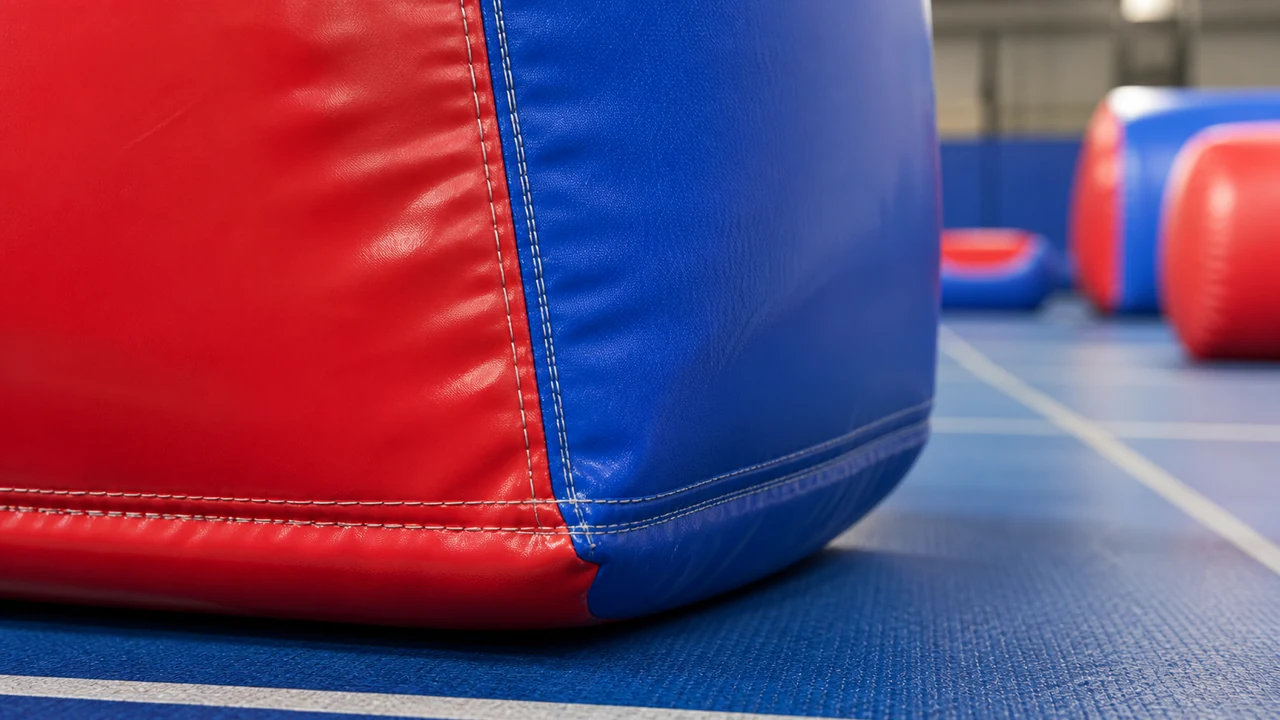
A bunker field inflatable set is only as good as its layout. The industry reference is the 5v5 field: a rectangular footprint roughly 25 x 15 m for paintball, mirrored so both teams face identical cover. A standard set mixes tall bunkers (snakes and temples, ~1.5–1.8 m) that block standing sightlines with low bunkers (cans and wedges) that reward crouched movement. The center line carries the most cover to create the contested "50" where games are won.
For archery tag and laser, footprints shrink — a 10 x 10 m to 15 x 20 m arena suits 5–10 players a side — and cover density rises so players are never fully exposed. When you spec a fleet, order bunkers as balanced sets rather than loose pieces, and confirm the supplier can scale the same shapes up for 7v7 or larger corporate events. This modular thinking is the same principle behind sizing any active-play asset, covered in our inflatable obstacle course buyer's guide.
Soft cover is the safety feature — rounded, air-filled bunkers with no hard edges mean players can dive into them at speed. Specify flame-retardant PVC, secure anchor points (stakes for grass, sandbags or water weights for hard courts), and clearly marked blower placement outside the field of play. For any commercial deployment, insist on documentation your insurer and venue will ask for: EN 14960 where it applies, plus material and flame-retardancy certificates. Netting or an enclosed wall keeps projectiles contained and spectators safe — a must for public events.
Turnover economics live and die on setup time. A constant-air arena for 10 players inflates in a few minutes per blower; a full paintball field of 30-plus bunkers is realistically a two-person, 30–45 minute job. The wins are in the workflow: pre-mapped bunker positions, colour-coded anchor kits and a repeatable teardown sequence. Standardising this pays back fast — our 5-step setup crew training SOP shows how to cut labour and avoid the mistakes that shorten product life. Deflated, bunkers roll tight into wheeled storage bags, so a full field moves in a van, not a truck.
PVC arenas ship as dense rolled goods, so freight is efficient. A complete multi-game fleet — an enclosed arena plus two to three bunker sets — consolidates well into a 40ft HQ container, and the container is the unit that sets your landed cost per set. Before you commit, run the numbers on cube utilisation; our comparison of 20ft vs 40ft HQ container loading shows how much per-unit freight you save by filling the larger box.
MOQ on stock bunker shapes is low, which lets new operators start with a single 5v5 set and expand. OEM is where margin lives: custom bunker colours, printed team livery, branded arena walls and bespoke field dimensions differentiate your rental offer and open white-label supply to other operators. Confirm FOB and CIF terms up front so quoted pricing is comparable across suppliers.
The right inflatable battle arena is a high-utilisation asset: impact-grade 0.9mm PVC, the correct bunker type for your client mix, a balanced formation, and a fleet that fills a container and sets up in minutes. Get those four right and the arena books out weekend after weekend.