
Walk a trade-show floor and you will see a dozen commercial inflatable obstacle courses that look broadly similar. Look closer at who is buying them, and the picture splits into three very different jobs. Spec sheets that ignore those differences end up oversized for one buyer and underbuilt for another.
The first profile is the corporate HR or event manager, buying for a single annual event — a summer family day, a sales kickoff, a new-office opening. They want photo-worthy modules, themable surfaces, and premium finish quality. Budget per unit is high because the unit is amortised over visibility rather than rental nights. Interactive sports games often sit alongside the course at the same event.
The second profile is the school administrator or PE department. Here the course is bought once and reused for five to seven years across sports days, fundraisers, and end-of-term events. Safety-first, low-profile modules dominate; 5m climbing walls give way to tunnels, low humps, and forgiving pursuit lanes sized for younger users. Budget is mid-tier, and the buyer cares as much about replacement-part availability as about initial spec.
The third profile is the rental fleet operator, serving festivals, birthday parties, and corporate clients on rotation. Per-unit cost is mid-to-low, but fleet count is high — six to twelve courses across length tiers is typical. Durability under repeated setup and teardown is the dominant criterion; aesthetics come second.
Most commercial courses are assembled from a fixed vocabulary of five module types. Understanding what each one contributes lets you specify a course that matches your audience instead of accepting a generic catalogue layout.
Tunnels are the crawl-through sections — 2 to 4m long, low to the ground, soft-sided. They reset the user's pace and carry the lowest injury risk of any module. Schools over-index on tunnels for that reason.
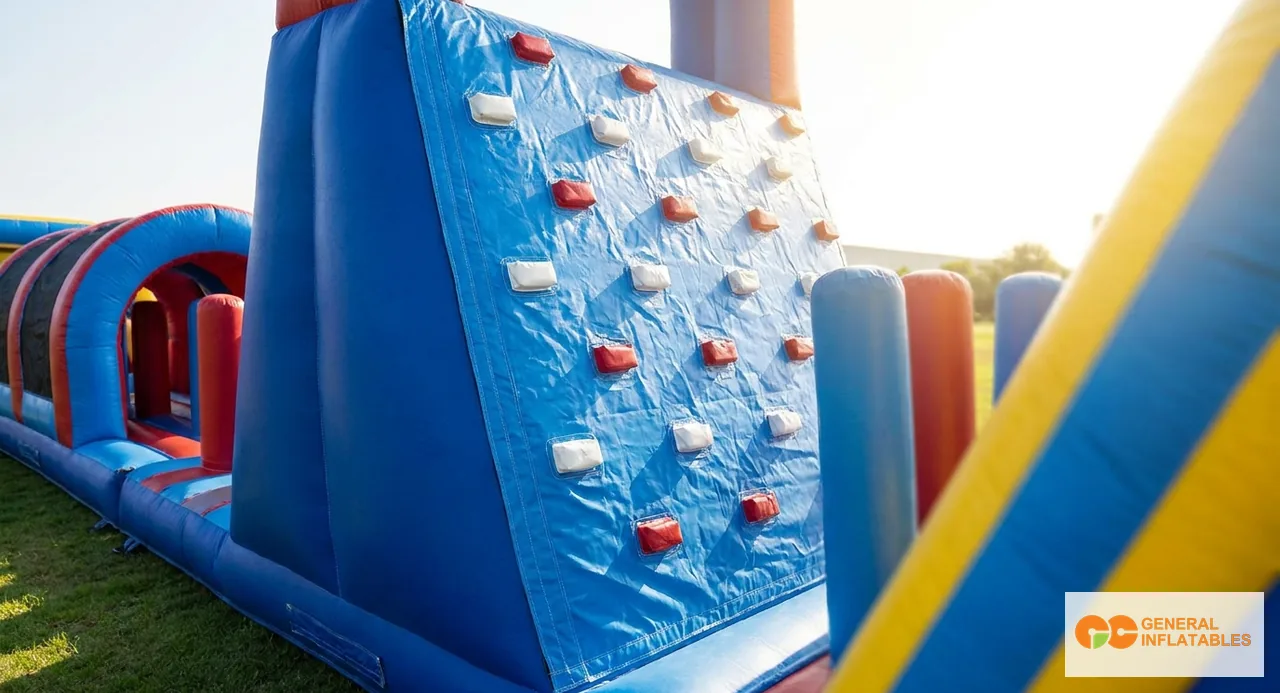
Climbing walls are the vertical features. Commercial courses offer 3m, 4m, and 5m heights; 3m suits schools and family events, 4m is the rental sweet spot, 5m belongs at festival-scale corporate installs. Wall faces can be themed with logos or colour blocks.
Pop-up obstacles are the inflated bumpers and pillars that force a direction change. They lift perceived difficulty without adding real risk and make the course feel less linear, which drives repeat runs.
Pursuit lanes are the two-person side-by-side racing sections — the social-media winner. Every photo of two runners neck-and-neck becomes shareable content for the event host.
Exit slides close the course. A 3 to 4m slide off the final climbing wall is the standard photo opportunity, and almost every buyer should specify one.
Length is the variable most often specified wrong. Buyers ask for "as long as possible" and end up with a course nobody can fully staff or shift. Match length to expected attendance and run time instead.
10 to 15m suits small school events and HR activations. Throughput is not a constraint because attendance is capped.
20 to 30m is the rental workhorse range. A 30m course supports roughly 60 runs per hour at one minute per run with two operators — sustained throughput for a four-hour rental block.
40 to 60m is the festival range, usually run with multiple lanes. A 60m single-lane course drops to about 30 runs per hour because recovery time lengthens; multi-lane configurations recover the throughput.
80m and beyond belongs to signature installations — corporate kickoffs, charity fundraisers, brand activations where the course is the headline attraction. These are bespoke specs.
Staffing scales with length, not with attendance. A 60m course needs more attendants, more anchor checks, and more blower capacity than a 30m course regardless of how many people show up.
Logistics often decide whether a course earns out or sits in storage. A typical 30m course requires a two-person setup crew for 45 to 60 minutes — unrolling, positioning, anchoring, and bringing two to three blowers online. Teardown runs 30 to 45 minutes including a basic surface wipe before folding.
Anchor count for a 30m course runs eight to twelve sandbag points, more if climbing walls exceed 4m. Blower count is two for shorter courses and three once you cross the 40m mark; running undersized blowers is the most common cause of mid-event sag complaints.
Folded storage volume for a 30m course is approximately 1.5 cubic metres at 120 to 180 kg, which fits comfortably on a single pallet. For export, multiple 30m units ship together in a single 20ft or 40ft container — useful for rental operators building a fleet from scratch or for school districts pooling a regional purchase.
Safety practice on commercial courses is mostly about anchoring discipline and operator ratios — the two areas where shortcuts cause incidents. Anchor requirements scale with course height: a 3m climbing wall section needs roughly half the ballast of a 5m equivalent, and outdoor installs on grass need more anchor points than indoor installs on hard floor where you can supplement with weight bags. For a deeper walkthrough of point counts, sandbag weights, and stake-vs-ballast tradeoffs, see our reference on anchor systems for commercial inflatables.
Operator ratios are simpler but enforced less consistently. The working guideline is one attendant per entry point and one spotter for each climbing or exit module. A 30m course with one entry, one climbing wall, and one exit slide therefore needs three trained operators on duty — not two, which is what most rental quotes assume.
A pre-use checklist should run before the first user every session, not just at install: pressure check on each chamber, seam inspection at high-stress junctions, anchor verification with a tug test, blower CFM confirmation, and a surface check for puncture risks under the footprint. Five minutes done properly saves hours of incident paperwork later.
Inflatable obstacle courses lend themselves to themed branding more readily than most other inflatable categories — large flat panels on climbing walls and tunnel exteriors accept corporate logos, school colours, and sports team graphics with minimal compromise to structural integrity. Corporate buyers should always specify removable branding panels rather than printed-in graphics, so the same course can be redeployed across multiple events.
Modular construction also supports phased expansion. A school can start with a 30m core layout and add a 15m extension section the following season, or swap a tunnel for a climbing wall as the user base ages up. This staged-buy approach spreads budget across fiscal years without locking the school into a single configuration.
For rental operators, the smartest fleet strategy is to stock two or three length tiers — typically 15m, 30m, and 60m — so quotes can match event size without going back for a custom configuration on every booking. Pair the obstacle-course fleet with adjacent product lines from the broader inflatable sports product family, and the fleet covers nearly every active-event request a rental client will throw at it. Operators who already stock mechanical bull rides find obstacle courses a natural complement — both target the same booking calendar of festivals, corporate days, and large private events, and both reward fleet operators who can mobilise quickly with trained crews. Adding inflatable sports games to the same fleet rounds out the active-event lineup, giving rental clients a single source for both the headline course and the supporting competition games.
A ninja warrior style inflatable obstacle course is a themed configuration inspired by the Ninja Warrior TV format, built from the same commercial-grade modules as a standard course but sequenced for a tougher athletic narrative. Typical features include a warped wall climb at the finish, balance beams across inflated channels, hanging-ring transitions, pillar dodges that force lateral movement, and slip-through walls that test agility rather than raw strength. Course length usually lands in the 20 to 30m range, configured as a multi-station circuit so participants encounter four to six distinct challenges in series. The target market skews toward corporate team-building activations, school field days, and fitness boot-camp operators who want a recognisable hook for promotional photography. Browse our full commercial obstacle course product line for ninja-themed configurations.
A trained four-person crew can stage a 15m unit in 30 to 45 minutes from truck to first runner, and a 30m or longer course in 60 to 90 minutes. The trick is running anchor installation in parallel with inflation rather than sequentially — two crew members lay out anchor points and stake sandbags while the other two unroll the body and bring blowers online. Teardown follows a similar cadence at 30 to 45 minutes including a surface wipe, controlled deflation, fold, and pack to the transport bag. Crews new to the unit should budget an additional 15 to 20 minutes on the first deployment until rigging sequence becomes muscle memory. For full crew sequencing, see our setup crew SOP article.
Commercial obstacle courses built on 1100D+ PVC tarpaulin at high-impact zones typically deliver five to seven years of service for high-rotation rental fleets running 80 to 150 events per season. Units owned by corporate venues or school districts see eight to ten years because event frequency is lower and storage conditions tend to be more controlled. The first failure points are usually seam stitching at the climbing-wall base and abrasion wear on pursuit-lane floors — both repairable by patch-and-reseam in the field, which extends usable life by another two to three years before full replacement becomes more economical than continued repair. Buyers planning multi-year amortisation should ask manufacturers for the specific denier rating zone-by-zone rather than relying on a single headline number.
Concurrent capacity depends on course layout rather than length alone. A single-lane standard 15m course supports one to two simultaneous users — one entering as another exits — which translates to roughly 40 runs per hour at sensible pacing. A dual-lane racing format doubles that to two simultaneous runners with throughput in the 80 to 120 users per hour band, which is why pursuit lanes dominate festival and rental specs. Mega courses at 30m and above can accommodate three to four users at staggered start intervals provided operators enforce 8 to 10 second gaps between launches. Event planners sizing courses for fixed-window activations should always work backward from expected attendance and event duration, not forward from course length.
Wholesale procurement of commercial obstacle courses typically flows through factory-direct channels rather than distributor networks, because most buyers want custom branding, colour matching, or layout adjustments that pure resellers cannot accommodate. Minimum order quantities are forgiving — one to two pieces for stock catalogue designs, scaling to three to five pieces when full OEM theming, custom logo printing, or non-standard module sequencing is involved. Sourcing checklist before issuing a PO: request a complete spec sheet covering denier rating, seam construction, blower CFM, and anchor count; evaluate a physical fabric sample or visit a reference install; vet the manufacturer's export history and after-sales support footprint. Read our spec sheet reading guide before signing any quotation.
Two standards dominate global procurement. EN 14960 is the European commercial inflatable standard, mandatory across EU markets and widely referenced by insurers elsewhere; it covers anchor load, seam strength, blower requirements, and operator signage. ASTM F2374 is the American equivalent, written by ASTM International and adopted by most US state inspection regimes. Both standards require annual inspection by a qualified third party for insurance compliance, and most commercial event venues will refuse to host a course without current documentation on file. Operators are additionally responsible for following the manufacturer-supplied safety guidelines covering user weight limits, wind speed thresholds, and pre-use inspection routines. Buyers exporting between regions should confirm dual-certification at order time rather than retrofitting compliance later.
Tell us your buyer profile (corporate, school, or rental), target course length, and branding requirements, and we will return a configuration proposal — module list, length options, anchor plan, and container shipping breakdown — typically within five business days.
For related buying considerations, see our inflatable ninja warrior course buyer's guide and our kids FEC buyer's guide.