
Anchor failure is the single largest contributor to inflatable-related injury claims worldwide. When a unit lifts, rolls, or shifts under load, the cause traces almost without exception to an undersized anchor count, the wrong anchor type for the substrate, or operators reusing a stake-and-strap kit on a surface it was never specified for. The major event-liability carriers now ask for a written anchor plan before they will quote a commercial inflatable fleet.
The certification side mirrors the insurance side. EN 14960 and ASTM F2374 both treat anchorage as a calculated load case, not an accessory. The right system depends on three variables: the substrate you are pinning to, the exposure category (open field, walled courtyard, beach, indoor hall), and the design wind speed you have committed to operate up to. A unit certified for 24 mph needs a different anchor count than one certified for 38 mph, and the factory test report should spell out both figures. Buying equipment without that paperwork means inheriting the anchor calculation liability yourself. Anchoring buys you margin against gusts, but it never replaces the wind ceiling itself — review the safe wind speed limits and shutdown protocol so your crew knows the threshold at which to evacuate and shut the unit down.
Ground stakes are the default for grass, packed dirt, and most outdoor festival surfaces. The standard steel stake on commercial gear is 18 in / 45 cm long, driven at roughly a 45-degree angle leaning away from the inflatable, with the strap pulled over the bend so the load tightens the stake into the soil rather than levering it out. Most manufacturers spec a minimum of four stakes per anchor point on larger units, and that count is not negotiable downward when the wind picks up.
Pullout capacity varies wildly by soil. A single 18 in stake in firm loam will hold roughly 800-1,000 lbf before the surrounding plug fails; the same stake in dry sand or saturated clay can fail below 200 lbf, which is why specifying ground stakes for those substrates is an operational mistake even though the kit physically fits. For typical commercial inflatable bouncers on a school lawn, four stakes per corner at the rated angle delivers the EN 14960 load case with margin. On softer or sandier ground, you either move to ballast or you augment stakes with helical earth anchors, which are slower to deploy but recover the holding load.
Once the surface goes hard — asphalt, concrete pad, gymnasium floor, hotel ballroom — stakes are off the table and ballast becomes the only honest answer. The working rule of thumb most operators run on is one 50 lb / 23 kg sandbag per 30 lbs of calculated wind force at 25 mph for a small unit, scaling up linearly with frontal area and design wind. For a mid-size bouncer with roughly 80 sq ft of windward face, that math typically lands at four sandbags per corner anchor point as a starting count, then up to six or eight when you push the operating wind class.
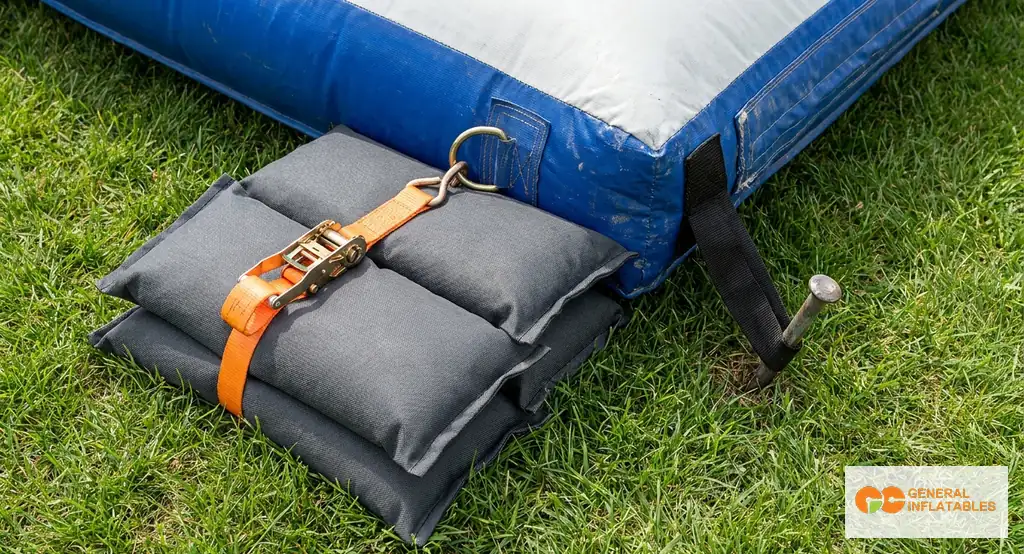
Ballast plates are the denser alternative — typically steel or concrete pucks with a welded D-ring, delivering the same hold weight in a smaller footprint. They cost more up front and they are heavier to handle, but they do not split, they do not absorb water, and they store flat on a pallet. Stacking pattern matters with sandbags: a 2x2 base with the strap pulled over the top course keeps the bags compressed and prevents the strap from slipping off as the unit flexes in gusts. Bags laid in a single row almost always walk under load.
Stakes cannot bite water and sandbags cannot float, so anything sitting on a pool, a lake, or wet sand at the tideline runs on water ballast. The mechanics are simple: heavy-duty bladders, usually 200-500 L / 50-130 gal, are filled on-site from a hose or pumped from the surrounding water, then strapped to the unit's anchor points or to a perimeter mooring line. The shipping advantage is significant — empty bags weigh almost nothing in the container, which matters when you are exporting a full airtight aqua play systems package to a resort halfway around the world.
On floating installations, anchor strategy splits into two patterns. Direct ballast hangs weight bags off the underside of each module so each piece holds its own station. Perimeter mooring runs a continuous anchor line around the entire course, tied at intervals to dead-weight blocks or screw anchors set into the lakebed, and the modules clip to the line. Most large-scale modular water park projects use a hybrid: perimeter mooring for the outer ring plus direct water ballast on internal high-traffic modules where rider load can shift the geometry. Pool installations almost always run direct ballast because the pool wall itself acts as the perimeter.
EN 14960 specifies that anchorage must resist the calculated horizontal force generated at the unit's design wind speed, expressed in kilonewtons per anchor point, with a safety factor applied. The standard does not hand you a single magic stake count — it forces the manufacturer to calculate the windward area, derive the force, divide by the rated holding capacity of the chosen anchor, and document the result. A compliant factory test report will show three lines you can audit: design wind speed, calculated horizontal load per anchor point in kN, and the anchor specification (stake length and count, or ballast mass) that satisfies that load.
The red flag to watch for is a factory data sheet that lists "6 stakes recommended" with no wind-class statement attached. That is a marketing number, not an engineering one, and it is the kind of documentation that gets a claim denied. ASTM F2374 takes a similar engineering approach for the US market, and ANSI/ASTM F846 covers the playground-adjacent crossover cases. When you spec equipment, ask for the full anchor calculation page — the same page that the EN 14960 testing protocol requires the manufacturer to file. Fabric strength on the anchor patches themselves traces back to ISO 1421, which is what underwrites the D-ring pull rating.
The right anchor system for your business is the one that matches your installation tempo and your fleet logistics, not just the one that holds the most weight on paper. Ground stakes are the fastest to deploy on suitable soil — two crew, roughly 8-10 minutes of staking time on a mid-size unit — and they pack into the smallest transport volume, but the steel corrodes after a couple of wet seasons and bent stakes get quietly thrown away.
Sandbags take longer, typically 15-20 minutes of placement and strap routing per unit with two crew, and they dominate transport volume on the truck. UV exposure makes the polypropylene weave brittle within 18-24 months, so the bags are a consumable line item. Water ballast inverts the logistics: near-zero shipping weight, but fill and drain time runs 25-40 minutes depending on water access, and bladder seams develop slow leaks after a season or two. The pick-by-business-model lands cleanly: indoor rental fleets standardize on sandbags or plates, outdoor festival operators run stakes with a sandbag backup kit, and water park operators run water ballast as primary with mechanical mooring on the perimeter. Sourcing the right hardware from the same factory that built the unit is usually cheaper than assembling kits piecemeal — most manufacturers will quote anchor kits matched to your fleet — for example, the deeper anchor calculations bundled with modular water park module sets matched to the load case on the test report, which closes the documentation loop for your insurer in one purchase order. Buyers specifying anchor systems should cross-reference our PVC tarpaulin grades guide for material strength at attachment points, source kits from factory-direct vendors that align hardware to the host inflatable, and recognize that airtight drop-stitch construction demands a different anchor footprint than traditional constant-air units of the same surface area.
Tell us your typical installation surfaces, target wind class, and unit count, and we will return a complete anchor kit specification — stake counts, sandbag capacities, water ballast sizing, and strap ratings — matched to your operating profile.