For international importers buying commercial inflatables, sourcing rarely fails on product quality alone — it fails on who you are actually buying from. The same bouncer SKU can pass through three layers of intermediaries before reaching your warehouse, and each layer adds margin, delay, and a point of failure for warranty claims. Going inflatable factory direct is the single biggest lever you have on landed cost, lead time, and product consistency. This guide walks through how to identify, vet, and onboard a true factory partner in China.
"Factory-direct" gets used loosely. In practice, there is a spectrum, and knowing where your supplier sits on it changes how you negotiate.
For a long-term relationship, the inflatable manufacturer china buyers should target is usually the third type — someone who owns the welding machines and the export paperwork under one roof.
Verification is not a single document — it is a stack of consistent evidence. Before you wire a deposit, work through this checklist.
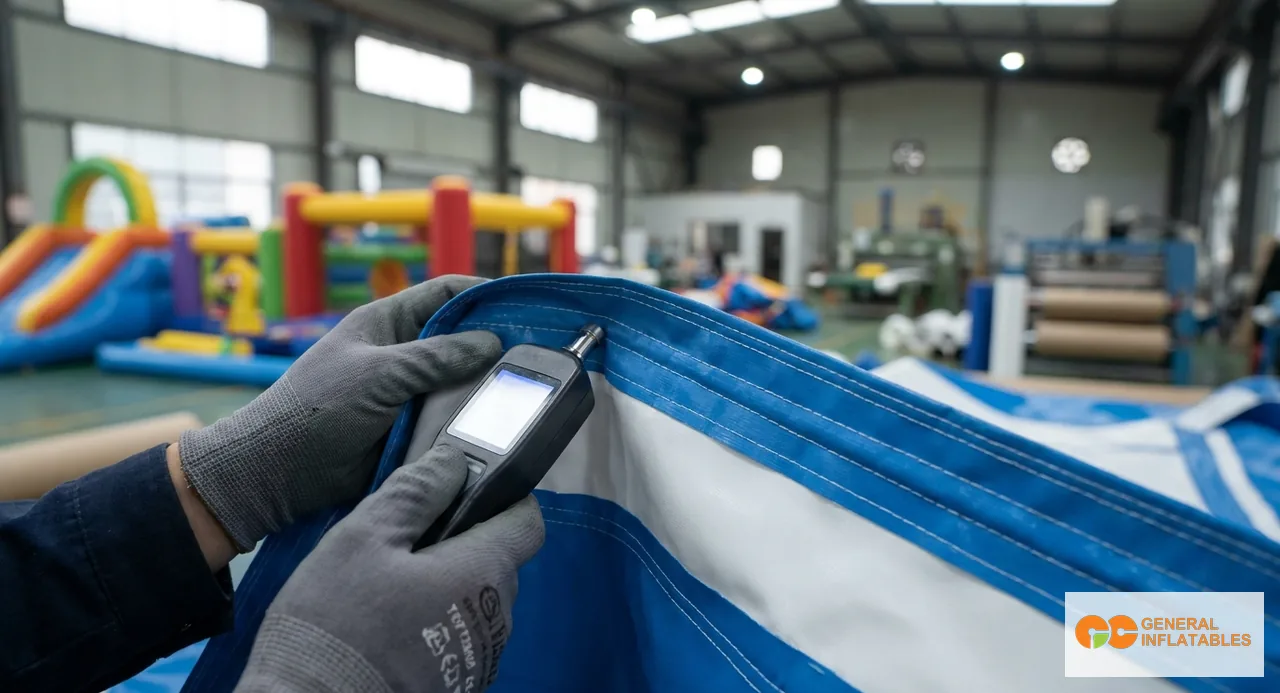
A genuine oem inflatable supplier will welcome every one of these requests. Resistance is itself the answer.
Most disputes between importers and factories trace back to under-specified purchase orders. Pin these technical points down in writing before the deposit goes out.
You do not need to fly to Guangzhou to verify a factory, but you do need more than a sales pitch. There are four practical engagement levels, and most buyers use them in sequence.
1. Paid sample order. One unit, shipped at sample pricing. Inspect against the spec sheet line by line: PVC thickness with a gauge, seam pull test, blower compatibility, repair kit contents, stitching count per inch on reinforced areas.
2. Live video walkthrough. A 30-minute call during the factory's working hours. Ask the sales rep to walk through cutting, welding, the unit in production for your order, and finished goods. Real factories do this routinely; brokers stall.
3. Third-party inspection. Before the container is sealed, commission an SGS, BV, or TÜV pre-shipment inspection. Cost is modest relative to container value and catches wrong colors, missing accessories, or stitching issues while goods are still on the factory floor.
4. In-person factory tour. For larger annual orders or custom product development, an in-person inflatable factory tour is worth the trip. Walk the floor, meet the production manager, and inspect engineering capability behind higher-complexity builds such as airtight aqua play systems. Factories that build airtight inflatables to tight pressure tolerance generally build simpler products well too. Buyers planning modular water park projects should treat the visit as part of engineering, not just supplier verification.
Factory-direct pricing scales with volume and customization. Rather than chase a single per-unit number, model your total landed cost across a year of purchasing.
A factory-direct relationship pays for itself within the first or second rental season once you remove middleman margin. The right custom inflatable manufacturer will help you model this — not just send a price list.
Production typically runs 25–45 days from deposit-confirmed PO, depending on complexity and season. Peak season (Feb–May for northern-hemisphere summer demand) pushes lead times to the upper end; plan backwards from your launch date. For a full breakdown of inflatable production lead times, map each stage against your delivery deadline before you commit.
On customs, your factory should provide a clean commercial invoice, packing list, B/L, and certificate of origin (Form A, Form E, or generic CO depending on destination). HS codes for inflatables generally fall under 9506 (sporting articles) or 9503 (toys under-14); confirm with your customs broker because duty rates differ. A good factory-direct bounce house partner provides documentation clean enough that your broker has no questions.
Finally, do not forget supporting hardware. Blowers, anchor stakes, repair kits, storage bags, and replacement valves all ship with the inflatable. Bundle these factory-supplied accessories into the same PO to consolidate freight and avoid sourcing later from a different supplier with different specifications.
Treat factory-direct sourcing as a long-term partnership. Start with a sample, verify the floor, lock specs in writing, and consolidate into full containers as your fleet grows. The economics and consistency follow.
Three discovery channels dominate the market. Industry directories like Alibaba Verified and Made-in-China Gold Supplier surface registered factories with basic vetting layers; trade show floor visits at IAAPA Orlando or the Canton Fair in Guangzhou let you handle product and meet sales teams face to face; and referrals from existing distributors in your network often produce the highest-quality leads because the supplier already has a track record with someone you trust. None of these channels guarantee quality on their own — verification beats discovery. Once you have two or three candidates, the structured manufacturer vetting process matters far more than how you found the names in the first place.
MOQ depends on customization depth. For stock catalog items pulled from existing inventory, 1-3 pieces is realistic as a small starting test, particularly for sample evaluation before a full PO. Custom-branded stock with your color scheme or logo print typically requires 3-5 pieces per design to justify setup. Full OEM builds with new molds or unique artwork run 5-20 pieces depending on complexity and tooling cost. Smart buyers use multi-SKU container loads to keep per-product volume low while still filling a 20 ft or 40 ft container — combining bouncers, slides, and water play in one shipment gives you variety without crossing into per-SKU minimums. Read the spec sheet carefully before locking MOQ into your PO.
Lead time scales with customization. Stock catalog items shipped from existing inventory move in 5-15 days of production preparation. Custom-branded stock (ODM) where the factory applies your logo or colors to an existing mold runs 25-35 days from deposit confirmation. Full OEM with new mold tooling or custom artwork extends to 35-50 days because the factory has to cut new patterns, weld test units, and run QC before main production. On top of factory lead time, add 15-35 days for ocean freight to North America, Europe, or Australia. Air freight cuts shipping to 5-10 days but is rarely cost-effective except for urgent replenishment of high-margin SKUs.
For first-time orders, the market standard is 30 percent deposit on PO confirmation and 70 percent balance against B/L copy before shipment. Some factories require 50/50 on the first transaction until trust is established. Established relationships over multiple containers may negotiate to 30 percent deposit with 70 percent due within 30-60 days post-delivery, which materially improves your cash conversion cycle. Letter of credit (L/C) at sight is the norm for orders above 50 thousand USD equivalent, particularly in regions with FX controls. Wire transfer (T/T) remains the most common settlement method for small and medium B2B buyers because it is fast and cheap relative to L/C banking fees.
Yes — factory visits are strongly recommended for orders above 10 thousand USD equivalent or for any program involving custom tooling. Most Chinese commercial inflatable factories cluster in two regions: Guangdong province near Guangzhou (the largest cluster, with mature export logistics) and Zhejiang province near Yiwu. Schedule visits 1-2 weeks ahead through your sales contact, and bring a technical advisor or independent QC consultant if your team lacks deep inflatable engineering background. Visa-free transit rules for many Western nationalities now allow 5-7 day visits without a full business visa, which makes a single-trip multi-factory tour realistic. Treat the visit as engineering review, not just verification.
IP protection in China requires layered defense. Start with an NNN agreement (non-disclosure, non-circumvention, non-compete) drafted under Chinese law before sharing any designs, artwork, or technical drawings — a standard NDA written for US courts is largely unenforceable here. Register your trademark with CNIPA before production begins, because China operates first-to-file and brand squatters routinely register foreign marks. For sensitive designs, split production across two factories so no single supplier holds the complete build. Most importantly, define IP ownership explicitly in your purchase contract from day one. The OEM versus ODM distinction directly drives who owns the resulting tooling and design rights.
Tell us your target product mix, target markets, and order volume, and our export team will return a sourcing proposal — typical samples, MOQs, lead times, and FOB pricing — within three business days.
Related guide: Inflatables from China: Manufacturing Standards, Testing & Export Certification — which welding method belongs on which seam, PVC batch testing, factory QC checkpoints, and the certification route per market.
For related buying considerations, see our industry glossary of sourcing and construction terms and our inflatable slide manufacturing OEM buyer's checklist.