Ask ten Chinese inflatable factories for an inflatable lead time quote and you will hear answers ranging from 15 days to 60 days for the same job. That spread reflects real differences in scheduling honesty, factory backlog, and how many corners a supplier is willing to cut. After running production lines for international wholesale orders for more than a decade, our realistic window for a fully custom unit is 25 to 45 days from deposit to container loading, with peak-season spikes pushing certain categories closer to 50.
This article breaks that window into the five phases a job actually moves through on the factory floor, so first-time importers, rental operators chasing summer deadlines, and event companies with hard show dates can plan with no surprises.
Every custom job starts with a CAD sketch, a color spec, and (for branded units) a logo file. On a clean order where the buyer sends vector artwork in CMYK and approves the proof within 24 hours, this phase closes in 3 days. Typical orders take 5 to 7 days. The delay almost always comes from the buyer side: low-resolution logos that need redrawing, mid-stream Pantone changes, or a stakeholder who needs to "show the boss" before signing off.
For complex themed builds such as custom-themed inflatable castles and bouncers, we recommend a paid 30x30 cm welded sample patch before bulk cutting. It adds 4 to 6 days but eliminates the single most expensive mistake in this industry: a 12 m unit finished in the wrong shade of royal blue.
Once artwork is locked and the 30 percent deposit clears, your job enters the production queue. A mid-sized factory runs 8 to 12 cutting tables in parallel and processes roughly 25 to 35 custom units per week. From November through February the queue is short and a job hits the cutting table in 3 to 4 days. From March through July the same factory sits on a 7 to 10 day backlog, and orders placed in late April for a July 4 deadline frequently miss their window.
Factories prioritize jobs by deposit-clear date, not PO date. A buyer who wires same-day jumps ahead of one who took five days, even if both POs signed the same Monday.
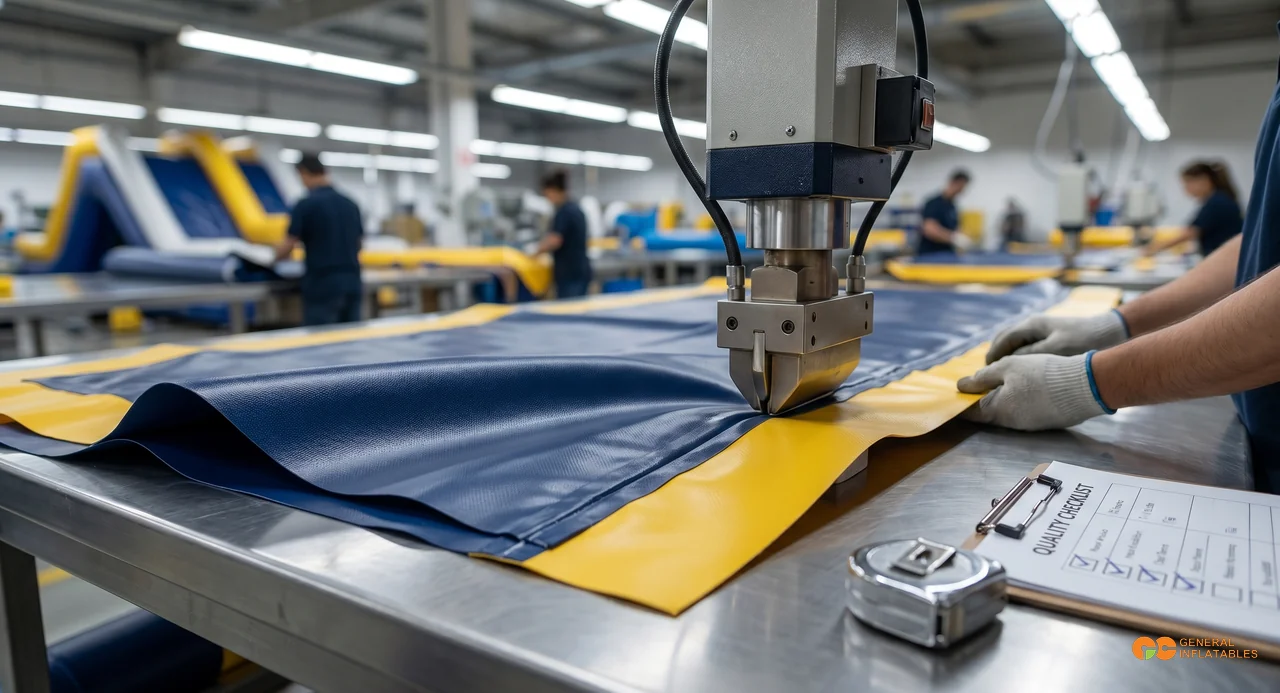
This is the core of custom inflatable production time and the phase where size and complexity drive the spread. A 4x4 m residential-style bouncer with simple panel art moves through cutting, high-frequency welding, and reinforcement sewing in 12 to 15 days. A 10x10 m combo unit with slide, climb wall, and three-color airbrush graphics needs 18 to 22 days. A 25 m commercial water slide with internal staircase and dual lanes routinely takes 22 to 28 days.
The breakdown inside this phase looks roughly like this:
Commercial water slide builds add an extra dimension of complexity because every internal water-channel seam has to be welded twice and pressure-tested in isolation. That is why a water slide of the same footprint as a dry combo typically runs 4 to 6 days longer on the welding line.
Honest factories run every commercial unit through a 24-hour inflated air-hold test. Acceptable pressure loss is under 8 percent in 24 hours; anything above that sends a seam back to the welder. Skipping this step is the single biggest reason buyers receive units that lose shape within two months of use. Packing adds another day: vacuum-rolling, PE film wrap, separate blower boxing, and freight labels. Plan for 3 days minimum, 5 when QC catches rework.
Many buyers forget this phase. From packed to leaving Ningbo or Shanghai you lose another 3 to 7 days: container booking (1-2 days), factory-to-port trucking (1 day), port loading and customs (2-4 days). During peak shipping season (August-October), congestion alone can extend this to 10 days. Build this buffer into every inflatable delivery time you quote your end customer.
Shortening the timeline is mostly about removing buyer-side friction. Factories rarely lose time once a job is on the cutting table; the delays cluster at the start and around payment milestones. Four practical moves consistently shave 7 to 12 days off a quoted window:
For custom-branded advertising inflatables and corporate replicas, artwork approval dominates the timeline more than welding. Get the dieline approved in week one and the finished product ships two weeks faster than a competitor still revising their proof in week three.
If a supplier quotes 15 days for a fully custom 10x10 m combo unit, walk away. Cutting, welding, and sewing alone require 12 days minimum on a rushed line, leaving zero time for artwork, queue, QC, and packing. A 15-day promise means one of three things, all bad for the buyer:
Realistic bounce house manufacturing time for a commercial-grade unit with full QC is 25 days minimum. Realistic OEM inflatable lead time for a complex themed build is 35 to 45 days. Any factory promising materially faster than that is either lying about their process or cutting something that will cost you a warranty claim within six months.
The best protection is verification before deposit. Ask for a written day-by-day production schedule, request the names of the QC lead and the welding supervisor, and require weekly photos from the cutting and welding stages. Our team covers the verification checklist in detail in our guide to factory-direct sourcing without trading-company markup, and we walk through the proof, dieline, and color-match sequence in our custom artwork approval workflow for branded inflatables.
Count backwards from the date your unit has to be on-site. A US East Coast importer needing a unit ready for July 4 should plan: 30 days ocean transit from Ningbo, 7 days inland trucking and customs, 5 days warehouse intake and inflation testing. That is 42 days of post-factory time. Add the 35-day average production window and your deposit must clear by late April. Operators who try to compress that math end up airfreighting at five times the ocean cost, killing the margin on the whole rental season.
Lead times are not a negotiation. They are a physical constraint of cutting, welding, drying, and shipping. The factories worth working with will tell you the real number, hand you a written schedule, and hit it.
Our production team gives you a precise day-by-day schedule before deposit, with weekly progress photos through the build. Browse our combo inflatable catalog and request a lead-time quote tailored to your delivery deadline.