Most marketing managers placing their first fully branded inflatable order assume it works like ordering printed t-shirts: send a logo, get a proof, ship the goods. In reality, OEM inflatable customization is closer to a small industrial project — artwork specs, color systems, application methods, and approval checkpoints all need to be locked down before the first cutting table is loaded. Getting any one wrong rarely cancels the order, but it routinely pushes delivery back by weeks.
Buyers tend to bundle every form of customization into one phrase — "we want it branded" — but in production terms there are three very different tiers. The first is a custom color scheme only: you select brand colors and the factory builds an existing product mold in those PVC tones, no logos, no shape changes. Lead time runs 25-30 days. The second adds a logo printed onto an existing product: same mold, same panels, your artwork applied via heat transfer, silkscreen, or direct print. Lead time stretches to 35-45 days for artwork prep, proofing, and the print pass. The third tier is the one buyers most often underestimate — a fully custom shape with full branding, where the factory tools a new mold, develops new patterns, prints custom panels, and assembles a unit that has never existed before. Plan on 50-70 days from artwork lock to FOB cargo.
If you are sourcing through a standard factory-direct sourcing process, the quote you get assumes one of these tiers, but quotes rarely state the tier explicitly — confirm with your project manager which level you are buying before signing.
Most branded OEM orders for promo programs fall into tier two and live inside the broader promotional inflatables product family. Custom shapes for activations and brand experiences are usually built off platforms inside the inflatable games product family, Among the most demanding of these custom builds are inflatable mascots and custom replicas, where brand-accurate shapes and artwork are tooled from scratch.
Print-ready artwork is the single most common bottleneck, so get file specs right before briefing the factory. Vector files — AI, EPS, or print-ready PDF — are required for any logo needing crisp edges at large scale. Vectors hold geometry no matter how the panel is enlarged, which matters when a logo sized for screen ends up two meters tall on the finished unit. Raster files (JPG, PNG, TIFF) are acceptable only at 300 DPI at final print size — a 1.5 m wide panel needs an image roughly 17,700 pixels wide. Almost no logo files supplied by marketing teams meet this threshold.
For color modes, send artwork in CMYK or, ideally, with Pantone Solid Coated (PSC) callouts. RGB looks correct on a monitor but shifts unpredictably on PVC. Add a minimum 5 mm bleed around every artwork edge to absorb cutting tolerance and weld seams. For minimum text height, the working rule is 8 cm cap height for legibility from a 5 m viewing distance — anything smaller becomes decorative texture rather than readable copy.
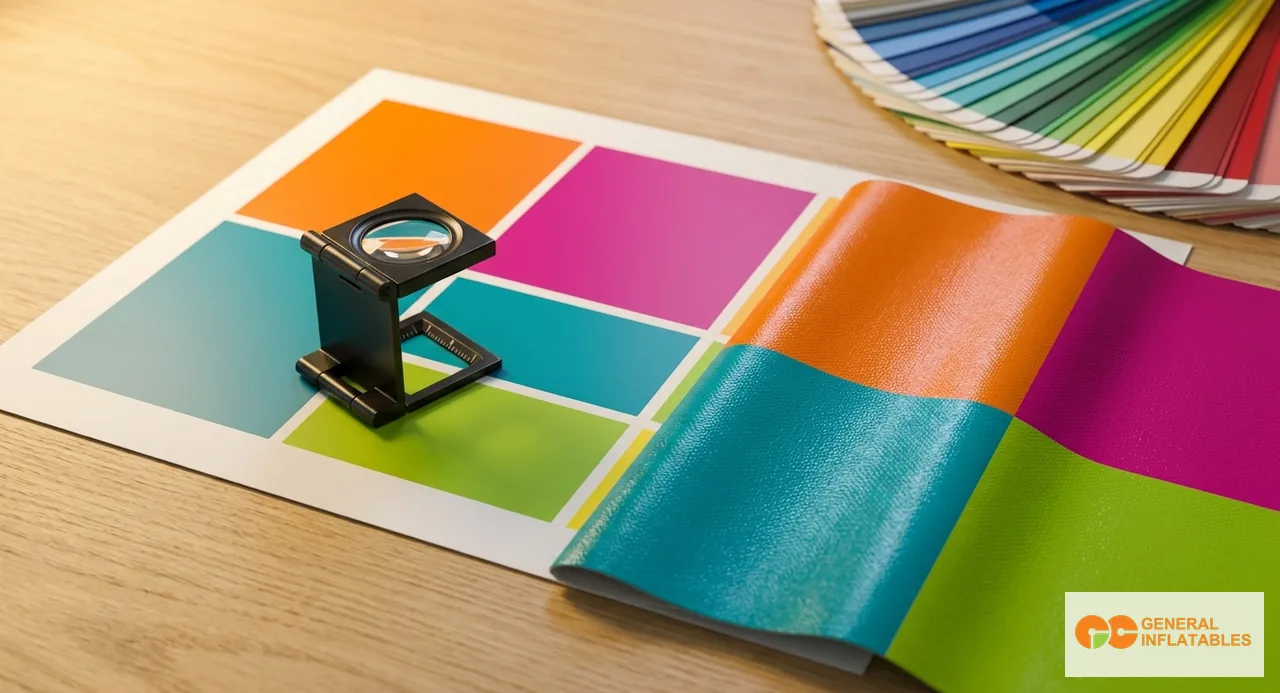
Brand color fidelity is where most post-delivery disputes happen, and almost all trace back to the color system chosen at quoting time. Pantone Solid Coated (PSC) codes are the gold standard: each code corresponds to a mixed ink formula matched against a physical swatch. The catch is that each spot color generally requires its own print pass, so a four-color Pantone logo costs more than a four-color CMYK print of the same image. CMYK process simulates Pantone by overlaying cyan, magenta, yellow, and black dots — faster and cheaper but typically within a 5% color shift of target, fine for general retail but risky for brand-mandated palettes. Custom Pantone matches for colors outside the standard PSC book require the factory to mix and submit a sample for approval — the only reliable path for proprietary brand colors.
The practical rule: if your brand guidelines specify Pantone codes, hand them to the factory in writing at the quote stage and confirm they will be matched as spot colors, not simulated in CMYK. This is how disciplined buyers run branded air dancer programs across multiple production batches without visible color drift between shipments.
OEM inflatable production runs through four formal checkpoints. Design lock (1-3 days of buyer-and-factory iteration) is where artwork placement, panel mapping, and dimensions are agreed in writing — nothing moves forward until this is signed. Digital proof (1-2 days turnaround) is a PDF mockup showing artwork on each panel with dimensions and Pantone callouts annotated — your last cheap chance to catch placement errors. Pre-production sample, or "golden sample" (10-15 days), is a fully manufactured unit produced ahead of the main run for physical inspection — optional but strongly recommended for any order over roughly 50 units. Mass production begins only after the sample is approved in writing.
Buyers occasionally try to skip the pre-production sample to save two weeks. When a color or registration issue is caught in mass production instead, the recovery cycle — reprint panels, reassemble, reinspect — usually costs three to four weeks plus scrapped material. The sample stage is not where you save time.
Three print technologies dominate inflatable customization. Heat transfer works best for small, detailed logos with fine lines or gradients — durable for 3-5 outdoor seasons in normal rental use, with a modest per-panel cost scaling linearly with transfers applied. Silkscreen is the workhorse for large solid graphics — team logos, bold typography, single-color brand marks — and lasts 5-7 seasons because the ink bonds into the PVC. The trade-off is a screen setup charge per color, making silkscreen cost-efficient on long runs but expensive on small orders.
Direct UV print is the newest and most flexible option: photo-quality images, unlimited colors, gradients, and complex artwork in a single pass with no screen setup. It commands a premium per square meter, and outdoor durability is still being benchmarked — field data suggests 2-4 seasons in heavy rental use, longer indoors. For one-off activations and complex visual identities, direct print is often worth the premium; for repeat catalog items in a rental fleet, silkscreen still wins on cost-per-season.
After enough OEM cycles you see the same five mistakes pull schedules off track. First, submitting low-resolution JPG logos pulled from a website — the factory has to re-vectorize by hand and return the result for approval, adding 5-7 days before the project even reaches digital proof. Second, failing to specify Pantone codes for brand colors and then objecting to CMYK results after mass production — at that point the only fix is reprinting panels with correct spot inks. Third, requesting design changes after digital proof approval: once the proof is signed, panels are cut and printed in batch; reopening the design resets production by 7-10 days.
Fourth, underestimating sample approval time on a first-time order — buyers plan as if mass production begins on day one, when the first 25-30 days are absorbed by artwork prep, proofing, and sample inspection. Fifth, splitting OEM orders across multiple factories without aligned artwork files: each factory interprets specs slightly differently, and units rarely match in color or registration. If you must dual-source, lock the artwork package, Pantone callouts, and tolerance spec in a single shared brief before either factory begins. The same discipline applies to container loading for multi-unit branded shipments, where mixed-batch cargo needs consistent labeling to keep distribution clean.
Send us your artwork files, target product, and unit count, and our OEM project team will return a complete proposal — application method recommendation, color-match approach, sample timeline, and production schedule — typically within three business days.
For related buying considerations, see our comparison of full-print, hand-painted, and banner art printing methods, our guide to licensed character copyright risk on inflatables, and our custom logo inflatables for events guide.