
Walk past any car dealership on a Saturday afternoon and you will see one: a tall fabric tube whipping arms in the air, pulling eyes off the road and onto the lot. Air dancers, sky dancers, tube men — whatever you call them, they are one of the cheapest sustained-attention assets in outdoor marketing. And yet most retail operations either rent a tired-looking unit for a weekend or skip them entirely, missing the multi-year ROI of owning a branded fleet. This guide is for marketing managers and dealership operators ready to treat air dancers as a real line item, not an impulse buy.
The mechanism is simple: a high-output blower forces air up a fabric tube, and pressure imbalances at the open arms create the signature whipping motion. The marketing value is not the shape — it is the motion. Human peripheral vision is hard-wired to detect movement, which is why a driver glancing past a row of static signs at 35 mph will still register a dancing tube. Practical sight-line range from a moving car is roughly 300 to 400 feet, enough to give drivers time to read your storefront and decide to turn in.
They are not universal, though. High-wind sites near coastlines or open highways will trigger the auto-shutoff on most units, and constant cycling shortens fabric life. Indoor placement only works under ceilings of about 14 feet or more, ruling out most retail interiors. Residential-adjacent locations also create friction — the blower runs at around 70 dB and neighbors notice. If your site clears those three filters, well-built commercial-grade air dancers — and their cousin products like factory-produced inflatable promotional balloons in the same outdoor-advertising family — will out-perform almost any other outdoor signage dollar-for-dollar.
Standard commercial heights run from 12 ft (3.6 m) for tight urban storefronts up to 25 ft (7.6 m) for highway-frontage dealerships. The sweet spot for most retail use is 18-20 ft — tall enough to clear surrounding rooflines but short enough to stay within most municipal sign-height rules. Fabric is typically 190T polyester with reinforced stitching at the arm seams, where the highest stress concentrates.
Blower sizing matters more than buyers expect. A 12 ft tube needs around 350-450 CFM; an 18 ft tube wants 750-950 CFM; a 25 ft tube needs 1100 CFM or more. Underpowered blowers cause the tube to droop and the motion to look sluggish — the exact opposite of the visibility you paid for. For anchoring, ground stakes work on grass medians, sandbags suit asphalt lots, and weighted steel base plates are the standard for permanent storefront deployment. Two-leg "tube man" variants — the classic waving-arms-and-legs character — need a wider footprint and slightly higher CFM but read as friendlier and more on-brand for family retail. Always budget for spare blowers and anchor accessories from day one; blowers are the single most common failure point in any fleet.
Compare a vinyl banner zip-tied to a fence with a 20 ft air dancer deployed at the same site. The banner attracts a single glance per driver; the dancer attracts repeated glances and often a head-turn from passengers. Industry-side estimates put motion-based outdoor assets at roughly five to eight times the unaided recall of static signs in the same line of sight. That recall lift compounds over the asset's life.
A commercial-grade air dancer used daily during business hours will typically last 3-5 years before the fabric tube needs replacement, and the blower itself often outlasts the tube. By contrast, a vinyl banner faded by UV usually needs replacement inside 12 months, and A-frame signs are routinely lost to wind, theft, or vehicle strikes. Spread the purchase across that 3-to-5-year window and the per-day cost is trivial — most operators report the unit pays for itself within the first selling season, especially at locations where foot traffic or test-drive bookings are the conversion metric. Maintenance is light: monthly fabric inspection, quarterly blower filter cleaning, annual stake or sandbag check.
The biggest design mistake is over-detailing. At 300 feet, fine print, gradient backgrounds, and intricate mascot faces all collapse into visual noise. What reads from a parking lot is solid blocks of high-contrast color. Pick two brand colors — ideally one warm and one cool — and split the tube horizontally or vertically into clean bands. Save the detail work for the storefront window.
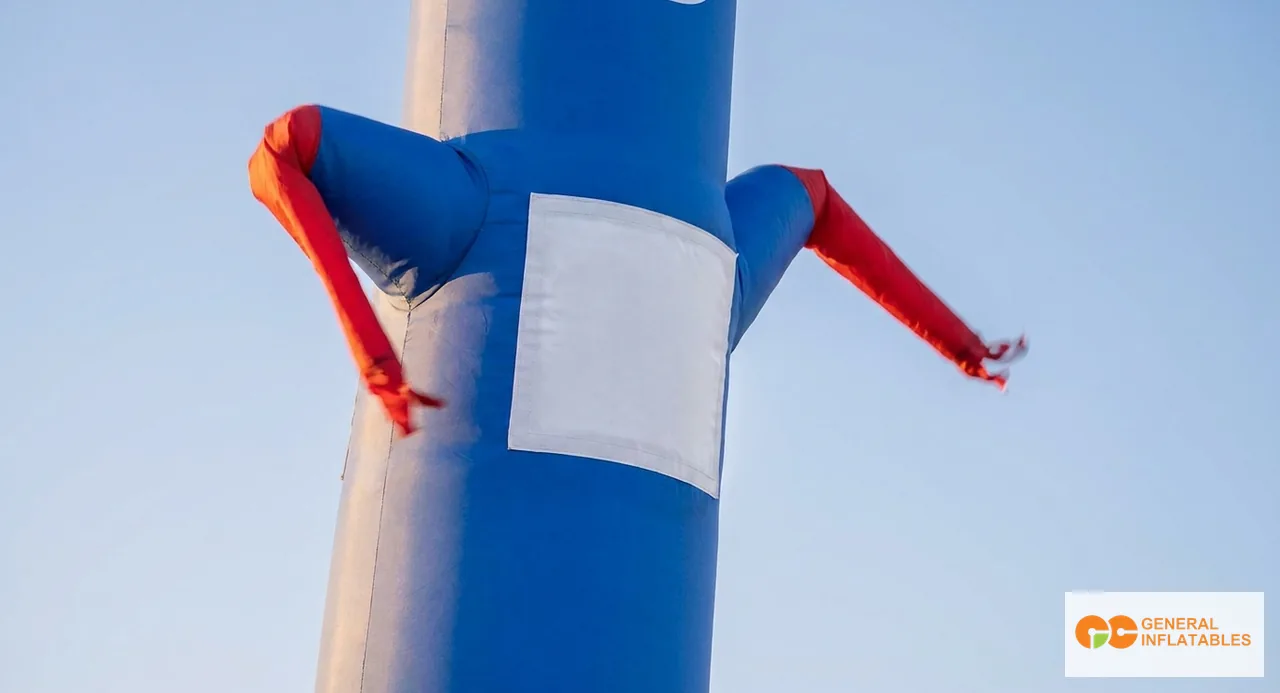
Logos belong on the mid-chest section, never on the arms. The arms whip too fast for the eye to lock onto printed marks, and continuous flexing wears printed graphics down within months. The mid-chest stays relatively stable in the airflow and gives passing drivers a one-second readable window. For custom themes, the strongest performers are seasonal characters (Santa tubes in December, ghosts in October), franchise mascots adapted to the tube silhouette, and two-color brand variants matched to event campaigns. Pair them with branded event arches at the lot entrance and you create a coordinated visual funnel that pulls drivers from the road, through the entrance, and toward the showroom door.
Permitting is the part most buyers underestimate. Many municipalities classify air dancers as temporary signage and restrict permanent placement, often allowing them only on weekends, during posted special events, or within a set number of days per quarter. Some commercial zoning codes treat them as flutter signs subject to the same height and setback rules as feather flags. Always check local ordinances before committing a fleet — the deployment calendar may shape your purchase quantity more than the marketing plan does.
Wind ratings are usually quoted as operational maximums. Most commercial units are rated to roughly 25 mph sustained wind; above that the unit should be shut down and stored, not just left running. Power is straightforward but worth planning: blowers ship in 110V (North America) or 220V (most export markets) configurations, draw 1-1.5 kW depending on tube size, and a typical 10-hour retail day pulls 10-15 kWh per unit. Multiply that across a 50-store fleet and the electricity line item becomes real — worth flagging to your operations team before rollout.
Rolling out 50 branded air dancers across a chain is a procurement project, not a marketing purchase. Start with a locked brand design — colors, logo placement, tube height, and base type — approved by both marketing and field operations before any production begins. Variation between stores looks unprofessional from the road and confuses brand recall.
Batch production through a single factory keeps color tones consistent and lets you negotiate container shipping rather than parcel freight; the per-unit landed cost difference is significant. A factory-direct sourcing approach also lets you specify reinforced stitching, upgraded blower motors, and matched spare-part SKUs from the start. Build a central blower spares pool — usually 10-15 percent of fleet size — and ship replacements regionally rather than per store. Plan a seasonal color rotation (summer brights, fall warm tones, holiday accents) and produce all variants in the same factory run to keep palette consistency.
Finally, give each store manager a one-page quick-card: deploy time, wind shut-off rule, anchor check, blower restart steps, and a contact for replacements. Train once at rollout and the program runs itself. Many chains expand the same vendor relationship into the broader promotional inflatables line — branded archways, custom tents, and giant product replicas — once they see the per-store visibility lift the first fleet produces. Operators chasing maximum brand presence often add inflatable mascots and custom replicas to the same activation kit, since custom-shape figures and air dancers share the identical promotional-inflatable sourcing path.
For a single weekend promotion, renting makes sense — you avoid storage and off-season upkeep for a one-time event. But for any recurring use (weekend rollouts every month, a permanent lot entrance marker, a multi-store franchise program), buying wins on cost within the first season. A rented unit typically runs a per-weekend fee that adds up to the purchase price of an owned unit within 3-6 rental cycles, and after that every additional rental weekend is pure expense with nothing to show for it. A US dealership running an air dancer most weekends of a selling season, for example, usually recoups the purchase cost well before year one closes, then owns the asset outright for the following 2-4 years of service life. Renting only stays cheaper if deployment is genuinely rare — a handful of one-off events per year.
For placement patterns, commercial-duty spec requirements, and a full cost breakdown specific to dealership and retail lots, see our air dancers for retail guide. For a side-by-side comparison against another popular attraction-grade inflatable when allocating a promotional budget, see bumper boats vs air dancers: which attracts more revenue.
An inflatable air dancer — sometimes called a sky dancer, tube man, or wacky waving inflatable — is a tall tubular fabric figure, typically 4 to 7 meters (roughly 12 to 25 feet) in height, kept upright and animated by a continuous-output electric blower at its base. The form was invented in the late 1990s for the Atlanta Olympics opening ceremony and quickly migrated into outdoor brand activation, where it has become a standard fixture. You will see them on car dealership lots, in front of retail grand openings, lining festival entrances, flanking real estate open-house signs, and anchoring weekend promotional events. For B2B marketing buyers, they sit in the same procurement category as branded commercial air dancer product lines sold in bulk for chain rollouts.
The mechanics are straightforward but often misunderstood. A bottom-mounted electric blower pushes a continuous stream of pressurized air into a hollow fabric tube that is open at the top — unlike a sealed inflatable, the air is meant to escape, and the imbalance between intake pressure and escaping airflow is exactly what creates the whipping dance motion. Internal fabric baffles and seam placement determine the rotation and arm-flick pattern, which is why manufacturers offer single-arm, double-arm, and multi-arm configurations with distinctly different visual signatures. The blower runs continuously while the unit is deployed; there is no compressor, no internal valve, and no on-board mechanism beyond the fabric geometry itself. That simplicity is also why the asset class is so cheap to maintain over a multi-year service life.
Pricing varies meaningfully by tube height, fabric weight, blower spec, custom-print complexity, and order quantity, but commercial air dancers sit in the lower tier of outdoor marketing equipment — well below digital signage, projected LED installations, or even mid-range vinyl wraps on a per-unit basis. The best per-unit economics come from bulk MOQ runs in the 10-to-50-piece range, where a single factory production batch absorbs setup and tooling costs across the order. We deliberately avoid publishing fixed dollar prices because every quote depends on artwork, height mix, and shipping lane; serious buyers should request a spec-based quote with their store count, target height, and brand artwork attached so the proposal reflects actual landed cost rather than a generic web list price.
A single-unit air dancer installation typically takes under 15 minutes for someone familiar with the process: unfold the tube, secure the base sleeve to a weighted plate or ground stakes depending on the surface, connect the blower, and confirm the motion clears any overhead obstructions. Multi-unit dealership or franchise rollouts take longer per site during the first deployment while staff learn the process, but drop to the same sub-15-minute window once a location's team has done it once or twice. No specialized tools or contractor involvement are needed for a standard installation — it's designed to be handled by in-house staff, which is part of why the format has a lower total cost of ownership than options requiring a professional install crew.
A commercial-grade air dancer running in continuous outdoor service typically delivers 2 to 4 years of usable life, with UV exposure and daily operating hours being the two dominant wear factors. A reasonable maximum is 6 to 8 hours of daily operation; pushing past that into round-the-clock running accelerates fabric fatigue and blower bearing wear noticeably. End-of-life is usually triggered by visibly faded brand colors — UV bleach is what buyers notice first — followed by fabric tearing at the high-stress seam points where the arms meet the main tube. When a unit reaches that stage, the blower is almost always still serviceable and worth retaining; only the tube needs replacement. For a structured framework on when to refurbish versus retire a unit, see this repair-versus-replace decision guide.
For B2B buyers the practical answer is factory-direct from a manufacturer offering OEM customization — buying through a domestic reseller adds a markup layer without adding production control, which matters when you are specifying brand colors and silhouette accuracy. Custom-shape inflatable mascots are produced one project at a time because each silhouette requires its own pattern, so MOQs typically run as low as 1 to 3 pieces per design, with cost amortization improving sharply once you reach 5 or more identical units. Standard categories include character mascots, product replicas (giant bottles, cans, shoes), and brand icons. Browse the custom cartoon and mascot inflatable catalog for examples of past OEM builds and silhouette categories.
The two assets do different jobs and work best together rather than as substitutes. An air dancer is tall, narrow, and animated — its job is to draw the eye to a single point from long distance, exploiting motion-detection in peripheral vision to pull drivers off a road. An inflatable arch is wide, static, and structural — its job is to frame an entry or finish line, carry a brand logo across a long horizontal span, and signal "the event is here" to anyone already on-site. Air dancers convert glances into approaches; arches convert approaches into entries. Most well-designed B2B promotional deployments use both, with dancers flanking the road frontage and an arch at the entrance, creating a coordinated visual funnel from highway to showroom door.
Operators often pair a street-side air dancer with an inflatable arch over the entrance for full-frontage branding; our inflatable arches guide covers sport, wedding and brand specs.
Tell us your store count, target tube height, and brand artwork, and we will return a multi-unit production proposal — custom design mockups, blower kits, anchor options, and container shipping breakdown — typically within five business days.
Related guide: Air Dancer Inflatable Costs, Setup & ROI — blower wattage and daily power draw, anchoring methods, service life, and a working cost-per-impression framework.