
Every rental operator hits the same wall around year five: a unit comes back from a weekend rental with damage, the repair quote lands on your desk, and you have to decide whether to patch it, retire it, or write it off. Make that call wrong on twenty units a season and you've either bled cash on dying inventory or scrapped assets that had two more years of revenue left.
This guide formalizes the call. It's the framework we use with rental fleets, event companies, and water park operators who manage 30+ unit rotations and need a defensible standard their crew can apply without calling the owner every time.
Not all damage is equal. Before you even look at age, classify what's in front of you. The retention threshold for each category determines whether age becomes the deciding factor at all.
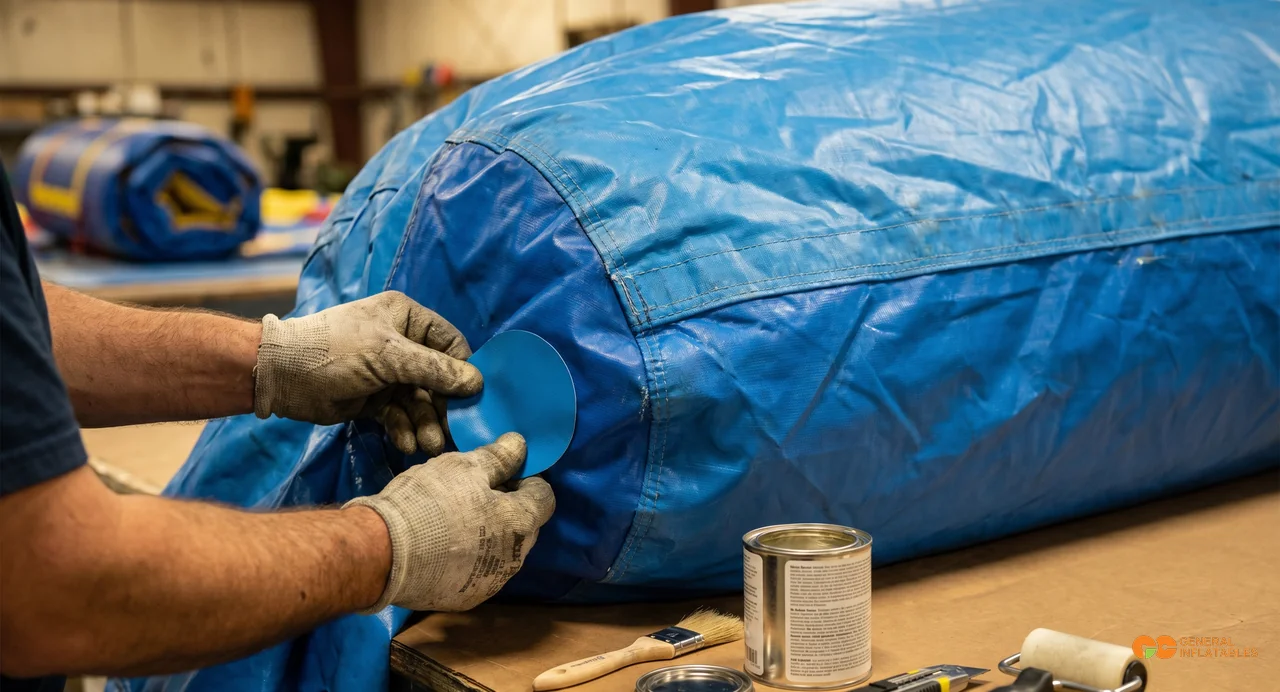
Always repair, regardless of unit age. A hot-bond PVC patch applied correctly bonds at the molecular level and the patched zone will outlast the surrounding wall. We've seen properly patched units take three more punctures over their remaining life and still retire on schedule. Crew training matters more than unit age here: a sloppy cold-glue patch on a one-year-old unit will fail before a hot-bond patch on a seven-year-old one.
Repair if the unit is under four years old and shows no other major damage. Seam re-welding runs roughly 5% of replacement cost and a clean re-weld restores about 90% of original seam strength. Past four years, a single seam failure is usually the first visible signal of stress accumulation across the whole unit — patch it, but flag the SKU for closer inspection at the next teardown.
Replace if the unit is over four years old. If newer, retire from peak-weekend rotation and reassign to off-peak, low-energy use (corporate events, indoor setups). Multiple failure points mean the PVC has lost plasticizer across the structure and you're now in the failure cascade phase. Every repair buys weeks, not months.
Cosmetic only. Structurally, chalked PVC retains most of its tensile strength for another two to three seasons. Replace only when customer complaint frequency starts dragging down your rebook rate. Track this in your CRM — if more than 10% of post-event surveys mention "looked old" or "faded," that SKU has reached commercial end of life even if it's mechanically sound.
Almost always replace. Internal baffles are heat-welded during factory assembly and are not field-repairable. A factory rebuild runs 60% or more of new-unit cost, at which point you're paying nearly full price for a unit with a used outer shell. The only exception is a high-value custom unit where the outer print is worth preserving.
Damage category sets the floor; age sets the ceiling. Apply this curve after you've classified the damage.
| Unit Age | Default Decision | Disposal Path |
|---|---|---|
| Years 0–2 | Repair anything. Modern commercial PVC has a 10+ year design life. | N/A — keep in peak rotation |
| Years 3–5 | Repair small/medium damage. Major damage triggers retire-from-fleet. | Sell at 30–40% residual to secondary market |
| Years 6–8 | Repair only structural damage on high-rotation SKUs. Cosmetic damage = consider replacement. | Sell to small operators in cost-sensitive regions |
| Years 9+ | Replace. Don't repair. | Part out, donate, or recycle |
For operators managing mixed fleets, this curve applies most cleanly to dry units. If you're running water slides and wet inflatables exposed to pool chemistry, shift the entire curve forward by 18–24 months. Chlorine and UV combine to accelerate plasticizer migration, and a five-year-old water slide is structurally closer to a seven-year-old bouncer.
When age and damage category both point to a gray zone, run the formula:
Repair if: Repair cost < (Replacement cost × Remaining useful life ÷ Total design life)
Worked example: a five-year-old castle quoted at roughly 13% of replacement cost to repair, ten-year design life. The break-even is 1.6 years of remaining useful life. If the unit has been hitting 40+ rental days per season and shows no other damage categories from the matrix above, you're getting another two seasons easy — repair. If it's already showing chalking and a prior seam repair, you're rolling the dice on 18 months — retire.
The formula misses one large cost: downtime risk during peak weekends. A unit that fails mid-event on a Saturday in July costs you the rental fee, the customer trust, possibly a refund, and the labor cost of an emergency swap. Aging units cluster their failures in peak heat, exactly when you can't afford them. We add a 20% risk premium to the repair side of the equation for any unit over six years old going into peak season.
Damage isn't the only retirement trigger. Track these soft signals across your fleet — they show up before catastrophic failure and give you time to phase replacements at off-peak pricing.
A retired unit isn't worthless. Choose the disposal path that matches the unit's remaining condition and your local market.
The operators who get this right share three habits. First, they classify damage before they classify cost — the matrix above runs before any repair quote gets read. Second, they track soft signals in the CRM, not just in the maintenance log, because commercial end of life often arrives before mechanical end of life. Third, they phase replacements at off-peak pricing rather than emergency-buying in May, which means fleet planning happens in November.
If you're rebuilding a bouncer fleet rotation plan that staggers unit ages across the inventory, aim to never have more than 25% of your fleet entering year six in the same season — otherwise you face a synchronized replacement wave that breaks your cash flow. Stagger purchases by two-year cohorts and the replacement curve flattens.
Two operational references that pair with this framework: our recommended field repair kit contents for on-site patches covers the consumables every crew should carry to handle category 1 and 2 damage without a trip back to the shop, and the off-season storage protocols that meaningfully extend fleet life is the single highest-ROI maintenance investment — units stored correctly age 30% slower than units stored wet, folded tight, or stacked under weight.
Build the matrix into a one-page laminated card for your warehouse manager. The first time a crew member triages a unit using the framework instead of waiting for a phone call, you've recovered the time you spent on this article.
We help rental operators stage fleet rotation: phasing out 5-7 year-old units while staging replacements at off-peak pricing. Browse our combo inflatable line and request a fleet renewal proposal with phased delivery scheduling.