
After fifteen seasons running a rental fleet across the Upper Midwest, I can tell you that what you do between November and March determines whether your inflatables last six years or sixteen. Storage is not warehousing. It is preservation. The operators who treat off-season as a passive holding period are the same ones replacing welded seams every other spring and writing off units after eight rotations. The ones who follow a disciplined storage SOP routinely push commercial bouncers past 1,500 inflation cycles. Here is the playbook we use across our 80-unit fleet, refined through three Midwest winters and one disastrous summer where we learned what humidity really does to folded vinyl.
Cleaning is non-negotiable. A unit folded with sand in the seams will abrade itself from the inside out over 90 days of dormancy. Start with a dry sweep — visual sand and grit removal using a soft-bristle push broom, paying attention to corner welds and the inflation tube where debris settles. Tip the unit on each side to dislodge embedded particles. Then move to wet cleaning with mild dish soap diluted in cold water — never hot, never bleach, never solvent-based degreasers, all of which break down PVC plasticizers and accelerate brittleness.
The critical step that 60% of operators shortcut is full air-drying. Minimum 48 hours, ideally 72, inflated outdoors or in a ventilated shop, with airflow circulating across all internal chambers. Mold spores will colonize a humid fold in under two weeks, and once mildew penetrates the PVC backing, no surface cleaner brings it back. If you fold damp, you have already lost the unit. Before any of this, run the full cleaning and disinfection SOP so no contaminants or moisture get sealed into the fold.
Before any unit goes horizontal, run through seven inspection points. This is the cheapest insurance you will ever buy.
Document everything with date-stamped photos. You will want these for insurance later.
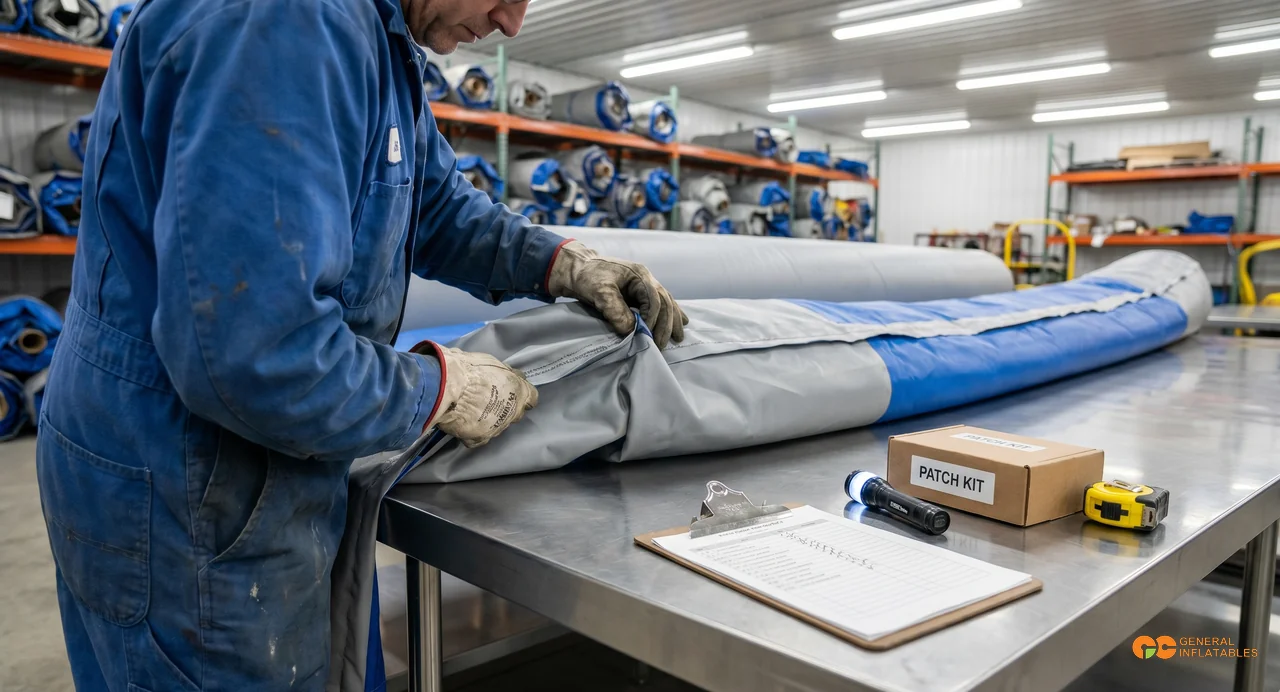
This is where most damage happens silently. Each product geometry demands its own approach. For traditional commercial bouncer units, use the panel-stacking fold: deflate fully, lay flat, fold the side walls inward along the natural weld seams, then fold the roof down in thirds. This respects the geometry the welds were engineered for and avoids creating new stress creases.
Slides require length-wise rolling with foam pool-noodle buffers placed at the curve radius — a sharp fold across a slide curve will crack the inner liner within two seasons. Water slides need an additional 24 hours of drying beyond the standard 72, plus a light dusting of unscented talc on internal surfaces before rolling; this prevents the inner walls from adhering to themselves under storage pressure. Our water games inventory sees the highest off-season casualty rate precisely because operators rush the drying step. Arches and tunnels need a controlled deflation sequence — open the secondary release valve first, allow 4-5 minutes for full evacuation, then collapse from the base upward. Forcing air out through the primary valve creates negative pressure that strains the apex welds.
The storage space matters as much as the technique. Target temperature is 5-25°C — below freezing makes PVC brittle and prone to crack at fold lines when handled, above 30°C accelerates plasticizer migration. Humidity must stay below 60%; install a hygrometer and a dehumidifier if your space runs damp. Direct sunlight is poison even through windows — UV degrades vinyl even when the unit is folded, so cover shelving racks or store in interior bays.
Pest barriers are mandatory, not optional. Rodents chew PVC for nesting material, and one mouse can write off an entire fleet unit overnight. Use sealed plastic totes for accessory storage, deploy snap traps along walls, and consider professional pest contracts for warehouses over 2,000 sq ft. Stock spare patch kits, talc, and replacement anchor straps in your storage accessories inventory so pre-season repairs do not stall waiting on shipping.
Treat units differently based on how long they will sit. 3-month dormant storage (standard winter break, December-February) requires the baseline protocol above with one mid-storage inspection at the 45-day mark. 6-month seasonal storage (Northern European or Canadian operators with long winters) demands a 90-day re-fold cycle — unfold every unit, inspect, refold along different axes to prevent permanent crease memory. 12-month strategic backup units held as fleet redundancy need quarterly re-folding, full inflation testing every 6 months, and rotation into active service at least once every 18 months to prevent permanent set damage to the PVC.
Commercial-grade PVC tarpaulin is engineered for flex cycles, not static compression. Plasticizers — the additives that keep vinyl flexible — migrate over time, and migration accelerates at fold lines under storage pressure. Stress cracks at fold creases are the single most common end-of-life failure for stored inflatables. The countermeasure is rotation: every 90 days for any unit stored longer than 6 months, unfold, lay flat for 4 hours, and refold with creases offset by at least 15 cm from the previous fold lines. For deeper context on which vinyl grades resist plasticizer migration best, see our breakdown of PVC tarpaulin grades and lifespan factors.
Rodent damage repair runs 3-8x the cost of standard puncture repair because chewed material is shredded across multiple layers and rarely sits on a single weld line. Mice and rats target folded vinyl because it offers warmth, insulation, and nesting fiber. Deploy snap traps at 3-meter intervals along storage walls, use tamper-resistant bait stations outside the warehouse perimeter, and seal all wall penetrations larger than 6mm. For field repair guidance when damage is discovered at season opening, our repair kit contents and field technique guide walks through patch sizing, adhesive cure times, and which damage patterns require factory return.
Most operators do not realize their commercial inflatable policy treats stored units and operational units as separate premium classes. Stored units typically carry lower theft and weather premiums but require documented storage conditions to remain covered — meaning if your warehouse exceeds the humidity threshold in your policy, a mold claim can be denied. Photograph every unit's condition immediately before storage, log warehouse temperature and humidity weekly, and keep a maintenance record per unit. When a claim happens, this paper trail is the difference between a paid claim and a denied one.
Spring activation is not "inflate and rent." Run a 48-hour inflation test on every unit before its first booking: inflate, leave running for 4 hours under monitored pressure, deflate, inspect every seam under tension, then re-inflate for the remaining 44 hours to identify slow leaks. Walk every weld line under full inflation pressure — your bodyweight stress-tests welds the way a kid's jump will. Run a pressure-drop check: shut the blower, time how long until visible deflation begins; a healthy unit holds shape for 90+ seconds. Finally, verify blower compatibility — match CFM ratings against unit spec sheets, because last season's blower may not be this season's correct match if you rotated equipment.
Operators who run this full activation protocol catch 90% of storage-related defects before they become customer-facing failures. The two-day investment per unit pays back the first time you avoid a mid-event blowout and the refund-plus-reputation cost that follows.
Distributors stocking 1-2 backup units per high-rotation SKU avoid downtime during peak weekends when a primary unit needs repair or storage rotation. Browse our obstacle course catalog and request a high-rotation fleet backup quote.