
Denier is a textile unit, not a coating measurement. One denier equals one gram per 9,000 meters of yarn. When a factory quotes 1000D or 1100D (and for high-pressure applications, see our drop-stitch construction deep dive) — PVC tarpaulin, that number refers to the thickness of the polyester yarns woven into the scrim layer buried between two PVC coatings. It says nothing about how thick the PVC itself is, how the fabric was calendered, or how well the coating bonds to the scrim.
This is the single most common misconception buyers carry into a sourcing call. A higher denier number indicates a heavier base yarn, which generally correlates with higher tensile and tear strength — but only if the rest of the construction holds up. A 1100D scrim woven loosely with low thread count per square inch can underperform a tightly woven 1000D scrim. Ask for the scrim count (often quoted as 9x9 or 14x14 threads per inch) alongside the denier number, because the two together describe the fabric's real load-bearing capacity.
Denier also tells you nothing about flexibility at low temperatures, UV resistance, or how the seam will behave under heat-weld. Those properties depend on PVC formulation, plasticizer chemistry, and stabilizer packages — variables that sit outside the denier number entirely. Treat denier as one line in a spec sheet, not the headline number.
For most kids' bouncers running short rental cycles in temperate climates, 1000D PVC tarpaulin at 0.55 mm total thickness is the workhorse spec. It survives weekend events, folds reasonably well, and resists the abrasion of children's shoes and grass debris. Operators running fleets of commercial inflatable bouncers on short three-to-four-hour rentals rarely see a meaningful failure-rate difference between 1000D and 1100D in the first three seasons.
The 1100D advantage becomes visible in three scenarios. First, high-traffic commercial units installed at indoor family entertainment centers, which see continuous use eight to twelve hours a day. The extra yarn mass resists the cumulative abrasion of thousands of jumps per week. Second, water park modules and slides where surfaces stay wet, because saturated fabric loses some tensile strength and the heavier scrim provides a margin. Third, structures stored folded between events — repeated folding creates microscopic stress along the crease, and 1100D fabric tolerates more fold cycles before scrim fatigue shows up as pinhole leaks.
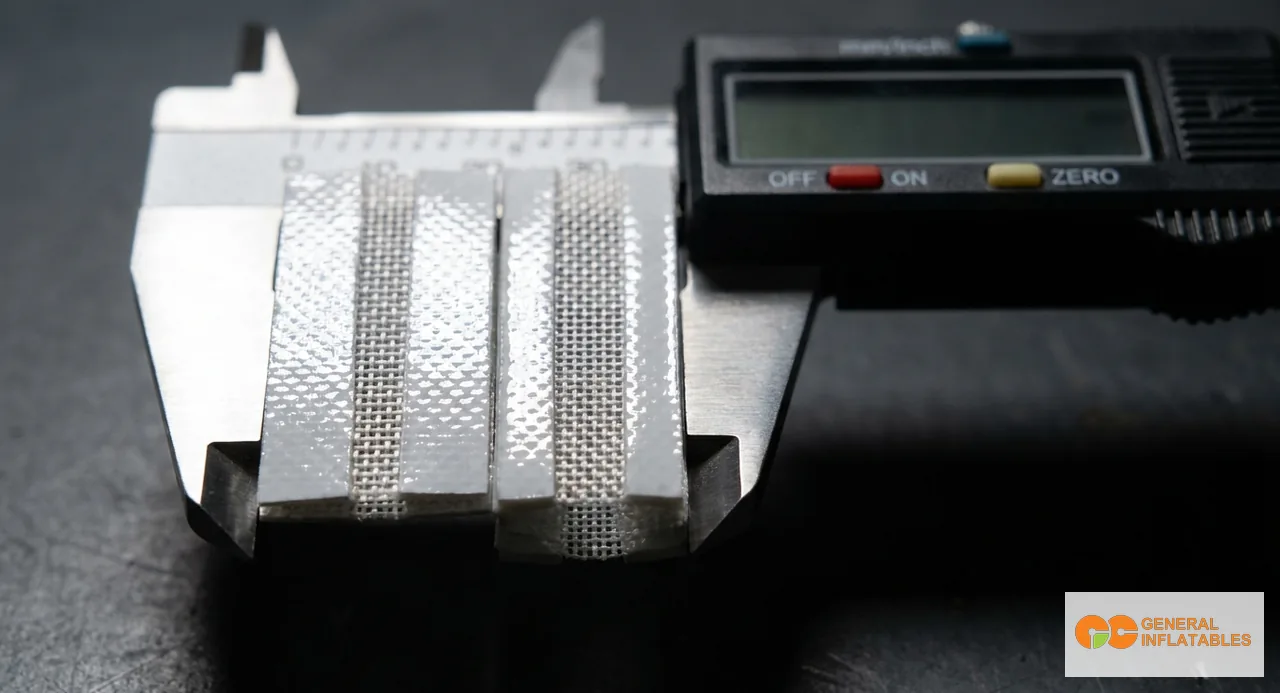
The price gap between 1000D and 1100D base material is small at the roll level — usually under ten percent. That cost difference disappears entirely when you amortize it over a unit's service life, but only if your operating profile actually stresses the fabric enough to need it. Buyers running indoor party-rental routes typically over-spec; buyers running outdoor water attractions typically under-spec.
The second variable hiding behind a tarpaulin quote is coating weight, measured in grams per square meter, and total fabric thickness, measured in millimeters or mils. A 1100D scrim coated thinly — say 480 g/m² total fabric weight — can underperform a 1000D scrim coated at 620 g/m². The PVC layer is what resists puncture, abrasion from grit, and UV degradation. The scrim only matters once something has cut through the coating.
Typical commercial-grade tarpaulin for bouncers and slides runs 0.55 mm total thickness at roughly 610 to 650 g/m². Heavier structural applications — large water slides, drop-stitch floors, obstacle course bases — push to 0.65 mm or 0.9 mm. When a factory quote lists "1100D commercial PVC" without specifying coating weight or total thickness, you are reading a marketing sheet, not a spec sheet. Push back for the g/m² number and the mil thickness.
A practical buyer's habit: divide total fabric weight (g/m²) by total thickness (mm). The ratio gives you a rough density check. Numbers far below 1000 g/m²/mm suggest a porous or foamed coating that will not wear like solid PVC.
Standard commercial PVC tarpaulin handles seasonal outdoor use in temperate climates without special treatment. Three conditions justify upgrading to marine-grade or UV-stabilized variants: prolonged direct sun exposure in tropical or subtropical latitudes, regular saltwater contact, and continuous outdoor installation rather than event-based deployment.
Tropical UV degrades unstabilized PVC plasticizers within two to three seasons — the surface chalks, the fabric stiffens, and cold-crack resistance falls off a cliff. UV-stabilized formulations add hindered amine light stabilizers (HALS) and absorbers to the PVC compound, extending useful surface life by one to two seasons in equatorial conditions. Marine-grade goes further: it adds anti-fungal additives, salt-resistant adhesion promoters at the scrim-coating interface, and often a slightly heavier coating to compensate for accelerated wear.
For water-exposed products — splash pads, floating platforms, commercial water slide lines, and pool-adjacent inflatables — marine-grade is worth the premium when units stay deployed for weeks at a time. For weekend-rental water units that dry between events, standard UV-stabilized tarpaulin is usually sufficient. Drop-stitch airtight pools sit at the demanding end of this category, because the dual-wall fabric holds water continuously and any delamination at the drop-stitch threads ends the product's life immediately.
Factory lifespan tables describe ideal conditions: indoor storage, moderate use, temperate climate. Real fleet data tells a different story. As working ranges:
0.55 mm 1000D tarpaulin in a temperate climate with seasonal storage lasts five to seven rental seasons before seam fatigue and pinhole leaks make repairs uneconomic. The same fabric deployed in tropical conditions — full sun, high humidity, year-round operation — drops to three to four seasons. Add saltwater exposure without marine-grade treatment and the working life can fall below two seasons.
0.55 mm 1100D in temperate climates extends the curve by roughly one season versus 1000D; in tropical climates the gain is smaller because UV and plasticizer migration dominate over scrim fatigue. Marine-grade 1100D at 0.65 mm in tropical conditions delivers five to six seasons of useful life, comparable to standard 1000D in temperate climates — which is generally the right benchmark when quoting tropical-market buyers.
These ranges assume the unit is washed after each event, dried fully before folding, and stored away from direct sun. Operators skipping any of those steps should expect to subtract one to two seasons from every number above.
A proper material spec sheet from a manufacturer will list, at minimum: scrim denier and thread count, base fabric weight in g/m², total thickness in millimeters, tensile strength in megapascals tested under ISO 1421, tear strength tested under ISO 4674, cold-crack rating (the minimum temperature at which the fabric remains flexible without fracturing — typically -30°C for commercial grades), and a flame retardancy certificate referencing the destination market's standard. For European buyers, the relevant material compliance sits inside the broader play-equipment cert, and EN 14960 cert tests material compliance as part of the structural and burn-test suite. Note that flame-retardant PVC is a separately-tested fabric spec rather than a coating add-on, so always confirm the fire retardancy standards on the certificate match your destination market before signing off.
Red flags on a spec sheet: phrases like "high-quality commercial PVC" or "heavy-duty material" without numbers attached; missing g/m² figures; tensile strength quoted as a single number rather than separate warp and weft values; no cold-crack rating; no test-method reference (a strength number without an ISO method is unverifiable). Reputable factories publish numbers with method references because their suppliers test to those methods routinely.
For buyers new to direct-from-factory sourcing, the conversation goes faster when you arrive with a target spec sheet rather than asking the factory to recommend one. Sample questions, fabric swatches, and third-party test reports are reasonable to request, and factory-direct sourcing tips covers the broader RFQ process. Compare two quotes line-by-line: same denier, same g/m², same coating thickness, same test methods. Only then does the price comparison mean anything.
The D stands for "denier" — a textile measure of fiber thickness defined as the mass in grams of 9,000 meters of yarn. Higher denier numbers mean thicker fiber strands woven into the scrim, which generally delivers more abrasion resistance and tear strength under load. 1000D is the commercial baseline for bouncers and slides, while 1100D and 1500D are heavy-duty grades reserved for high-rotation rental fleets, water attractions, and drop-stitch construction. Denier alone, however, does not tell you fabric weight or coating quality — the GSM (grams per square meter) figure and the number of PVC coating layers determine actual material performance just as much as the base yarn thickness. Always read denier alongside GSM and coating thickness.
1000D PVC tarpaulin typically lands at approximately 610 g/m² and delivers an 8 to 10 year design life under standard commercial rental rotation — weekend events, indoor storage, seasonal use. 1100D moves up to roughly 700 g/m² and extends design life to 10 to 12 years, with measurably better resistance to puncture from grit, stones, and shoe scuffing, plus improved abrasion tolerance at high-traffic landing zones. The material cost premium between the two grades sits around 10 percent at the roll level, but the lifecycle extension is closer to 20 percent. For high-rotation fleets running multiple events per weekend or indoor FECs operating continuously, the upgrade pays for itself. Lower-rotation operators often do not need 1100D.
Request a cutting — a small offcut from the same roll your order will be cut from — and perform independent weight testing with a digital kitchen scale accurate to 1 gram. A 100x100mm sample weighing between 5.5 and 6.5 grams confirms 550 to 650 GSM, consistent with legitimate 1000D commercial tarpaulin. Tear-test the offcut by hand: genuine commercial PVC will resist hand-stretching without visible fiber separation along the scrim. Documenting these tests with photos creates a record you can reference if a shipment looks off. Our sample evaluation walkthrough covers the full incoming-inspection protocol step by step.
For water slides, yes — 1100D should be your minimum spec because constant moisture and pool-chemical exposure (chlorine, bromine) accelerate scrim degradation and the heavier yarn provides a longer safety margin. For pool floaters, splash toys, and lower-impact water play, 1000D is usually acceptable because peak impact loads on the fabric are lower. For drop-stitch construction — where thousands of internal threads hold two fabric layers apart under high pressure — 1100D to 1500D is required to handle the sustained internal load without delamination or thread pullout. Our drop-stitch construction guide details why pressure-bearing layers need the heaviest grade you can source.
Denier is one of five spec lines that actually determine field performance. GSM (grams per square meter) measures combined fabric and coating weight — the real indicator of how much PVC sits on top of the scrim. Tensile strength, quoted separately for warp and weft directions in Newtons, measures the breaking load. UV resistance is rated on the blue wool scale and predicts how fast color and plasticizer degrade in sunlight. Cold-flex rating describes flexibility at minus 20 Celsius, critical for cold-climate markets where folded units crack at low temperatures. Fire retardancy certifications (EN 71-2 for Europe, CPAI-84 for US, M1/M2 for France) are mandatory for commercial use. Our spec sheet reading guide shows how to interpret each line.
Partially — experienced buyers can spot obvious quality differences by hand, but feel tests should always be combined with measurements. Premium PVC feels noticeably denser and less plasticky than budget material; the surface has weight to it. A cold-snap bend test works well: fold a small offcut sharply and watch how it recovers. Premium PVC stays flexible and rebounds; cheap PVC creases visibly and the crease line stays. Smell tests also reveal quality — a strong vinyl or chemical odor indicates high plasticizer content, which will off-gas over the first months and leave the fabric stiffer. Visually, the surface should be uniform; visible bubbles, color streaks, or uneven gloss point to inconsistent coating application at the factory.
Tell us your target product and operating climate, and we will return a full material spec sheet — denier, coating weight, tensile and tear strength, UV stabilization, and cold-crack rating — for the grade we recommend, typically within three business days.