
Ask any operator who has lost a unit early: the inflatable rarely fails because someone scrubbed too little — it fails because someone cleaned it with the wrong chemical. Choosing the right disinfectant matters more than scrubbing harder. Bleach, alcohol, and solvents embrittle the PVC coating and attack glued seams, so the SOP below follows one safe flow every time: neutral cleaner first, certified disinfectant second, thorough drying last.
For a rental fleet, hygiene is not a compliance checkbox — it is the single most visible quality signal a customer sees up close. Kids crawl across the bed, parents watch, event planners inspect before they sign off. A unit that smells musty, shows ground-in dirt around the entry, or has a sticky landing mat loses the next booking even if the structure is perfectly safe. Clean units photograph better, pass venue inspections faster, and generate the word-of-mouth that fills a weekend calendar.
There is a durability angle too. Organic soil, sunscreen, food residue, and standing moisture feed mold and slowly degrade the PVC surface. A disciplined cleaning routine protects both your reputation and the asset itself, extending service life well past the EN 14960 inspection cycle. Cleaning is maintenance, not housekeeping.
The coated PVC fabric used on commercial inflatables is durable against abrasion but chemically sensitive. The plasticizers that keep the coating flexible can be stripped or oxidized by aggressive chemistry, and once the surface goes brittle the cracks start at the print edges and seams. Know your two lists.
Safe to use:
Avoid — these kill PVC:
When in doubt, test any new product on a hidden corner first and check that it carries a material-compatibility statement for PVC or vinyl.
Run this sequence every time. Skipping the rinse or shortcutting the dry is where most damage and mold problems start.
Inflate the unit fully on a clean tarp. Remove all loose debris — grass, sand, leaves, food, hair — with a soft broom or a low-power vacuum. Cleaning over loose grit just grinds it into the coating.
Mix your neutral cleaner at the labeled dilution in warm (not hot) water. Work in sections with a soft brush or microfiber, paying attention to high-contact zones: the entry step, landing mats, slide bed, and any handholds. Use moderate pressure — let the detergent do the work, not your arm.
After the soil is gone, apply your PVC-compatible disinfectant at the correct dilution. Disinfectants need contact time to work — typically 1 to 10 minutes wet, per the product label. Don't let it pool and dry; keep the surface visibly wet for the stated dwell time, then move on.
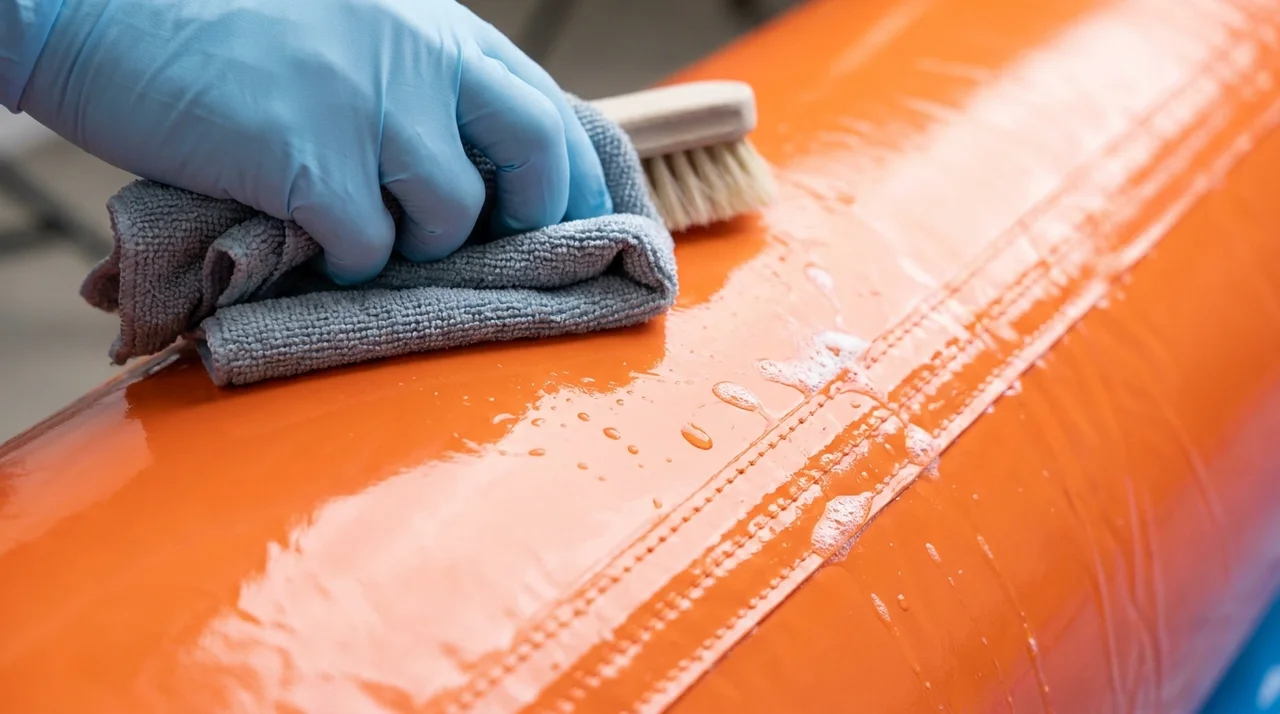
Rinse thoroughly with clean water until no slipperiness or foam remains. Leftover detergent or disinfectant film attracts dirt, can irritate skin, and accelerates surface aging. This step is non-negotiable.
Dry completely before deflation. Details below — this is the step operators rush and regret.
Water slides, slip-and-slides, and splash pools live in exactly the conditions mold loves: warm, wet, and folded for storage. Mold doesn't just look and smell bad — it stains permanently and the cleaning needed to remove it can itself damage the coating.
The defense is moisture control, not stronger chemicals. After every water event, drain all pooled water completely, wipe down troughs and seams where water hides, and never fold a water unit while any part is damp. For units used continuously through a hot season, a periodic disinfect-and-dry cycle keeps biofilm from establishing. If you run slip-and-slides or pool combos heavily, build the drying buffer into your turnaround time. See our Slip and Slides category for the unit types that demand the strictest drying discipline.
Storing a unit even slightly damp is the most common cause of mold, musty odor, and seam delamination in a rental fleet. Inflate the unit and let air circulate until every surface — including the underside, internal baffles, and folded creases — is bone dry to the touch. Direct sun speeds drying but don't bake the unit; prolonged UV exposure has its own cost, covered in our inflatable UV protection SOP.
Use a clean, dry blower run or natural airflow for the final pass. Only then deflate and fold. For folding technique, climate control, and pest protection during the off-season, follow our inflatable storage & off-season maintenance SOP.
Match cleaning depth to use. Spot-clean constantly; deep-disinfect on a calendar. The schedule below assumes an actively booked rental unit.
| Frequency | Tasks |
|---|---|
| Per event / per booking | Sweep debris, spot-wash high-contact zones (entry, mats, slide bed), wipe visible soil, drain water units, quick dry before pack-up |
| Weekly | Full wash + disinfect cycle on all units in rotation, inspect seams and print edges, check for early mold, thorough dry |
| Monthly | Deep disinfect including undersides and baffles, detailed seam and stress-point inspection, repair minor abrasions, refresh anchor points and blower screens |
| Seasonal / pre-storage | Full clean + disinfect + extended dry, complete EN 14960 condition check, document wear, treat and protect before long-term storage |
Seams and print are where a unit shows its age first, and both are vulnerable to the same chemicals you must avoid. Welded and glued seams lose adhesion when hit with solvents or repeated bleach; printed logos and panel artwork fade and crack under alcohol and oxidizers. Always wipe along seams, never scrub across them with abrasive pads, and keep your disinfectant inside its rated dilution so you're not leaving aggressive residue on the joints.
For artwork, lower pressure and neutral cleaners preserve color depth far longer than any "deep clean" with a harsh product. When you do find a lifted seam or a small puncture, address it immediately rather than letting water and dirt work in — keep a proper kit on the truck. See our guide to inflatable repair kits for operators. And if you're specifying new units or replacement panels, the base material grade sets the ceiling on durability — our PVC tarpaulin grades guide explains what to ask your supplier for.
Clean smart, not hard. The fleets that last are the ones that treat the right chemistry and a complete dry as the real SOP — scrubbing harder was never the answer.
Inflate the unit fully and let air circulate until every surface is bone dry to the touch — including the underside, internal baffles, and any folded creases where water hides. Run a clean, dry blower or use natural airflow for the final pass. Direct sun speeds drying, but avoid prolonged UV exposure. Never fold or store a water slide while any part is still damp; that is the single most common cause of mold, musty odor, and seam delamination.
Inflate it on a clean tarp, sweep out loose debris, then wash with a pH-neutral cleaner or mild dish detergent and a soft brush, focusing on high-contact zones like the entry and walls. Rinse thoroughly with clean water until no foam or slipperiness remains, then dry completely before deflation. Avoid bleach, alcohol, and abrasive pads that damage the PVC coating.
Use a certified surface disinfectant rated as PVC-compatible — quaternary ammonium ("quat") based sanitizers are the standard choice, typically diluted 1:64 to 1:256 per the manufacturer's instructions. Give it the labeled contact time while the surface stays visibly wet, then rinse. Avoid chlorine bleach, alcohol, and solvents such as acetone or MEK; they oxidize the coating, weaken seam adhesive, and embrittle the fabric.
Spot-clean high-contact zones per event and quick-dry before pack-up, then run a full wash-and-disinfect cycle weekly on units in rotation. Deep-disinfect undersides and baffles monthly, and do a complete clean plus extended dry alongside the EN 14960 condition check before long-term storage.