
Operators in Dubai, Brisbane, Phoenix, Valencia and the Greek islands all face the same fleet problem: a unit that lasts seven years in a temperate market often shows visible fade and stiffness within eighteen months under a UV index of nine or higher. The damage is not random. It follows predictable chemistry, and it responds to a tight operations protocol. This article gives high-sun operators a working SOP covering material specification, daily operations, inspection, color tracking, storage and lifecycle planning.
Commercial inflatable PVC fails under sunlight along two parallel paths. UV radiation breaks down the plasticizers that keep PVC flexible, leaving the fabric brittle and prone to seam cracking. At the same time, UV attacks the pigments bonded into the surface layer, causing visible color fade. Both processes follow Arrhenius-style kinetics: every 10°C rise in surface temperature roughly doubles the reaction rate.
High-UV markets sit in a different regime than most factory test data assumes. The Gulf states, northern Australia, the US Southwest, the Spanish coast and most of the Mediterranean run UV indices of 8 to 11 for five to seven months a year. Temperate Europe and the northern US average 3 to 5 across a comparable period. Field data from operators we work with shows degradation roughly 3 to 4 times faster in the high-UV band.
The early warning sign is color fade, and it does not appear uniformly. Bright reds and oranges visibly shift within roughly six months of daily exposure at UV index 9+, versus twenty-four months in temperate climates. Dark blues fade next. Whites and beiges hold color longest. By the time fade is obvious to a customer, plasticizer migration is already well underway in the same material.
The single highest-leverage decision is the spec sheet you sign at order time. Three line items matter.
Many factories offer an optional UV-extra topcoat at roughly 15 to 20 percent material cost premium. In a UV index 9+ market it typically extends visible color life by 30 to 40 percent and is almost always worth it. For airtight units where seam integrity is structural rather than cosmetic, the case is even stronger — see our notes on airtight water play construction where seam durability is non-negotiable for context on why UV-stabilized welds matter on these product lines.
Material specification only buys you headroom. The daily schedule decides whether you use that headroom up in two seasons or stretch it across five.
Dawn and dusk operation only in extreme heat months. From May through September in the northern hemisphere (November through March in Australia), restrict public operation to roughly 7-11am and 4-8pm. This is non-negotiable for fixed installations at resorts and hotels in the Gulf and Australian tropics.
Midday shutdown 11am to 4pm. When ambient air temperature exceeds 35°C or UV index exceeds 9, internal PVC surface temperature can climb above 65°C. At that temperature plasticizer migration accelerates sharply and the unit loses elasticity measurably with each exposure cycle. Close the unit, deflate partially or cover with a UV-blocking tarp.
Shade structures over fixed installations. A tensile sail shade rated for UV blockout 90 percent or higher adds 5 to 7°C of surface cooling. For permanent resort installations this single intervention often doubles useful color life. Themed castle units installed outdoors in high-sun resort settings benefit disproportionately because the vertical turrets and battlements catch UV at multiple angles a horizontal shade cannot fully cover.
Surface temperature monitoring. Issue a handheld infrared thermometer to each site supervisor. Check the sunward face every two operating hours. A surface reading above 55°C triggers a mandatory rest cycle until the unit cools below 45°C.
A five-minute morning check before opening catches the early failure signs that warranty claims depend on. Pair this UV inspection with a regular cleaning and disinfection SOP — both routines protect the same PVC surface and extend its working life.
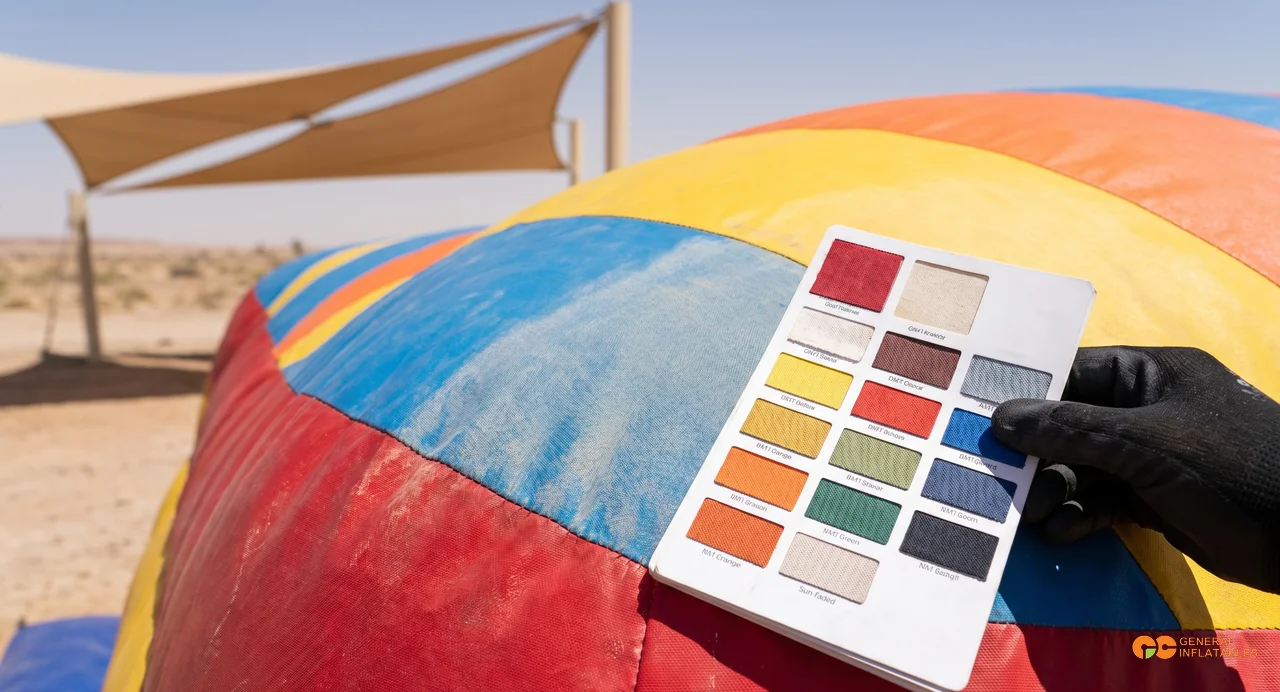
Treat color as a measurable quantity, not a vibe. Store the factory-supplied color swatch card in a climate-controlled bag (sealed, dark, 18-25°C) so it does not itself fade. Once a month, photograph each unit under standard lighting — 10am under light cloud cover gives the most repeatable result across months.
If you have access to a portable spectrophotometer, measure ΔE values against the original swatch per ASTM D2244. A ΔE above 3 is visually obvious to customers. Most factory warranties cover ΔE thresholds within the first 12 months, so dated photographs and measurements are the documentation that gets claims paid. This matters most on advertising and promotional inflatables where brand color accuracy is the entire commercial value of the product.
Most high-UV markets run year-round but have a short off-season — typically one to two months at the hottest peak when even early and late operation is not safe for guests. Use the off-period for material recovery, not abandonment.
Plan fleet replacement around realistic numbers rather than temperate-market assumptions.
Warranty language matters here. Most standard factory warranties exclude "extreme UV exposure" without defining it precisely. Negotiate explicit high-sun coverage in writing at order time, ideally tied to a stated ΔE threshold and a stated number of operating hours. Operators working in Gulf climates should review our case notes on Middle East market climate engineering for inflatable products before signing the spec sheet.
The cheapest UV protection is paint-box discipline at the design stage.
Operators who specify well, schedule tight and inspect daily routinely get 60 to 80 percent more useful life from the same factory product as operators who run the unit hard through midday and hope. The math is in your favor — if you do the work.
Our high-sun product line uses 1100D UV-stabilized PVC with color fastness rated ≥ 4 on the blue wool scale, plus optional extra-UV coating for Gulf/desert markets. Browse our water slide catalog and request a high-UV specification quote.