
The GCC bloc — UAE, Saudi Arabia, Qatar, Kuwait, Bahrain, and Oman — has quietly become one of the fastest-growing destinations for commercial inflatables. Resort developers along the Red Sea and the Arabian Gulf coastlines are commissioning year-round entertainment programs, malls in Riyadh, Dubai, Doha, and Kuwait City run rotating seasonal activations, and event-rental fleets expand sharply during the cooler October-to-April window when outdoor footfall returns. Demand spans soft-play modules for branded mall events, large slides and obstacle courses for resort beach clubs, and multi-lane water attractions for waterfront destinations.
Procurement patterns split cleanly by order size. Importers placing one or two SKUs typically buy from a regional distributor with stock in Sharjah, Jebel Ali, or Dammam — faster turnaround, no customs headache, predictable replacement parts. Resort-scale buyers commissioning a full modular water park installation or a multi-container event-rental fleet tend to go direct-from-factory, because unit economics and custom branding control matter more than lead time. A third pattern — factory-owned regional offices serving large hospitality groups — has emerged in the last two years and is reshaping how Gulf inflatable procurement works at the top end of the market.
The Gulf operating environment is uniquely demanding, and product specifications written for European or North American baselines will underperform here. UV exposure across the region runs roughly 30-40% higher than the European reference irradiance used in most fabric test reports, which accelerates fading, plasticizer migration, and surface chalking on standard PVC. Summer surface temperatures on dark-colored inflatable skins exposed to direct sun routinely exceed 70°C, softening seams that were welded for moderate-climate service and shortening blower motor life if intake air is not shaded.
Coastal venues add a second engineering layer. Salt aerosol attacks galvanized anchor stakes, blower frames, and zipper hardware within a single season, and any ferrous part not specified as marine-grade will rust through visibly before the first winter event cycle. Inland venues face a different problem — fine windborne sand that bypasses standard foam blower filters, scours impeller blades, and eventually reaches the motor windings. The four factors — UV, heat, salt, and sand — together drive every meaningful specification choice for the region, from base fabric weight to fastener metallurgy to filter strategy. Buyers who understand the relationship between PVC tarpaulin grades and UV stabilization can specify intelligently rather than relying on factory defaults.
Most GCC markets accept EN 14960 as the baseline structural safety standard for inflatable play equipment, and a current EN 14960 test report covering the imported model is the single most important document a buyer can hold. A working understanding of EN 14960 and ASTM F2374 standards helps buyers read manufacturer test reports critically rather than accepting marketing claims about "international certification."
Country-level overlays then determine what else is needed. Saudi Arabia requires Saudi Civil Defense — Defaa Madani — review for permanently installed attractions and for large public venues such as event halls and themed entertainment zones; this is a venue-level approval that the operator handles, but the manufacturer's documentation must support it. The UAE accepts EN 14960 plus a Dubai Municipality or Abu Dhabi DCT registration for fixed venues, with similar logic across the other emirates. Qatar and Kuwait operate on EN 14960 plus importer self-certification under their respective consumer-protection regimes. Bahrain and Oman align broadly with the UAE pattern. None of these regimes accept undocumented "factory inspection certificates" in place of a recognized standard.
The base document set required at GCC ports is consistent: commercial invoice, packing list, bill of lading, certificate of origin, and the EN 14960 test report. HS code 9506 (sports, games, and athletic equipment) covers most inflatable categories across the region, with sub-headings differentiating water play, bouncers, and structures.
Country-specific additions matter. Saudi Arabia requires SABER certification — a digital conformity platform — for many regulated product categories, and inflatable amusement equipment increasingly falls within scope; pairing SABER registration with the EN 14960 report is the cleanest route for KSA shipments. The UAE accepts a simplified Conformity Statement for amusement equipment that references the underlying EN 14960 testing. Qatar uses GSO (Gulf Standardization Organization) standards as the reference framework for product safety alignment, and shipments accompanied by GSO-aligned documentation clear faster. Kuwait and Bahrain accept the standard GCC document set with minimal additions. Sensible container loading for ocean freight — palletizing by SKU, separating blowers and accessories from main units, and labeling cartons to match the packing list line-by-line — reduces port inspection time across every GCC entry point.
Specifying upward from factory defaults pays back rapidly in the Gulf. 1100D PVC at minimum 0.55 mm thickness should be treated as the floor for the region, not the upgrade — 1000D fabrics commonly used in temperate climates will visibly degrade within two seasons under Gulf UV. A UV-stabilized topcoat (typically a lacquer layer with absorber and HALS additives) adds roughly two to three seasons of useful life and meaningfully slows color fade on branded surfaces. Anti-static treatment is worth specifying for sand-prone inland venues because it reduces the rate at which fine particles bond to the skin.
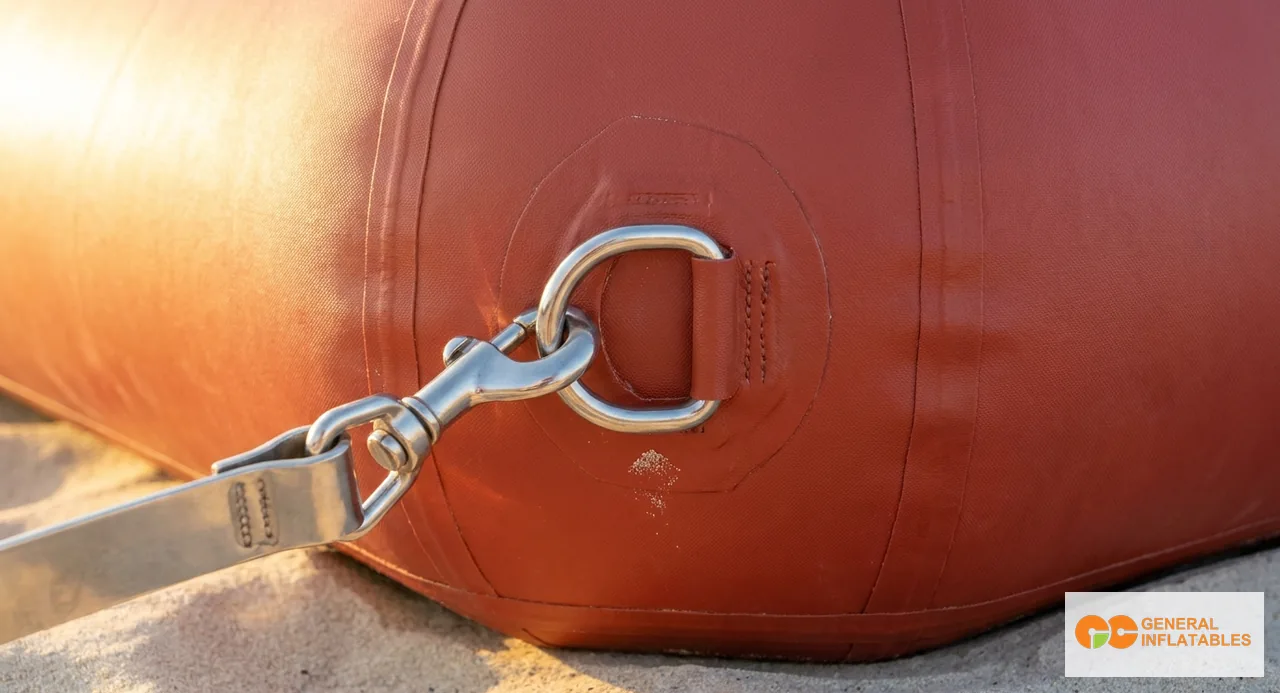
Hardware choices matter as much as fabric. Stainless steel anchor stakes, D-rings, and tether plates should replace standard galvanized parts on any unit destined for coastal service; the cost delta is modest and the corrosion outcome is dramatic. Coastal blower housings should be specified as salt-resistant — typically powder-coated aluminum or stainless enclosures rather than painted mild steel — and filter intakes upgraded to multi-stage media for sandy inland deployments. For resort buyers commissioning high-value waterfront attractions, marine-grade specification across the whole package — fabric, hardware, blowers, and electrical — roughly doubles useful service life. Premium airtight aqua play systems built to this standard remain a common specification for five-star Red Sea and Arabian Gulf resort projects.
Gulf buyers commonly use one of three procurement approaches, and the right choice depends on order size, technical maturity, and the value placed on local after-sales support. Direct-from-factory works well for single large orders — one container or more — where unit economics justify the documentation work and the buyer has in-house customs and compliance capability. Lead times are longer (typically 35-55 days production plus ocean freight), but per-unit pricing and customization flexibility are best.
Local distributor procurement suits smaller and more frequent orders. The distributor holds stock, handles compliance paperwork, and provides spare parts and field service. Per-unit cost is higher, but turnaround can be measured in days rather than months, and risk on the buyer side is much lower. Event-rental operators building or refreshing fleets typically work this way.
The regional office model — factory-owned distribution operating from a Gulf base — has grown quickly and is increasingly preferred by resort-scale buyers who want both direct-pricing economics and on-the-ground service. The factory carries fast-moving SKUs at a regional warehouse, ships custom-built units direct from the production plant, and provides Arabic-language technical support and warranty handling locally. For hospitality groups commissioning multiple properties, this model collapses the historical trade-off between price and service that defined Gulf inflatable procurement.
Tell us your destination country, target product mix, and venue type (resort, mall, event circuit), and we will return a region-tuned proposal — material upgrades for the climate, applicable certification stack, document set for customs, and recommended distribution model — typically within five business days.