
Ocean freight to most destinations is priced per container, not per kilogram. Whether your box leaves the port half-empty or packed to the ceiling, the carrier bills the same flat rate, plus terminal handling, documentation, and inland drayage on both ends. For dense cargo like machinery this rarely matters — the container hits its weight limit long before its volume limit. Commercial inflatables behave in the opposite way. A folded bouncer or water slide is bulky but light, so a container almost always runs out of cubic meters before it runs out of payload capacity. That makes volumetric utilization, not weight, the single biggest lever on your landed per-unit cost.
Three container types dominate the choice set: the 20ft standard, the 40ft standard, and the 40ft high-cube (HQ). The 40ft HQ adds roughly 30 centimeters of internal height over the standard 40ft, which sounds trivial until you realize that folded inflatables stack in layers — one extra layer per container often translates to one or two extra revenue-generating units delivered for the same freight invoice. Importers working with a factory-direct sourcing model have an advantage here, because the factory can fold, pad, and palletize to your specific container choice rather than shipping pre-bagged units sized for someone else's box.
Published internal volumes and the volumes you can realistically load are two different numbers. Loadable volume is always lower because of pallet footprints, dunnage, blower crates that can't be stacked on, and the air gap you leave around fragile valves and seams. Working figures most freight forwarders accept for inflatable cargo:
If your order includes smaller catalog items from the inflatable games product family — interactive sports, ring-toss frames, foldable arenas — they fill the awkward spaces between larger folded units and push effective utilization well above 90%, which is where the per-unit math really starts to favor the 40ft HQ.
Inflatables ship folded into reinforced PVC carry bags. The folding pattern itself changes the cubic-meter (CBM) footprint by 15–25%. A tight accordion fold along the longest axis followed by a single cross-fold gives the smallest reproducible CBM and the lowest risk of seam stress; tight cylindrical rolls look smaller but tend to recover into bulky cones once vacuum is released, which wastes space in the container.
A worked example: a 5 m × 5 m × 4 m commercial bouncer typically folds to a bagged footprint of about 1.2 m × 0.9 m × 0.8 m, or roughly 0.86 m³ per unit. Sixty such units would theoretically fit a 40ft HQ's loadable volume, but in practice you plan for 15–18 because blowers, anchor kits, and pallet dunnage all consume cubic meters too.
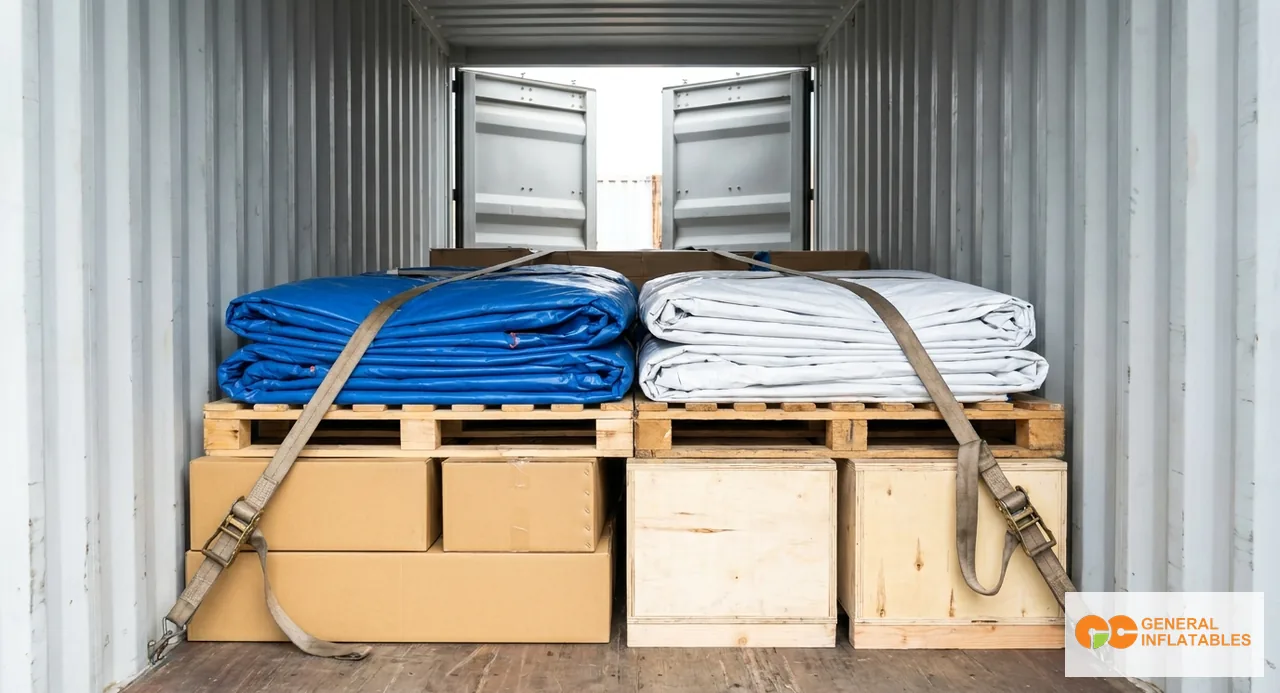
Stacking order inside the container matters as much as the fold. Heavy, rigid items — blower motors, steel anchor crates, manifold frames — go on the floor for weight distribution and low center of gravity during ocean roll. Folded inflatables stack on top, with woven polypropylene padding or foam sheets between layers to protect printed graphics and welded seams. Leave a 5–10 cm air gap to the container roof for thermal expansion; a closed steel box parked in a tropical port can swing 30°C between dawn and afternoon.
The inflatables themselves usually account for only 70–80% of the container's loaded volume. The rest is the support kit that turns a folded bag into a working revenue unit on arrival. A complete load plan should include one blower per inflatable (each in its own crate at roughly 0.05 m³), a repair kit per unit (PVC patches, adhesive, valve spares — about 0.02 m³), and anchor kits and tethering hardware matched to the deployment surface — sandbags for hard ground, 18-inch ground stakes with ratchet straps for grass, or concrete-rated bolt anchors for permanent venues.
Optional but freight-efficient additions: spare patch material in bulk rolls, inflation manifolds for operators running multi-unit setups from a single blower bank, replacement blower motors so a field failure does not idle a unit for a month, and a small inventory of consumable straps and buckles. Sourcing all of these — blowers, repair kits, and accessories — from the same factory in the same container avoids a second air-freight shipment that often costs more than the spare parts themselves, and it keeps your customs paperwork to a single entry rather than two.
Most inflatable amusement equipment classifies under HS heading 9506 — specifically the 9506.99 family for "articles and equipment for general physical exercise, gymnastics, athletics, other sports, or outdoor games, not specified or included elsewhere." Always verify the exact 8- or 10-digit subheading against the destination country's current tariff schedule before booking; classification can shift one or two digits for water-specific items, and the wrong code triggers either an overpayment or a customs hold for reclassification.
The standard document set the carrier and customs broker will expect:
Plan the container like a venue: every cubic meter has a purpose, every accessory has a home, every document is checked before the seal closes.
Send us your target product mix, destination port, and desired arrival window, and our logistics team will return a container loading proposal — model list, CBM breakdown, folding plan, and accessory bundle — typically within five business days.