Most distributors who call our factory asking for "OEM" actually want ODM, and most brand owners who request "ODM" end up needing OEM by their second purchase order. The terms get used interchangeably across sales decks, but on a production floor they mean very different things — different molds, different MOQ, different intellectual property terms, different lead times, and different unit economics. If you are transitioning from reselling finished units to building your own private label, picking the wrong path costs you either six weeks of lead time or a year of brand differentiation. This guide breaks down what each model really commits you to.
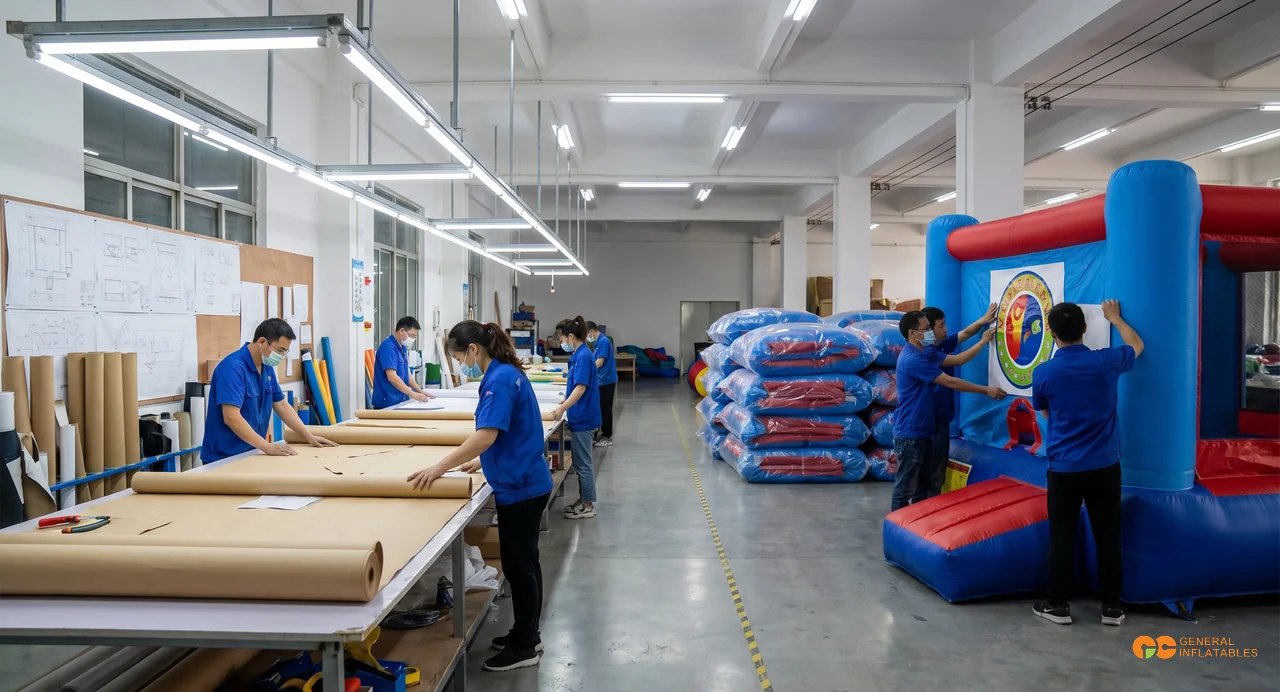
You bring the design. That can mean CAD drawings, a 3D model, a competitor sample you want re-engineered, or a sketch plus a written spec sheet. The factory builds tooling, cuts new patterns, sources materials to your specification, and produces the unit. You own the design IP and the mold. If you switch factories next year, the pattern set leaves with you. Common OEM scenarios on our floor include custom themed inflatable bouncy castles built to a licensed character brief — the buyer owns the artwork, the silhouette, and the exclusive right to that SKU.
The factory brings the design. You pick from an existing catalog — say, a five-in-one wet/dry combo that has been in production for three seasons — and we apply your branding: logo placement, color swaps, banner artwork, sometimes a minor dimensional tweak. The factory owns the base pattern and mold. You license the right to sell branded units. Most distributors start here because the catalog of proven ready-to-brand combo inflatables already covers 70-80% of what a regional rental market will buy in year one.
| Factor | Choose ODM | Choose OEM |
|---|---|---|
| Business stage | First 1-2 years of private label | Established brand with proven sell-through |
| Capital available | Limited — no mold budget | Mold/tooling budget approved separately from inventory |
| In-house design | None or marketing-only | Engineer or industrial designer on staff or contracted |
| Differentiation needs | Branding sufficient to win local market | Form factor itself must be unique |
| Volume per SKU/year | Under 50 units | 50+ units, ideally 100+ |
| Time to first shipment | Critical — under 35 days | Flexible — 45-60 days acceptable |
For ODM orders pulling from our catalog, typical MOQ runs 3-5 units per SKU, sometimes lower if you are bundling several catalog items into one container. Lead time is 25-35 days from artwork approval to ex-works, because the patterns are cut, the materials are stocked, and the only custom work is printing and trim color.
OEM is a different commitment. Because we are building new tooling and often sourcing non-stock PVC weights or colors, MOQ starts at 5-20 units depending on complexity. A simple OEM bouncer with a new silhouette might run 5-unit MOQ; a multi-chamber obstacle course with structural engineering review will push to 20. Lead time runs 45-60 days for the first production run — pattern-making and sample approval alone consume 10-15 days before cutting begins. Repeat OEM runs from the same tooling drop back to 30-40 days.
This is where most factory-buyer disputes originate, so be specific in your contract.
ODM has no tooling cost — you pay only the per-unit price plus branding setup (artwork plates, sample). OEM front-loads a tooling/mold investment that is amortized across your production run. The breakeven math depends on SKU complexity, but as a rule of thumb: OEM unit economics overtake ODM somewhere between 40 and 80 cumulative units on the same tooling. Below that, the mold amortization eats your margin. Above it, OEM wins because you skip the ODM licensing premium and you can negotiate raw material volume rates directly. For distributors planning custom-branded advertising inflatables for repeat corporate sponsors, the math almost always tips toward OEM by the second reorder.
The distributors we see scaling fastest do not pick one path — they sequence them. Year one: ODM across a 6-10 SKU catalog to test which units sell through in their region. Year two: take the top 2-3 sellers and commission OEM versions with proprietary silhouettes, better materials, and exclusive territorial rights. The ODM catalog stays as a long tail; the OEM SKUs become the brand identity. This sequencing also gives you time to build the design and engineering capacity OEM demands without paying for it before revenue justifies it. The same logic applies to factory-direct sourcing fundamentals — start with what is proven, escalate complexity only when sell-through data supports it.
Stop asking "do you do OEM?" — every factory says yes. Ask instead: What is your MOQ for a new silhouette versus a catalog unit? What is included in your tooling quote and is it refundable against units? What is your exclusivity language for ODM territory protection? How long do you store OEM molds and at what cost? What is your sample-to-production lead time on a brand-new pattern? The answers tell you within ten minutes whether the factory operates as a true OEM partner, an ODM catalog house, or a reseller pretending to be both.
One last point worth stating plainly: neither OEM nor ODM is "better." They are different commitments suited to different stages of a brand. A distributor who chooses ODM in year one and OEM in year three is not being indecisive — they are being capital-efficient. A brand owner who launches with full OEM because the silhouette is the differentiation is not over-investing — they are protecting the only moat that matters in this category. The mistake is choosing the path that sounds more impressive in a deck instead of the path that matches your sell-through data, your design capacity, and the lead-time pressure your sales calendar can absorb. Get those three honest, and the OEM-versus-ODM question usually answers itself before you finish the spreadsheet.
OEM (Original Equipment Manufacturer) means the buyer provides design and specifications, the factory manufactures the unit, and the buyer owns the intellectual property along with the mold itself. ODM (Original Design Manufacturer) means the factory provides an existing catalog design, the buyer adds branding such as a logo or color swap, and the factory retains ownership of the base IP and tooling. Here is a simple field test: if you can ask three different factories to bid on building "your design" using your CAD or spec sheet, you are running an OEM process. If all three factories instead show you the same catalog product with minor branding options, you are looking at ODM dressed up in OEM language. Knowing which side of that line you are on changes everything about contracts, MOQ, and lead time.
Yes — and this sequenced path is often the smartest move for new private-label brands. In Phase 1 you use ODM to validate market demand with low-risk catalog products plus logo branding, typically at an MOQ of 3-5 units per SKU and a 25-35 day lead time. Once 1-2 SKUs prove themselves through real sell-through data, Phase 2 commissions OEM molds for those winners so you can differentiate on silhouette, materials, and exclusivity, accepting an MOQ of 5-20 units and a 35-50 day lead time. This sequencing minimizes capital risk and builds factory relationship trust before you commit tooling deposits. Many of our long-running accounts began with custom-branded artwork on catalog units and only commissioned OEM molds in their second or third reorder cycle.
Under a standard OEM contract, the buyer owns the mold outright while the factory holds physical custody during production runs. Mold transfer rights mean the buyer can move production to a different factory by transferring the mold and pattern set, which is your insurance policy against being held hostage by a single supplier. Design IP belongs to the buyer per the contract — but contracts only protect you if the underlying trademarks are registered in both China and your origin country before tooling begins. We recommend pairing every OEM engagement with the vetting steps in our factory-direct sourcing guide so the mold ownership clause, storage terms, and IP registration sequence are all locked down before deposits move.
Plan for 25-40 days from design submission to start of production on a new OEM SKU. Initial mold creation runs 10-15 days after design approval, depending on the complexity of the silhouette and how many pattern pieces are involved. First sample production takes another 5-7 days after the mold is ready. Sample evaluation plus revisions typically consumes 7-14 days, with most projects going through 1-2 revision rounds to dial in stitching, internal baffles, and print color. Pre-production approval — the final sign-off before bulk cutting begins — adds another 3-5 days. Buyers who try to compress this timeline almost always end up paying for it in rework or a flawed first production batch, so build the lead time honestly into your sales calendar.
For small SKUs like single-lane bouncers, arches, and basic slides, mold cost is usually amortized into the first production order with no separate tooling fee, because the pattern complexity is modest. Medium custom shapes such as themed castles or branded mascot inflatables carry tooling cost amortized over the MOQ, which is why a 10-unit minimum on a custom castle pencils out very differently than a 3-unit minimum. Complex multi-piece designs — large combo units, water park modules, multi-chamber obstacle courses — typically require a separate tooling deposit because the pattern engineering and material testing absorb real factory hours up front. The negotiation move that protects your margin is locking in "mold cost waived if MOQ X is met" upfront, which aligns the factory's incentive with your production volume rather than punishing you for ordering smaller initial batches.
Watch for these warning signs during the quote stage. First: "Send us a photo, we'll make exactly that" without ever asking for engineering drawings, dimensional tolerances, or material specs — that factory will deliver a generic look-alike, not an OEM unit. Second: no questions about your target market, certifications (EN14960, ASTM), climate, or use case, which signals zero real OEM project experience. Third: the same factory offering an identical "OEM" design to multiple buyers without mold exclusivity language in the contract — your custom silhouette becomes their next catalog item. Fourth: refusal to sign an NNN (Non-disclosure, Non-use, Non-circumvention) agreement before reviewing your design files. Run any candidate through the structured checks in our manufacturer vetting playbook before sharing CAD or paying any deposit.
Our engineering team helps distributors evaluate whether a hybrid ODM-first / OEM-second roadmap matches their capital and timeline — with concrete MOQ, mold-cost, and exclusivity terms upfront. Browse our bouncer catalog and request a private-label proposal.