First-order disasters in the commercial inflatable trade follow a handful of patterns. A buyer wires a deposit and goods never ship. A "factory" sends polished photos of products it does not actually make, then subcontracts to an unknown workshop. Certifications turn out to be expired or lifted from another supplier. The paid sample looks excellent, but mass-production units arrive with thinner PVC, uneven stitching, and blowers that overheat in hours.
Almost every failure traces to the same cause: the buyer skipped basic vendor verification because the price looked good and the salesperson replied quickly on WhatsApp. The 12-point checklist below catches roughly 95% of these problems before money leaves the account. This guide picks up where our earlier piece on the factory-direct sourcing approach leaves off — once you bypass trading companies, vetting becomes the single most important procurement skill.
The first four items are document-based and can be completed by email before any video call. They are low-effort filters that quickly eliminate the weakest vendors from your shortlist.
1. Chinese business license. Request the scanned business license (营业执照) and verify the registered company name and address match the factory location the salesperson described. Cross-check the unified social credit code on China's National Enterprise Credit Information Publicity System. A registration date under three years is a yellow flag worth pairing with stronger reference checks.
2. Export license and shipping entity. Many "factories" found online are trading companies sourcing from unrelated workshops. Ask which legal entity will appear on the commercial invoice and bill of lading. If it differs from the business license, you are working with a middleman — sometimes acceptable, but price it in.
3. Two reference customers willing to take a phone call. Written testimonials are worthless. Ask for two recent international customers in markets similar to yours who will spend ten minutes on a call. Vendors with nothing to hide will provide them within days. While you have the vendor on the line, confirm their familiarity with destination-market standards such as EN 14960 and ASTM F2374 certifications, and ask which specific product lines those certifications cover.
4. Bank reference letter. Ask the vendor's bank for a short letter confirming three or more years of stable trading activity on the corporate account. This is routine, and a vendor that refuses or stalls is telling you something important.
Documentation only proves a company exists on paper. The next three items confirm a real production operation stands behind it.
5. Live video walkthrough on a working day. Schedule an unannounced video call during working hours and have the salesperson walk the camera through cutting, welding, sewing, QC, and the finished-goods warehouse. Pre-recorded clips do not count. A real factory floor has noise, half-finished units, and scrap PVC offcuts. A staged set has none.
6. Headcount and dedicated inflatable lines. Ask how many workers are assigned specifically to inflatables, and whether those lines are shared with unrelated categories. Facilities that split workers between inflatables, tents, and tarpaulins struggle to maintain consistent quality — the welding skill set is not interchangeable.
7. Third-party audit report within the last twelve months. Reputable inflatable factories are audited regularly by SGS, BV, TÜV, Intertek, or a comparable firm at the request of their largest customers. Most can email a recent report on request, with commercially sensitive sections redacted. A vendor never audited in the last year is either very new or very small — both carry execution risk on a first order.
The sample order is the cheapest insurance a buyer ever pays for. It confirms that what the factory does under perfect conditions matches normal production, and gives the buyer something physical to stress-test.
8. Paid sample at production quality. Insist the sample be pulled from a standard production run, not hand-finished by the factory's best craftsman as a "golden sample" that mass production cannot replicate. Pay full sample pricing — discounted or free samples invite shortcuts. A typical first sample is a mid-range commercial inflatable bouncers unit, because it exercises welding, stitching, anchor points, and blower compatibility in one product. If the order carries your brand, this is also the moment to validate the vendor's OEM artwork approval workflow end-to-end on the sample unit.
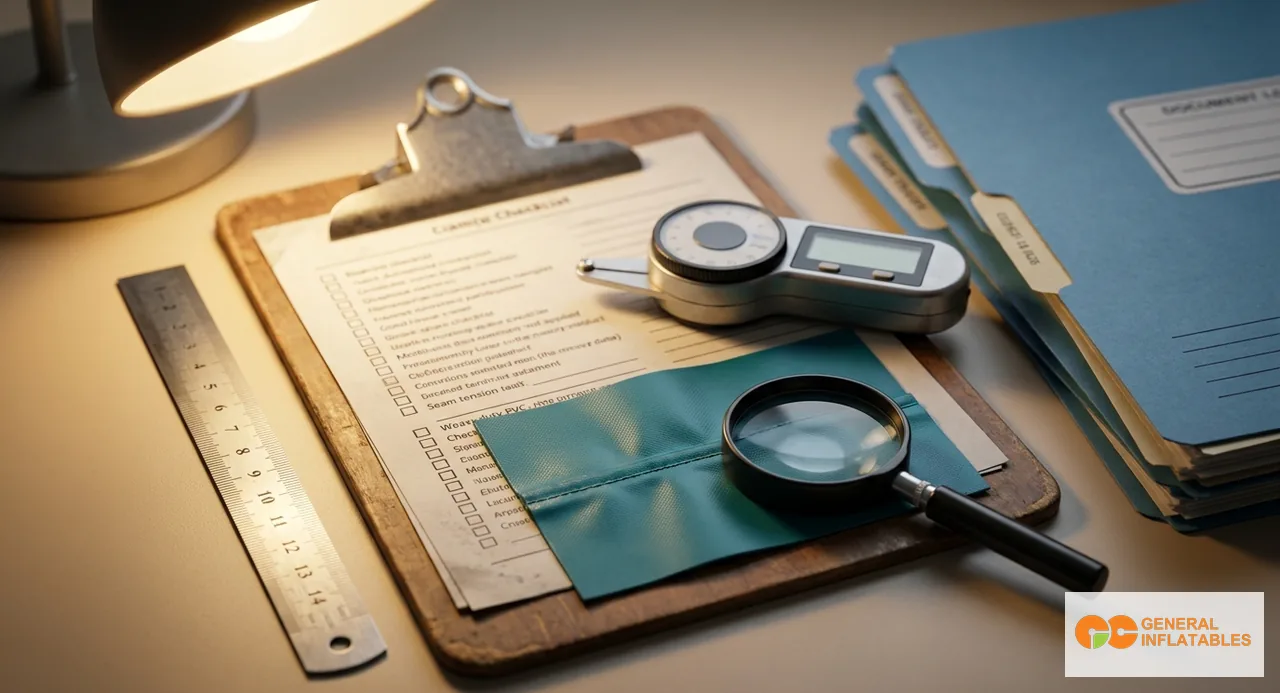
9. Independent buyer testing protocol. Do not rely on the factory's QC report. Run your own tests on arrival: a seam pull test on every major weld, a fabric burn test for flame-retardant treatment, a blower load test with the unit fully inflated for at least four hours, and an anchor stress test on each tie-down point. The most informative check is the seam — refer to a welded vs sewn seam inspection guide for what a good weld looks like under load, since seam failure is the dominant warranty-claim cause in this category.
The final three items protect cash flowing across the transaction. Even a competent factory can create pain through bad payment structures, and fraudulent operations almost always reveal themselves here.
10. Standard T/T 30/70 payment structure. Industry standard is a 30% deposit on order confirmation and 70% balance against a copy of the bill of lading before shipment. Variations exist — some buyers negotiate 30/40/30 with an interim inspection payment — but any vendor demanding 100% upfront on a first order is either desperate or running a scam. Walk away.
11. Escrow for the first order. For first orders in the small first-order range, use escrow rather than direct wire transfer. Alibaba Trade Assurance is the most widely used option and is free for the buyer. Independent third-party escrow agents handle off-platform deals. The fee is trivial relative to the protection.
12. Bank reference letter confirming account ownership. Just before wiring, request a fresh letter from the vendor's bank confirming the receiving account name exactly matches the business license. Account-name swap scams — where a fraudster intercepts email and substitutes a personal account at the last moment — are the most common way first-time importers lose money, and this single document neutralizes the entire attack.
Running this checklist end-to-end takes most buyers two to three weeks of part-time effort plus a modest outlay on the sample and testing — dramatically smaller than a single bad shipment of unusable inflatables, demurrage at destination, and a lost rental season. The checklist is not a guarantee, but it is the difference between procurement decisions made on evidence and decisions made on hope. Once a factory clears every point on this list, the next thing to plan around is realistic inflatable production lead times, so you can set delivery expectations before the rental season starts.
Send us your reference contact, ask for our business license documentation, request a video walkthrough, and we will arrange the documentation pack and a live production-floor call within two business days — the same starting point we recommend buyers use with any new vendor.
Related guide: Inflatables from China: Manufacturing Standards, Testing & Export Certification — which welding method belongs on which seam, PVC batch testing, factory QC checkpoints, and the certification route per market.