
If you only inspect one thing on a factory sample before signing a PO, inspect the seam. Internal warranty data from commercial inflatable distributors shows that more than 60% of returns trace back to seam failure — not punctures, not blower issues, but the structural joints holding pressurized chambers together. Air leakage, delamination, and chronic deflation almost always begin at a weak seam.
The seam method a factory chooses tells you more about its quality positioning than the PVC denier on the spec sheet or the brand on the carton. A workshop running heat or RF welding lines has invested in capital equipment, trained operators, and a slower production cycle — none of which is compatible with the cheapest end of the market. Before you compare denier numbers, ask which seam method is used on each pressurized chamber, and pair that answer with the PVC tarpaulin grades guide. For buyers procuring against a written standard, the third-party tear and burst tests defined in EN 14960 seam strength testing give you a numerical floor to specify in the contract rather than relying on factory marketing language.
Welded seams fuse the PVC coating of two fabric panels into a single continuous polymer bond — no mechanical fasteners, no foreign material introduced. There are three production methods you will encounter on a factory floor.
Heat welding uses an industrial hot-air welder running at roughly 450–550°C, paired with a pressure roller that consolidates the molten PVC layer as the operator feeds the seam. This is the most common method in mid-to-high-volume commercial production because the equipment is durable and the output is consistent across long seams. RF (radio-frequency) welding uses dielectric heating, where high-frequency electromagnetic energy excites the PVC molecules directly between two electrodes. Cycle time is faster and the seam profile is extremely uniform, but tooling cost is high and the method is best suited to standardized geometries. Solvent welding uses a chemical bonding agent that softens both PVC surfaces and allows them to fuse under pressure. It is rarely the primary production method for new units, but it dominates field repair and irregular geometries.
All three methods, when properly executed, create a seam stronger than the fabric itself. In a destructive pull test the fabric tears before the seam separates — the single most useful QC signal.
Sewn construction joins panels with heavy-duty industrial thread, typically a UV-stable PTFE or polyester product — Tenara is the most commonly referenced industry standard. The thread is fed through both fabric layers by a walking-foot machine, and the seam is held by the mechanical loop of each stitch.
The advantages are real but narrow. Sewn seams are dramatically easier to repair in the field; a torn stitch line can be re-sewn with a hand-held machine or even by hand, and a well-prepared field repair kit specifications reference lists needle and thread alongside PVC patches and adhesive. Setup cost is lower, and a sewing line can join dissimilar fabrics — PVC to nylon webbing, for example — that no welder can bond.
The disadvantages dominate at the structural level. Every stitch is a needle hole, and every needle hole is a stress concentration through the airtight PVC membrane. The thread itself, no matter how UV-stable, degrades faster than the surrounding PVC coating under tropical sun. Under cyclic inflation and deflation, stitching loosens at corners, transitions, and any geometry that flexes — exactly the points where a commercial unit sees the most stress. Sewn-only construction is acceptable for low-stress decorative inflatables, indoor short-cycle props, and advertising shapes. For pressurized play structures with daily setup cycles, it is not a long-life choice.
The honest numbers, gathered from rental operators rotating units through documented service cycles, look roughly like this. In temperate commercial use — moderate UV, daily setup and takedown through a 6-to-8-month season — welded units routinely deliver 5 to 7 seasons of revenue service, while sewn units reach end-of-life at 2 to 3 seasons. In tropical or high-UV environments the gap widens: welded drops to 3 to 5 seasons, but sewn collapses to 1 to 2 seasons as thread degrades ahead of the PVC.
High-flex applications make the comparison brutal. Slides, water parks, and any unit with sharp internal geometry flex the seams thousands of times per shift, and sewn seams in this category fail within months. This is why every reputable factory producing commercial inflatable bouncers for the rental market uses welded construction on every pressurized seam, with sewn reinforcement reserved for handles, anchor patches, and non-structural trim. Indoor low-traffic units are the one category where sewn can match welded lifespan, and even there the cost advantage disappears once you account for tighter thread quality control.
You do not need laboratory equipment to triage seam quality on a factory floor. The sequence below takes about five minutes per sample and reliably separates welded from sewn — and good welding from rushed welding.
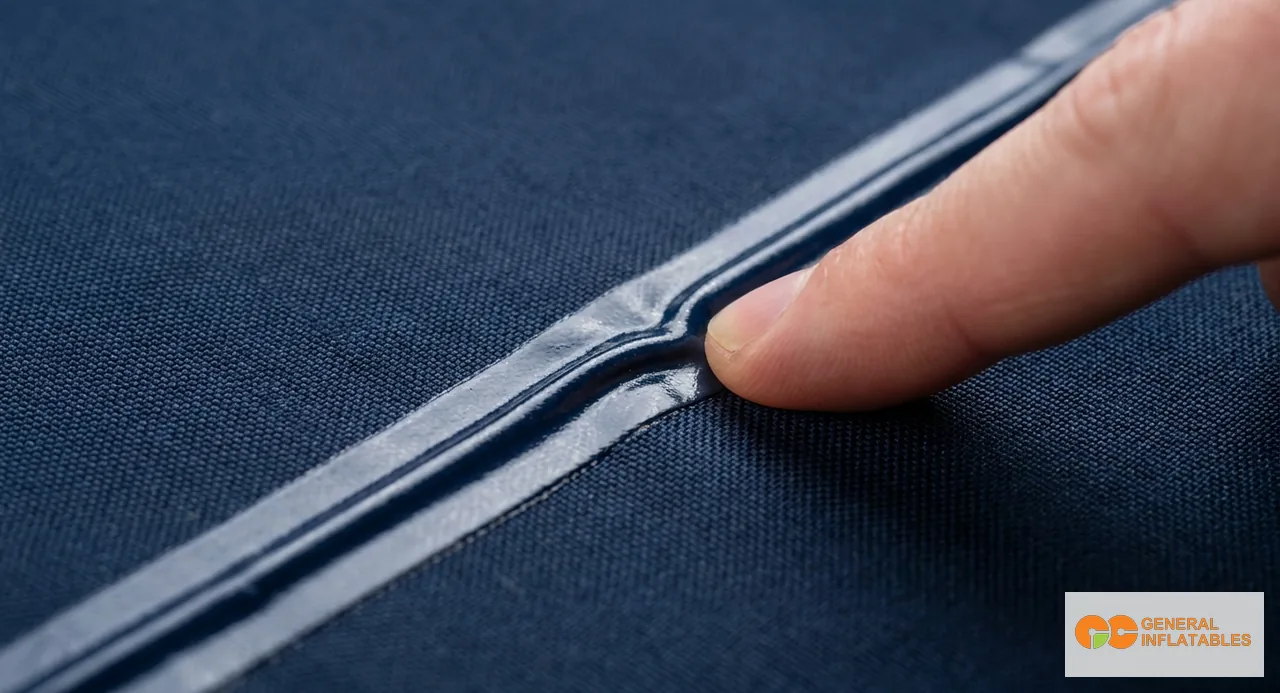
First, run a fingernail along the seam. A welded seam feels smooth and continuous; a sewn seam reveals a raised thread ridge and the regular bumps of individual stitches. Second, look closely on both sides of the panel for visible thread — none means welded, two parallel rows means a lockstitch sewn seam. Third, flex the seam back and forth twenty times by hand. A welded seam stays uniform; a sewn seam shows micro-loosening at the stitch holes. Fourth, measure the seam width — welded production typically uses a 25–40 mm overlap, while sewn seams run narrower at 15–20 mm. Fifth, with the vendor's permission, conduct a small tear test on a sample offcut: a properly welded seam tears through the surrounding fabric before the seam itself separates, while a sewn seam fails along the stitch line every time.
This inspection routine pairs naturally with the broader vendor-evaluation framework in the factory-direct sourcing approach — once you can read a seam, you can ask the kind of questions that separate genuine producers from trading-company resellers.
Welded production costs more at the factory gate. Welding machines are capital equipment that has to be amortized, cycle time per seam is slower on complex geometry, and operators require training because a bad weld is not visible until it is pressurized. Comparable units with welded pressurized seams typically carry a 15–25% premium at the factory level.
The lifecycle math reverses that premium quickly. Over five years of temperate commercial operation, a welded unit delivers two to three times the operating seasons of a sewn equivalent. On cost per deployment — the only number that matters to a rental operator — welded is significantly cheaper across the asset's life. For any operator running more than 50 deployments per year, the premium pays back by mid-season two, and every season after is pure margin. For high-utilization fleets and tropical-market buyers the math is not close: specify welded pressurized seams in writing on the purchase order, require the factory to confirm method per seam, and bring the inspection checklist above to the pre-shipment audit.
Tell us your target product line and operating environment, and we will return a material spec sheet — seam method per product, expected lifespan in your climate, and inspection criteria so you can verify the construction on receipt — typically within three business days.