
If you already operate a fleet of bouncers, you have hands-on experience with one inflatable architecture: constant-air. A blower runs the entire time the unit is open for play. Cut the power and the structure deflates within seconds. That single design assumption shapes everything about how the product is built, shipped, set up, and maintained. It is also why most procurement buyers assume every inflatable works that way — and why the second architecture, airtight (drop-stitch), often gets misunderstood during quotation rounds.
Airtight construction uses twin-wall fabric panels stitched together by thousands of vertical threads, then sealed and pressurized once at setup. After the initial inflation, the blower is disconnected. The structure holds shape on its own, behaving more like a foam panel than a balloon. This is the construction technique behind paddleboards, military pontoon bridges, and — at commercial scale — the airtight aqua play product family used in resort lagoons and open-water installations. Comparing constant-air to airtight is not a comparison of two similar products at different price points. They are two different categories of engineered fabric structure, and the right choice depends almost entirely on the venue and operating model.
Drop-stitch is the fabric technology that makes airtight construction possible. Two outer walls of high-tenacity PVC-coated fabric are held in parallel by a dense forest of vertical polyester threads — typically more than a thousand threads per square meter, each just a few tenths of a millimeter thick. When the panel is deflated, it folds flat. When pressurized to roughly 0.3 to 0.7 bar, every thread goes into tension simultaneously, and the panel becomes rigid. Wall thickness for commercial water and structural panels runs 10 to 15 cm, which is enough stiffness to walk on without noticeable deflection.
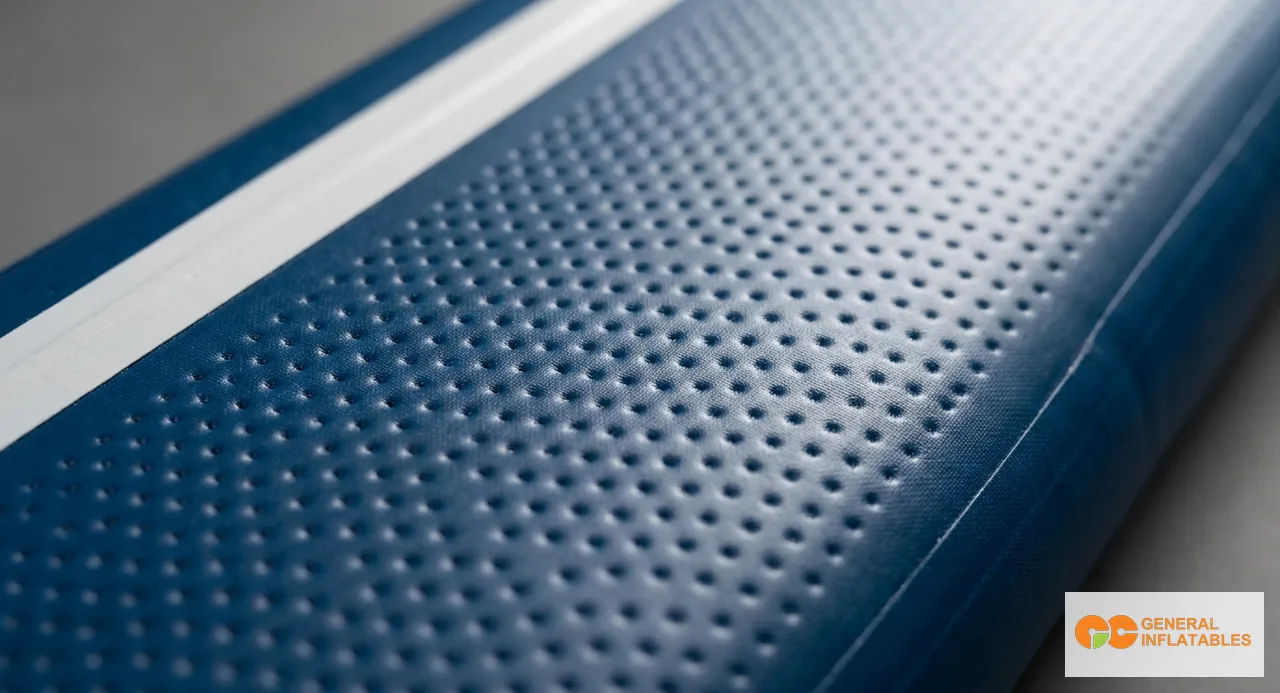
The technique came out of marine SUP board manufacturing in the early 2000s and has since scaled up dramatically. Commercial drop-stitch panels are now produced in widths over 2 m and lengths beyond 15 m, which is what makes large floating obstacle modules possible. A walkable surface like drop-stitch pool track obstacles is essentially a series of these rigid pressurized panels joined by airtight seams and reinforced with handhold loops. The exterior PVC layer is what you see and what wears; the structural work is happening invisibly inside, in the tensioned thread matrix.
Constant-air construction is conceptually simpler. A single layer of PVC tarpaulin — most commercial bouncers use 0.55 mm 1000-denier fabric — is cut into panels and welded or double-stitched into a closed envelope. The seams are not gas-tight. Air leaks continuously through stitch holes and along weld edges, and the envelope would collapse within a minute or two if not constantly replenished. A small electric blower pushes air in at low pressure, typically 5 to 15 millibars, just enough to keep the walls taut and the play surface springy.
This is the standard architecture for traditional constant-air bouncers, slides, and obstacle courses sold into the rental and event markets. It is cheaper per square meter to produce because the fabric is single-wall, the seams do not need to be airtight, and the structural engineering is forgiving — a small leak is just a slightly louder blower, not a failed product. The trade-off is permanent dependency on continuous power and the acoustic and operational footprint that comes with it.
The operational profiles of the two architectures diverge sharply once a unit is on site. An airtight module requires a high-pressure pump — usually an electric pump rated to at least 1 bar — for the initial inflation. Filling a mid-sized water park module takes roughly 15 to 30 minutes depending on internal volume. Once the valves are closed, the pump is removed and the structure operates on stored pressure for the rest of the day, week, or season, with periodic top-ups only as ambient temperature changes.
Constant-air units are the opposite. Setup is fast — staking and unrolling can be done in 10 to 15 minutes — but every unit needs a blower drawing 110V or 220V continuously, typically 1 to 3 kW per blower depending on the size of the structure. For a busy rental operator running six bouncers at an event, that is 6 to 18 kW of continuous draw and six blowers worth of noise. The practical consequences are concrete: airtight is the only viable option for open-water installations where shore power is impractical, and it is strongly preferred for indoor venues where acoustic load matters. Constant-air remains the right answer where grid power is abundant and turnaround speed dominates the economics.
Lifespan in commercial service is one of the least understood differences between the two architectures. Airtight units, properly specified, typically last 5 to 7 seasons under regular commercial use. The fabric panels are not constantly flexing — once inflated, the structure is essentially static, and stress is distributed across the entire thread matrix rather than concentrated at seam corners. The main wear vectors are UV exposure on the outer PVC layer, abrasion from users and the deck, and valve fatigue.
Constant-air bouncers see a different stress profile. Continuous airflow means the fabric is always slightly flexing, and every rider impact creates a pressure wave that travels through the envelope and pulls on the seams. Add to this the day-in-day-out setup and teardown that rental operators put units through, and typical commercial lifespan lands at 3 to 5 seasons. Material grade matters enormously here, which is why we recommend cross-referencing the PVC tarpaulin grades guide before signing off on a constant-air specification — the difference between a 0.45 mm economy fabric and a 0.55 mm commercial fabric is roughly two extra seasons of useful life. When you normalize purchase cost over operating years, the two architectures often land closer together than the sticker comparison suggests.
The decision is rarely about which architecture is "better" in the abstract — it is about which one matches your venue and operating model. A short framework that holds up across most procurement conversations:
Open-water installations — airtight is effectively required. There is no shore power, anchoring relies on water ballast, and you cannot tolerate a deflation event with users in the water. This is the standard architecture for modular water park installations in lagoons, lakes, and protected bays. For a worked example of how these airtight modules come together at scale, see our guide to aqua park design and layout.
High-traffic indoor rental — constant-air still wins on per-day economics. Setup speed, fabric repairability, and lower upfront capital outweigh the operating cost of blowers when a unit is rented out 100-plus days per year.
Resort and hotel fixed installations — airtight is usually the right call. Quiet operation matters near pool decks and guest rooms, daily electricity cost over a multi-year deployment adds up, and the cleaner aesthetic of a structure without trailing blower hoses is meaningful in a premium environment.
Pop-up event circuits — constant-air wins on deployment speed and capital efficiency. Crews can stake, plug in, and open within 20 minutes, and a damaged unit can be patched in the field with standard PVC repair kits.
If you are running a mixed fleet, the two architectures complement each other rather than compete. Use constant-air where labor and power are cheap and turnaround is everything; use airtight where power is scarce, noise matters, or the unit lives in water. The mistake is assuming one architecture must cover every venue.
Tell us your venue type, target capacity, and target use case, and we will return a side-by-side proposal — airtight and constant-air options with material specs, certification stack, and shipping breakdown — typically within five business days.