
Most first-time aqua park operators size their installation wrong. They hear "200-guest capacity" and order a floating park sized for 200 people on the water at the same time. Six weeks after opening they have 40-minute slide queues, two overworked lifeguards, and refund requests piling up at the dock. A 200-guest aqua park is a throughput target, not a simultaneous-load target — and once you understand that distinction, the rest of the planning math gets much easier.
This is a working planner for resort, hotel, lake-tourism and beach-club operators who are scoping a floating water park for the first time, or rebuilding one that under-delivered. Numbers below are drawn from typical mid-size installs in the 600–800 m² footprint range.
A 200-guest aqua park does not mean 200 bodies on inflatables at once. The realistic split for a comfortable guest experience is roughly:
That ratio drives footprint. At a usable density of roughly one in-water guest per 7–10 m² of play area, 80 in-water guests need 600–800 m² of floating water park layout. Push density higher and collision frequency climbs; push it lower and your capex per ticket sold falls off a cliff. Most operators run 45-minute sessions with a 15-minute changeover, giving roughly four sessions per day in peak season.
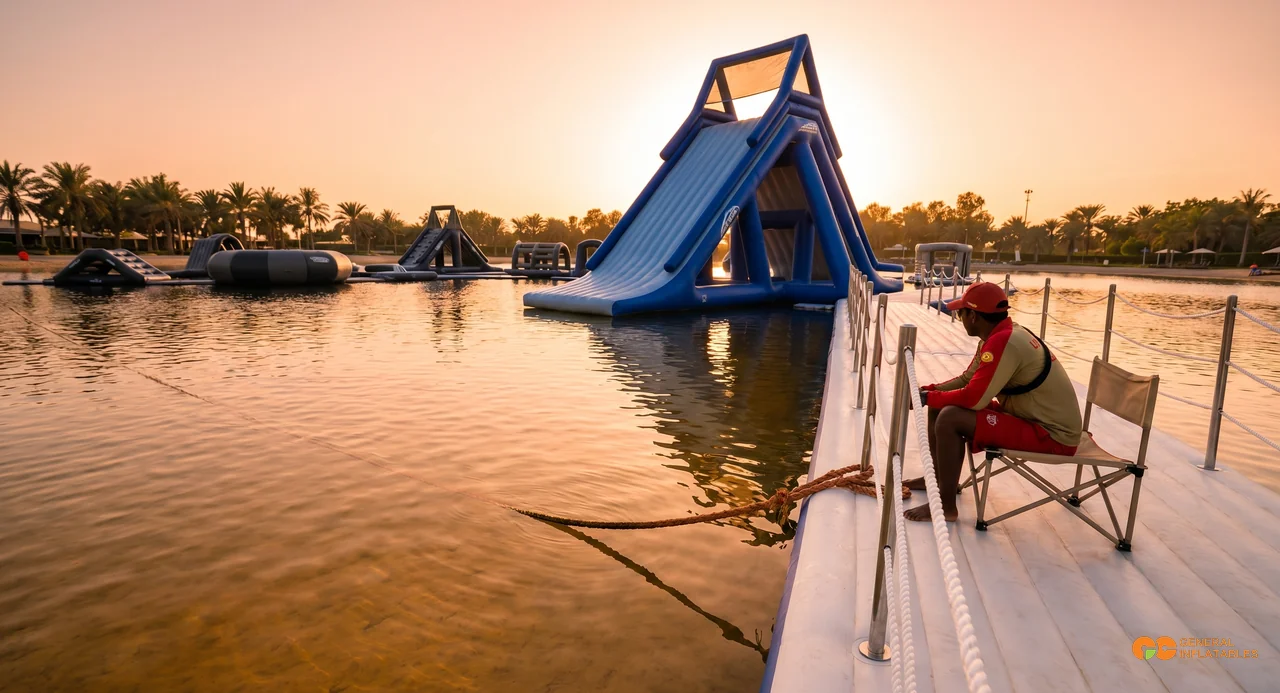
The instinct is to load up on slides because they photograph well. In practice, slides are the slowest-throughput modules on the park — one guest down every 8–12 seconds — and stacking too many of them creates queue chaos on the entry platform. A balanced 200-guest layout typically uses:
For a deeper breakdown of which modules pull the highest dwell-time and repeat-use rates, our guide to water park module selection walks through how to weight your mix based on guest demographics. Operators with a heavier kids/teen mix usually push the trampoline and climbing count up; resorts with adult guests lean into mid-height slides and longer runway sections. You can shop individual modular water park elements — slides, trampolines, climbing walls and jumpers if you're customizing, or specify a full turnkey set from our complete modular floating water park systems if you need a single-source layout.
Anchoring is where amateur installs fail. A 600–800 m² park typically needs 16–24 anchor lines on a perimeter-plus-internal pattern, not a perimeter-only ring. Each main slide module wants two dedicated anchor points to control sway under load.
Water depth requirements are non-negotiable:
Bottom type changes your anchor choice. Sand bottoms take screw anchors or 25–35 kg sand-filled bags. Mud and silt need heavier deadweight — typically 60–80 kg concrete blocks — because suction releases unpredictably. Rocky bottoms require pre-cast concrete blocks set by a dive team. Survey the bottom before quoting; an undersized anchor system is the single most common cause of warranty claims.
Industry standard is one lifeguard per 25 in-water guests. With 80 in-water at peak, that's 4 lifeguards on rotation, plus one supervisor on the dock. Mount two elevated lifeguard towers on the shore with clear lines of sight to the slide landing zones and the farthest perimeter modules. A third floating guard on a paddleboard or rescue craft handles the blind side behind the entry platform. Rotate guards every 30 minutes — visual fatigue on bright water surfaces is real and degrades reaction time fast.
Before committing to a location, run this checklist:
Daily setup for a fully deflated park runs about 2 staff × 90 minutes with two 5.5 kW electric or petrol blowers per major module — budget 6–8 blowers total for a 200-guest park. Most operators leave the park inflated for the season and only top up daily, dropping setup to a 20-minute pressure check. Fuel and electricity for daily top-up and night-time recirculation is modest — far smaller than your lifeguard payroll.
Revenue is the real story. At four 45-minute sessions per day, full bookings give you 800 ticket-sessions per day in peak season. Even at half load across a 90–120 day operating window, a well-sited 200-guest park typically pays for itself within one to two seasons, with the airtight drop-stitch hulls delivering 6–8 seasons of service life before major refurb. That's the ROI horizon worth quoting your investors — not a single-summer payback, but a multi-season margin profile.
Annual repair budget for a well-built park runs 3–5% of fleet cost; a poorly-welded park can hit 15–20% and still leak. The construction method matters enormously: high-frequency welded drop-stitch panels hold pressure for years, while glued or stitched seams fail at the seams within two seasons. Our breakdown of airtight drop-stitch construction and weld-seam quality standards covers what to inspect before signing a PO. Pay particular attention to the airtight floating platforms and anchor bases that carry the slide-tower loads — those are the modules under the most cyclical stress.
Have a written 4-hour deflation protocol before opening day. Sustained winds above 35 km/h or any thunderstorm warning triggers deflation; a 4-person crew can drop a 200-guest park to flat in under 90 minutes if the protocol is rehearsed. Off-season storage volume for a fully deflated and folded 600–800 m² park is roughly 18–24 m³ — plan a dry, rodent-proof container or shed with that capacity, kept at 5–30°C. Clean, dry, and talc the seams before storage and your fleet will outlast its accounting depreciation by years.
Operators who treat their first season as a calibration run consistently out-earn operators who lock in a full layout on day one. The smart play with an inflatable water park planning project is to commission the entry platform plus a 60% module set in year one, watch where queues form, photograph the dwell patterns, and add the remaining modules in year two where the data tells you they belong. A modular water park is built exactly for this — you bolt on new slides, trampolines, and climbing pieces season by season without redesigning the anchor grid, as long as you set the perimeter line generously from the start.
One more operator note: track your real session throughput from week one. Compare actual tickets sold against your 200-guest design assumption every fortnight. If you are consistently selling out, you have a footprint expansion case to make to ownership; if you are running at 60% load, you tune pricing and marketing before you order more modules. The park is the asset, but the operating data is what tells you when and how to scale it.
Our engineering team delivers CAD layouts, module specifications, and anchor diagrams matched to your site's water depth, current, and target capacity. Explore our airtight water play category and request a site-specific design consultation.
Related guide: Adult Inflatable Water Parks: Load Ratings, Modules & Site Requirements — per-module load ratings, minimum water depth measured at low water, anchor loading and lifeguard ratios.