
Wind is the single biggest threat to any outdoor inflatable operation, and the failures are almost never the unit's fault — they're a missed measurement or a shutdown call made ten minutes too late. The standard gives you a number; what keeps people safe is a written protocol your crew runs without debate.
Across documented inflatable accidents involving serious injury, wind is the recurring factor. A bounce house, slide, or obstacle unit is a large, light, sealed PVC structure — effectively a sail. When wind gets under or behind it, anchoring is the only thing holding hundreds of kilograms of lift down, and the loads climb fast: wind force rises with the square of speed, so a gust that doubles in speed quadruples the force on your anchors.
The pattern in incidents is consistent: a unit left running through a sudden gust front, anchored with too few points, or operated on a hard surface where stakes couldn't be used and ballast was under-spec. None of those are exotic failures. They're avoidable with a measured threshold and a crew that acts on it.
The inflatable wind speed limit under EN 14960 — the European safety standard for inflatable play equipment — sets the maximum safe operating wind at roughly 38 km/h (24 mph), which corresponds to Beaufort 5 (a "fresh breeze"). Above that, the standard requires the unit to be taken out of use. Treat 24 mph as a hard ceiling, not a target — your decision-making should start well below it.
Use the table below as your on-site reference. The "fly-the-flag" descriptions help crews who don't have an anemometer in hand make a fast, conservative read.
| Beaufort | Description | Wind speed (km/h) | Wind speed (mph) | What you'll see | Action |
|---|---|---|---|---|---|
| 2 | Light breeze | 6–11 | 4–7 | Leaves rustle, flags stir | Normal operation |
| 3 | Gentle breeze | 12–19 | 8–12 | Light flags extend | Normal — start watching |
| 4 | Moderate breeze | 20–28 | 13–18 | Dust lifts, small branches move | Heightened monitoring |
| 5 | Fresh breeze | 29–38 | 19–24 | Small trees sway | EN 14960 max — shut down at 38 km/h / 24 mph |
| 6 | Strong breeze | 39–49 | 25–31 | Large branches move, wires whistle | Closed — deflate and secure |
| 7 | Near gale | 50–61 | 32–38 | Whole trees in motion | Closed — clear the area |
One caution: the EN 14960 figure assumes the unit is correctly anchored to specification. Under-anchor it and 24 mph is already past your real limit.
A forecast is a planning tool, not an operating instrument. Wind at ground level on your site — funneled between buildings, lifted over a car park, blocked by a tree line — can differ sharply from the regional number. Measure where the unit actually stands.
Carry a handheld anemometer and read it at the height of the unit, in the open, not in a sheltered pocket. Two numbers matter:
Practical rule: if sustained wind is climbing through Beaufort 4 (20–28 km/h / 13–18 mph) and gusts are already touching 38 km/h / 24 mph, you are at the limit now — don't wait for the sustained average to catch up. Log a reading every 15–20 minutes once you're in monitoring range, and assign one named person to own the anemometer for the day.
The mistake is treating shutdown as a single yes/no decision at 24 mph. By then you may have guests on the unit and minutes of work ahead. Stage it instead:
Write these tiers on a laminated card at the operator station. A protocol your crew can read beats one your supervisor has to remember under pressure. This belongs in your setup crew installation SOP alongside the rigging steps.
Anchoring doesn't raise the EN 14960 wind ceiling, but correct anchoring is what makes 24 mph genuinely survivable instead of a gamble. Under-spec anchoring quietly lowers your real limit well below the number on the card.
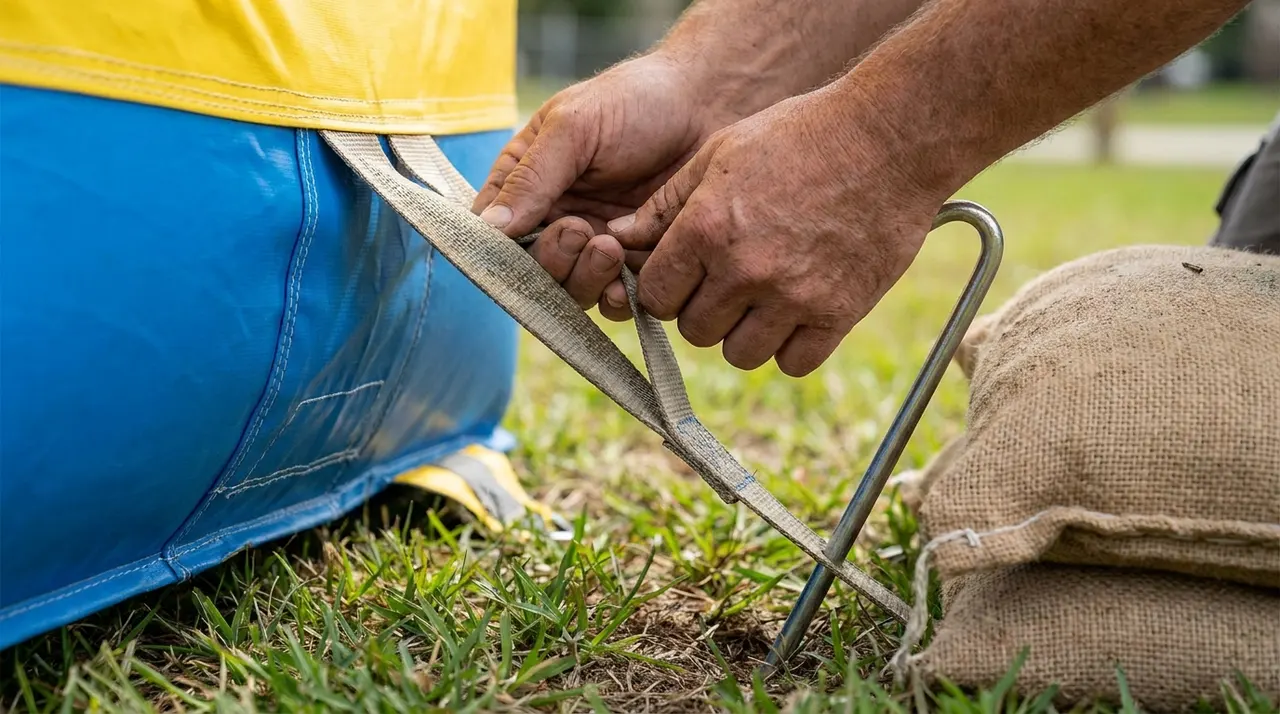
The right method depends on your surface. On grass, ground stakes driven to full depth at the manufacturer's specified angle give the strongest hold. On hard standing — concrete, asphalt, indoor floors — you can't stake, so you rely on ballast, and the weight required is substantial and easy to under-estimate. The trade-offs between sandbag, water ballast, and stake anchoring drive how much margin you actually have, and matching the method to your ground is covered in our guide to anchor system selection by terrain.
Use every anchor point the manufacturer provides — not a representative few. Skipping anchor points to save setup time is one of the most common contributors to wind incidents.
From a liability standpoint, "the wind picked up" is not a defense — it's the foreseeable hazard you are expected to plan for. Operators who can show a documented wind threshold, logged on-site readings, and a followed shutdown protocol are in a fundamentally stronger position than those relying on judgment alone.
Most operator policies assume you operate to the relevant standard. Running a unit above the EN 14960 limit, or with incomplete anchoring, can give an insurer grounds to dispute a claim. Keep your wind logs — they're evidence that you ran a managed operation. Understanding how cover responds to weather events is part of choosing commercial inflatable insurance for operators.
A protocol only works if someone owns it. Before the event, assign roles in writing:
The non-negotiable culture point: anyone can stop the operation for safety, and no one is questioned for calling it early. The crew that deflates a slide or obstacle course twenty minutes early on a gusty afternoon has done the job right, every time. Equipment is replaceable; a wind incident is not.