Ask any seasoned rental-fleet operator which single attraction punches above its footprint, and the inflatable mechanical bull comes up early. The unit occupies roughly the same floor area as a mid-size bouncer, yet operates on a per-ride revenue model rather than a flat-hour rental — each booking compounds into dozens of paid mounts across an evening. A busy bar residency or festival shift cycles multiple riders every minute, with each ride lasting 30 to 90 seconds before the bucking program throws the rider into the crash pad and resets the queue.
The economics get more interesting once you factor in the crowd-magnet effect. A mechanical bull draws a queue, and a queue draws spectators with phones out. That secondary spectator value translates into social-media reach for the host venue, which is why bars and festival promoters pay a premium over what raw ride count alone would justify. For fleet operators evaluating where to invest next, the mechanical category sits between novelty attractions and standard inflatables — and sourcing through a factory-direct sourcing approach keeps acquisition cost low enough that a single busy season often covers the hardware. Operators who already run the full inflatable sports family typically add the mechanical bull as their first powered attraction.
A complete mechanical bull rig is really three engineered subsystems that ship and set up as one package. Understanding each component matters because failure modes, maintenance intervals, and replacement costs differ sharply across them.
The hydraulic base is the powered heart of the unit. Most modern commercial bases run on an electric motor driving a hydraulic pump, though gas-powered variants still exist for off-grid festival use. The base houses a programmable controller that lets the operator dial in bucking patterns — gentle rotations for first-timers, aggressive multi-axis throws for experienced riders, themed sequences for events. A skilled operator working the controller is itself part of the show.
The ride body sits on top of the base. Commercial bull bodies are typically molded latex or heavy vinyl over an internal armature, with soft horns and dismount-safe rigging. The body releases the rider cleanly when the bucking pattern exceeds their hold strength — no sharp edges, no protruding hardware, and a deliberately slick saddle that encourages a controlled fall. These bull-body components see more cosmetic wear than almost anything in the broader inflatable games catalog, and usually need refurbishment first after a few hundred operating hours.
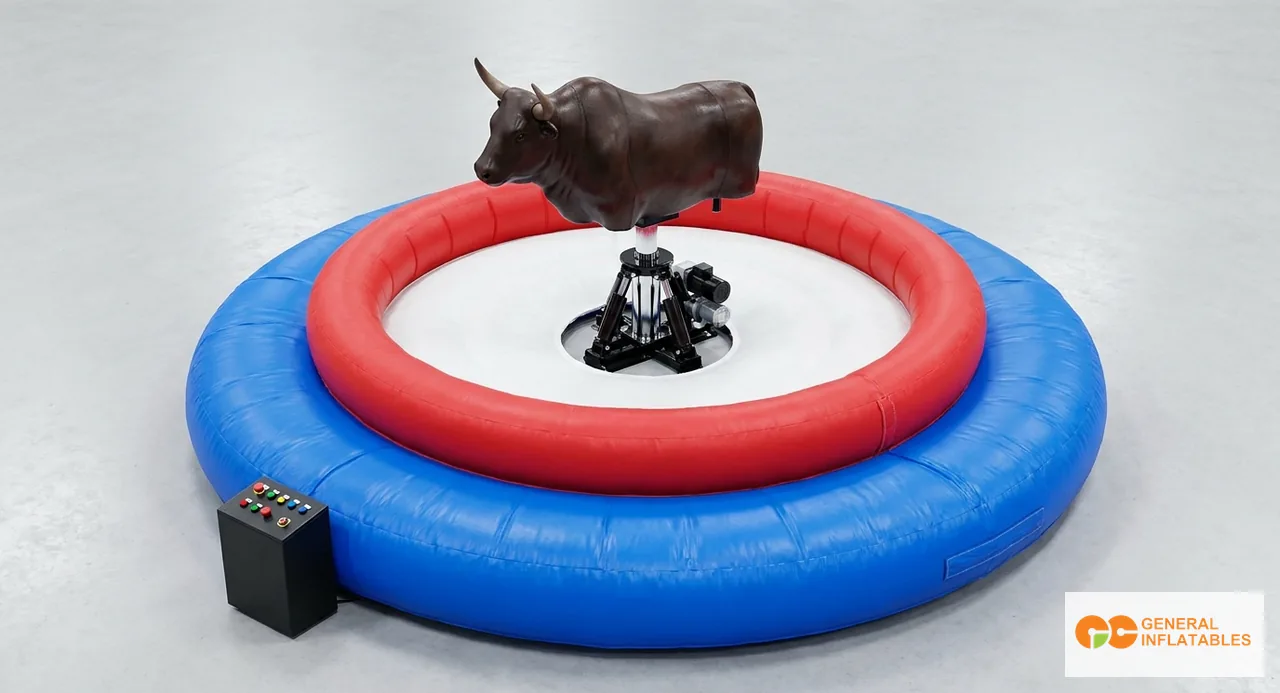
The inflatable crash pad is the safety envelope. A standard commercial pad is a 16-foot (4.9 m) diameter circular soft floor with 3 to 4 foot (about 1 m) inflated sidewalls that contain the rider's fall and keep spectators out of the throw zone. The pad inflates with a dedicated blower in 8 to 12 minutes and uses double-stitched, reinforced seams at the base-to-sidewall transitions where impact loads concentrate.
Mechanical bulls carry a different liability profile than passive bouncers, and treating them as if they were just another inflatable is the single most common mistake new operators make. Because the unit actively throws riders, most commercial general-liability carriers require an attendant on duty at the controller during every ride, signed waiver and release forms for adult riders, an age and weight cutoff posted at the queue, and proof of operator training for anyone working the controls. Some carriers will also require an incident-log discipline — every fall recorded, every minor scrape documented — as a condition of renewal.
The applicable standards split across the hardware. The inflatable crash pad falls under EN 14960 and ASTM F2374 standards for inflatable play equipment, covering material strength, seam testing, anchor points, and operator manuals. The hydraulic motion mechanism, however, sits outside those standards and is generally evaluated under separate ride-safety frameworks — EN 13814 for fairground and amusement rides in European markets, with TÜV and RPII inspection regimes layered on top depending on jurisdiction. North American operators typically work with their insurer's preferred third-party inspector rather than a single unified code. Document everything: certifications, inspection reports, controller-training sign-offs. A well-organized binder shortens renewal conversations dramatically.
Field economics ultimately come down to how fast a two-person crew can put the unit on the floor and pull it off again. Most commercial inflatable mechanical bulls run on 110V or 220V single-phase power, drawing roughly 2 to 3 kW during active operation — comfortably within a single dedicated 20A circuit at most venues. Generator-fed operation at festivals is straightforward as long as the generator is sized with headroom for the inrush when the hydraulic motor cycles.
Setup time for an experienced two-person crew runs 30 to 45 minutes: unroll and inflate the crash pad (8 to 12 minutes on the blower), position the hydraulic base on the center plate, secure the bull body to the base, run the controller cable, complete the safety checklist, and brief the on-site attendant. Tear-down lands in the same window, with most of the time spent waiting for the crash pad to deflate fully before rolling. Compared to fixed amusement rides — which often require trailer-mounted lifts and certified setup crews — the portable mechanical bull is exceptionally crew-efficient. Two staff, one cargo van or small trailer, and a venue with adequate power.
Three pricing models dominate the rental market, and most fleet operators run all three depending on the booking. The first is the hourly bar or nightclub residency, where the unit installs for a recurring weekly night and the venue pays either a flat hourly rate or a revenue split on per-ride charges. The second is the per-event corporate rental — a fixed-fee package covering a 4 to 6 hour activation with crew, attendant, and waivers included. The third is the per-day festival operation, where the operator collects ride fees directly from attendees and pays the festival either a flat space rental or a gate-percentage.
Demand concentrates in predictable seasons. Bachelor and bachelorette parties book year-round and skew toward Friday and Saturday evenings. Country-music venues and themed bars run residencies that pay through the entire calendar. Summer festivals fill the May-through-September window, and corporate team-building activations cluster in spring and fall. Operators who balance all four categories find the unit pays for itself within one strong season and continues generating margin for years afterward.
The mechanical bull is almost always the gateway purchase into a broader interactive-attraction category. Sumo suits are oversized padded costumes worn inside a soft-floor ring — low hardware investment, high spectator value, easy to pair on the same trailer as a bull rig. Gladiator joust uses an elevated inflatable platform with padded pugil sticks for two-rider knockout matches and books well for corporate events. Bungee run is a long inflatable lane where riders sprint against a bungee cord and slap a Velcro marker as far as they can reach — fast cycle times, simple operator workflow. Surfboard simulators round out the powered category with the same hydraulic-base economics as the bull but a different demographic appeal.
Each of these sits within the broader interactive sports inflatables line and ships in compatible containers, so a fleet expansion from one mechanical bull to a four-attraction interactive package is logistically simple. Rental operators who build out the full set can quote venues a complete activation package rather than competing on single-unit pricing, which materially improves margin per booking. Multi-attraction fleets also benefit from cross-category sourcing — operators serving resort circuits often add modular water park installations for waterside venues and large-format obstacle courses for corporate events, while keeping commercial-grade field repair kits on hand to minimize downtime across the entire interactive-attractions inventory. Buyers comparing categories before they commit can start with our inflatable sports games buyer's guide to see which SKUs an operator typically runs alongside a mechanical bull.
Tell us your target ride configuration, power source, and deployment frequency, and we will return a fleet proposal — hardware specs, bull body customization options, crash pad sizing, and container shipping plan — typically within five business days.