
Rental operators building out a promotional or attraction fleet often ask the same question in different words: put the budget into a motorized water attraction, or into an outdoor advertising inflatable? Bumper boats and air dancers sit at opposite ends of the commercial inflatable category — one is a capital-intensive water ride, the other is a low-cost marketing tool — and comparing them side by side exposes exactly what each is good for, and where each one stops making financial sense.
This guide breaks down setup cost, operating overhead, revenue mechanics, and lifespan for both categories, so buyers can decide which one belongs in a fleet, a dealership lot, or a seasonal event lineup — and when the honest answer is both.
Inflatable bumper boats are motorized, ride-ticket attractions: a PVC-tarpaulin inflatable hull, typically 1.5–2.2 m in diameter, fitted with a battery or gas-powered propulsion unit and a foam bumper ring. They run in a contained pool or purpose-built inflatable arena and are staffed as an active ride — an attendant manages queueing, battery swaps, and safety.
An air dancer is a single-tube, blower-fed figure that moves continuously in the airflow. It requires no water, no ride operator, and no ticketing — it runs unattended once anchored and connected to power, functioning as a visual attention device rather than an experience someone pays to use directly.
A commercial bumper boat program needs real infrastructure: a fenced water arena or above-ground pool (commonly 10–15 m diameter for a 6–8 boat fleet), filtration or regular water changeover, fencing or safety mats, and a staffed ticket booth. Container loading for a fleet of boats plus arena liner is a meaningful line item — boats deflate for shipping but the arena, pump station, and battery chargers add volume and weight.
An air dancer needs a flat concrete or paved pad, a stake or weighted base kit, a dedicated blower circuit (typically a standard 110–230V outlet), and nothing else. A single unit ships in one carton and one operator can install and anchor it in under 15 minutes. There is no water, no daily filtration labor, and no attendant cost once it is running.
Bumper boats generate revenue directly — per-ride tickets or timed sessions, typically 3–5 minute cycles per rider. Utilization is the real driver of ROI: a boat sitting half-empty on a slow weekday earns nothing against its water, power, and staffing overhead. Peak-season venues (waterparks, carnivals, resort programs) can run a bumper boat pool at high utilization for 90–120 operating days and recover setup cost quickly; a seasonal or low-traffic site struggles to hit payback in a single season.
Air dancers don't sell tickets — they sell foot traffic and impressions. Dealerships and retailers use them to lift walk-in rate during a promotion window, which is harder to attribute directly to revenue but far cheaper to sustain. Because there's no per-use cost and near-zero labor, an air dancer's break-even point is close to its purchase price alone, and it keeps producing value every day it's running with no marginal cost per "use."
Bumper boats see heavy mechanical wear: propulsion units, battery packs or fuel systems, and bumper rings all need scheduled maintenance, and the PVC hull is exposed to constant water contact, UV, and impact from collisions — that's the point of the product. Expect a multi-season lifespan with real parts replacement built into the operating budget, and factor motor/battery sourcing into supplier vetting up front.
Air dancers are simpler to maintain — the main wear point is fabric fatigue from continuous motion and UV exposure, plus the blower motor. A well-specified unit in 210D–420D ripstop fabric with a reinforced base sleeve typically holds up to daily outdoor use across a full season with minimal intervention beyond blower checks.
For a direct water game rental revenue comparison, model each format on realistic hourly throughput rather than headline day-rates:
| Bumper Boats | Air Dancer | |
|---|---|---|
| Fixed cost per operating hour | Attendant wage + water/power overhead | Power draw only, no attendant required |
| Revenue mechanic | Per-ride ticket, riders cycle every 3-5 minutes | Indirect — foot traffic and brand impressions, not direct sales |
| Realistic hourly capacity | Boat count ÷ cycle time (e.g. 6 boats ÷ 4 min = ~90 rides/hour at full utilization) | Not applicable — continuous passive operation |
| Break-even driver | Bumper boat seasonal utilization — peak-window booking rate against fixed water/staffing cost | Near-zero marginal cost once purchased |
To build your own hourly revenue estimate: take your realistic ride cycle time, divide your operating hour by it to get maximum theoretical rides per hour, then multiply by your actual (not theoretical) utilization rate — most venues run 40-70% of theoretical capacity during peak hours and considerably less during off-peak. That realistic figure, not the theoretical maximum, is what should drive your fleet-size and staffing decisions.
The two categories rarely compete for the same buyer or the same budget line — the comparison matters most for operators deciding where a limited capital budget delivers the clearest return this season.
For bumper boats, confirm hull material grade, propulsion unit sourcing (and whether replacement motors are available independently of the factory), and arena/liner compatibility before ordering. For air dancers, confirm fabric denier, base sleeve reinforcement, and blower wattage match your site's power circuit. If outdoor advertising and customer-acquisition inflatables are the priority, the broader outdoor advertising inflatables guide covers formats beyond air dancers.
For water-attraction buyers evaluating a wider fleet mix, see the rental fleet ROI breakdown for utilization and payback math that applies directly to bumper boat programs.
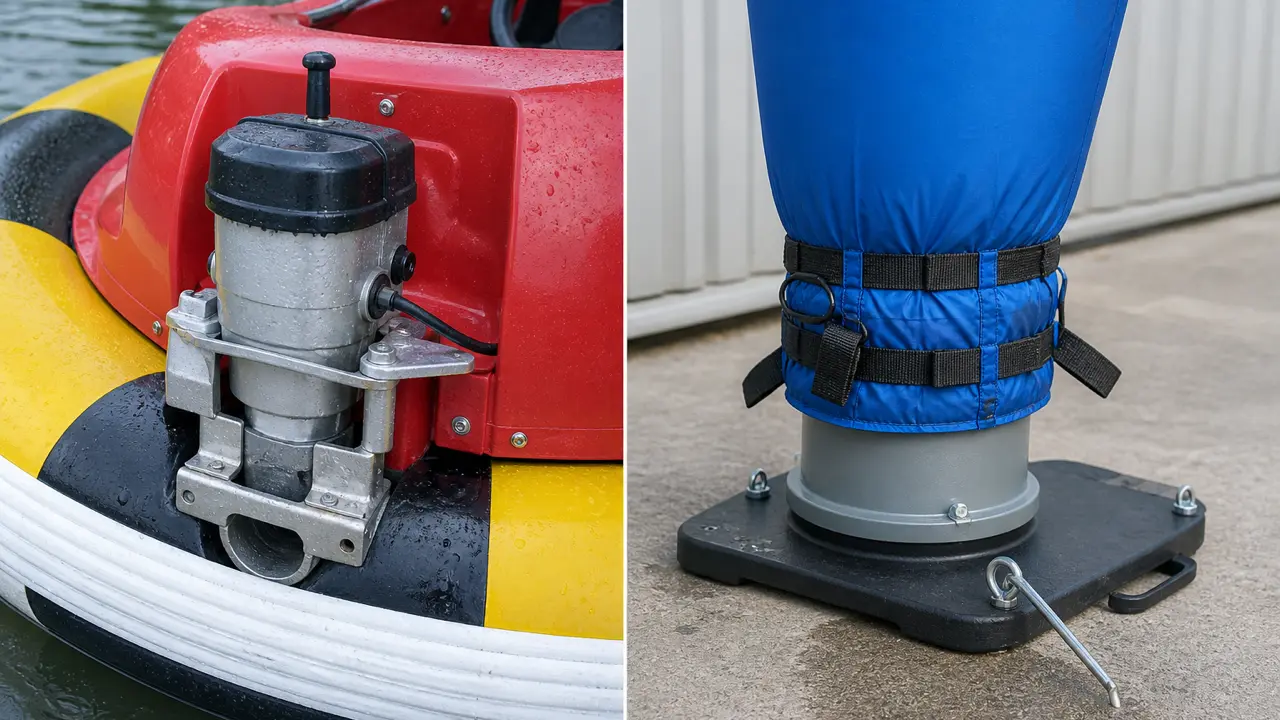
Bumper boats and air dancers aren't substitutes — they're tools for different jobs. A boat program is a revenue center that needs water infrastructure and staffing to pay for itself; an air dancer is a low-overhead traffic driver that pays for itself in impressions and walk-ins. Match the product to the metric you're actually trying to move — ticket revenue or foot traffic — and the sourcing decision becomes straightforward.
Browse the full inflatable boats category to compare current factory specifications for bumper boat hulls and propulsion options.