Few marketing tools buy you altitude as cheaply as inflatable advertising. A single tube of moving fabric or a 6 m sphere overhead pulls eyes from across a parking lot, a highway exit, or a crowded exhibition hall — and once the artwork is printed, the running cost is little more than a blower and a power point. For brands, event agencies and distributors, the real question is not whether promotional inflatables work, but which format fits a given deployment, and how to source it so it survives repeat use.
This guide compares the five main formats of outdoor advertising inflatables by use case, visibility, wind tolerance and reuse ROI. It is a sourcing map, not a spec sheet — where a format deserves a deep dive, we point you to a dedicated article. The starting point for any program is the full advertising inflatables category, which spans every format below.
Each format solves a different visibility problem. Match the format to the scenario before you compare quotes.
You want unmissable motion at street level plus a framed entrance. An advertising air dancer at the curb pulls passing traffic, while an arch over the door turns foot traffic into a branded moment. Both deploy in minutes from a single blower each.
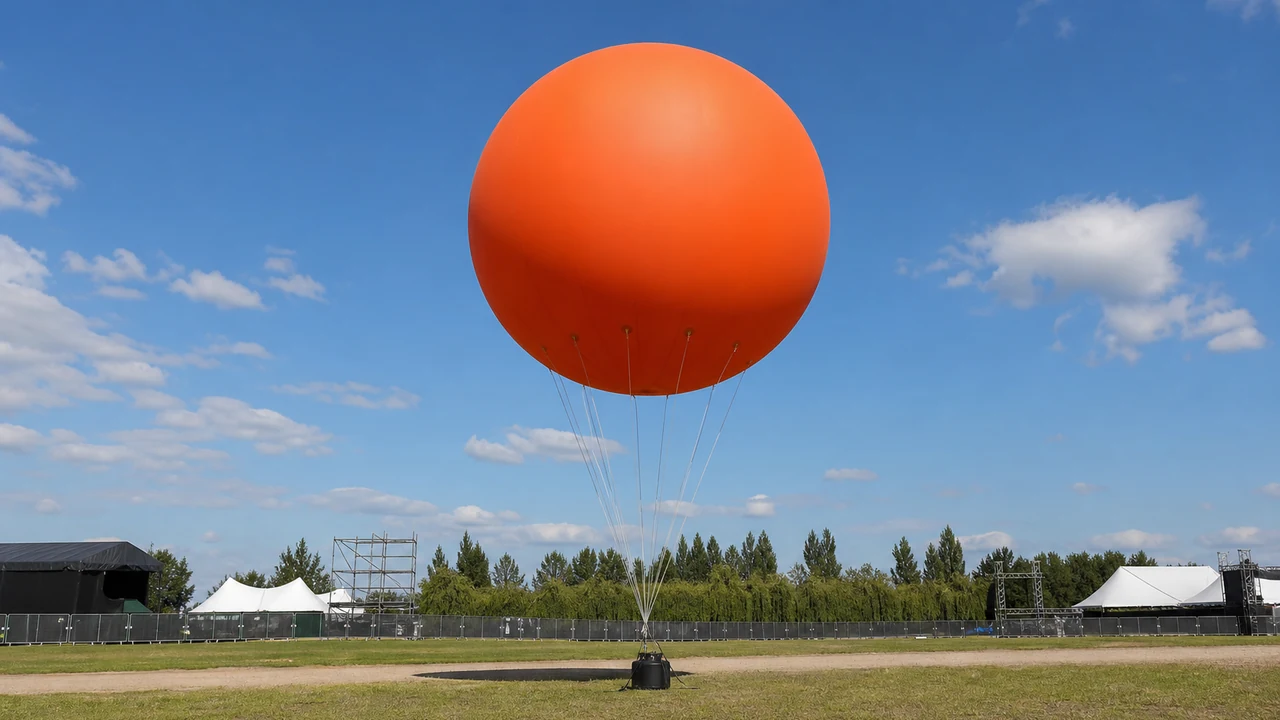
Indoor halls and open festival grounds reward height. An overhead balloon or sphere floats your logo above the noise of competing booths and can be seen from the far end of a hall. For the cold-air-versus-helium decision that governs how a balloon is flown, see the detailed breakdown below.
When the same setup travels city to city, prioritize fast rig-down and pack size. Air dancers and arches fold into a single bag and re-inflate in under two minutes — ideal crew-light tours. A custom product replica makes the strongest stop-and-photograph moment but needs more handling care in transit.
For a fixed location running for weeks, reuse rate dominates the math. A durable arch or a UV-stable balloon amortizes its tooling cost across the whole campaign, while reinforced seams and quality blowers keep daily run-time reliable.
Wind is the single biggest constraint on an outdoor program. Cold-air figures and arches handle moderate breeze well because air passes through and around them, but every format has a safe operating limit — published by the manufacturer and worth confirming before you commit a format to an exposed site. As a working rule: anchor everything (ballast bags, ground stakes or fixings rated for the unit), bring units down ahead of gusty weather, and keep flown balloons tethered with rated line.
Indoors, wind is a non-issue and you can fly larger overhead pieces safely, but you trade in ceiling height and fire-retardant material requirements common to exhibition venues. Specify FR-treated fabric when the venue demands it.
| Format | Wind Tolerance | Power Draw | Best Scenario |
|---|---|---|---|
| Air dancers / sky dancers | Moderate — continuous motion masks gusts, but has a published max wind rating | Continuous blower running, 0.5-1 kW typical | Roadside, drive-by visibility, dealership lots |
| Advertising balloons | Lowest — flown pieces are the first format grounded in rising wind | None once inflated (sealed helium/cold-air) or periodic top-up | Overhead branding at trade shows, festivals, open sites |
| Advertising arches | Good — low profile, air passes around the structure | Continuous blower on non-sealed models, 0.5-1.5 kW depending on span | Framing an entrance, race start/finish, aisle |
| Mascots & custom replicas | Varies by silhouette — tall thin extensions are more wind-sensitive than compact shapes | Continuous blower, scales with volume | Brand activation where the product/character is the hero |
| Custom shapes | Depends entirely on the specific geometry — confirm rating per design | Continuous blower, scales with volume | One-off statement pieces, bespoke campaigns |
The visibility of a brand activation inflatable lives or dies on its print. Two production routes exist: digital print for photographic artwork and fine gradients, or sewn/appliqué panels for bold solid-color logos that stay crisp at scale. Supply vector artwork and exact brand colors (Pantone references where you have them) so the factory matches across the run.
Custom tooling — molds and panel patterns for a bespoke shape or replica — carries a one-time setup, which is why a custom advertising balloon or shape becomes more cost-efficient as quantity rises. Standard formats (air dancers, arches, spheres) generally carry lower MOQ and faster lead times than fully bespoke replicas. Confirm MOQ, sampling policy and artwork sign-off steps in writing before production starts.
Two ways to get a balloon airborne. Cold-air units use a continuous electric blower, are fully reusable, carry no gas cost, and are the default for repeat campaigns and ground-tethered displays. Helium floats free without a power source — useful for true high-altitude lift — but adds recurring gas cost and is sensitive to leakage over multi-day use. For most B2B programs the reuse economics favor cold-air; the full trade-off, including material and valve considerations, is covered in our dedicated article on cold-air versus helium advertising balloons.
The headline appeal of promotional inflatables is cost-per-impression, and that number improves every time you redeploy the same unit. To protect reuse rate, look for double- or triple-stitched stress seams, reinforced anchor points, UV-stable coated PVC or oxford fabric, and a quality blower with thermal protection. Dry the unit fully before storage to prevent mildew, and keep a patch kit on hand. A well-built figure that runs across dozens of events delivers a far lower effective cost than a cheap unit replaced mid-campaign — which is the whole ROI case for sourcing on build quality rather than headline price.
Inflatables ship compact and light, so sea freight is highly economical for export buyers. Folded units consolidate well — a mixed program of air dancers, arches and balloons palletizes efficiently into a 40ft HQ, and FOB terms let you control freight from origin. Order on a lead time that absorbs production plus ocean transit (plan well ahead of campaign dates), and consolidate a season's formats into one shipment to cut per-unit landed cost.
Start from the scenario, not the catalog. Motion at street level points to an air dancer; overhead reach points to a balloon; a framed entrance points to an arch; brand-as-hero moments point to a mascot or product replica; and anything truly unique points to a custom shape. Layer formats for big moments — most high-impact grand openings and activations run two or three together. When you are ready to scope a program across formats, the full guide to inflatable air dancers is a useful next read for the most-deployed format, and your supplier can map MOQ, branding and shipping against your specific campaign calendar.
Alongside air dancers and balloons, an inflatable arch frames an entrance or finish line with your branding across the span — see our inflatable arches buyer's guide.
Related guide: Air Dancer Inflatable Costs, Setup & ROI — blower wattage and daily power draw, anchoring methods, service life, and a working cost-per-impression framework.