
An air dancer looks like a simple purchase: one tube of fabric, one blower, done. Then the second one tears at the ankle after four months, the third trips a breaker at a dealership forecourt, and the fleet you bought for twelve locations is down to seven. The unit price was never the number that mattered. Blower wattage, daily run hours, anchoring method and replacement cycle decide what each location actually costs you over twelve months.
This guide covers the procurement and operating numbers. If you are still deciding whether air dancers belong in your marketing mix at all, start with our overview of where air dancers fit alongside other retail marketing assets, then come back here to spec them.
Air dancers are sold by inflated height, and each tier behaves differently on site:
Beyond height, three construction choices matter. Single-leg tubes are the cheapest and the most fragile at the ankle seam. Two-leg (dancing man) units distribute stress across two anchor points and survive gusty sites better. Arch and tube-with-topper formats sit closer to signage than to dancers and hold artwork more legibly.
Fabric is normally 210D or 420D ripstop polyester for the moving body — light enough to dance at moderate blower pressure, and printable by dye sublimation for full-bleed artwork. Heavier PVC appears in the base skirt and reinforcement patches, not in the dancing tube. If a supplier offers you a PVC body on a 6 m dancer, ask why: the extra mass kills the motion the product is bought for.
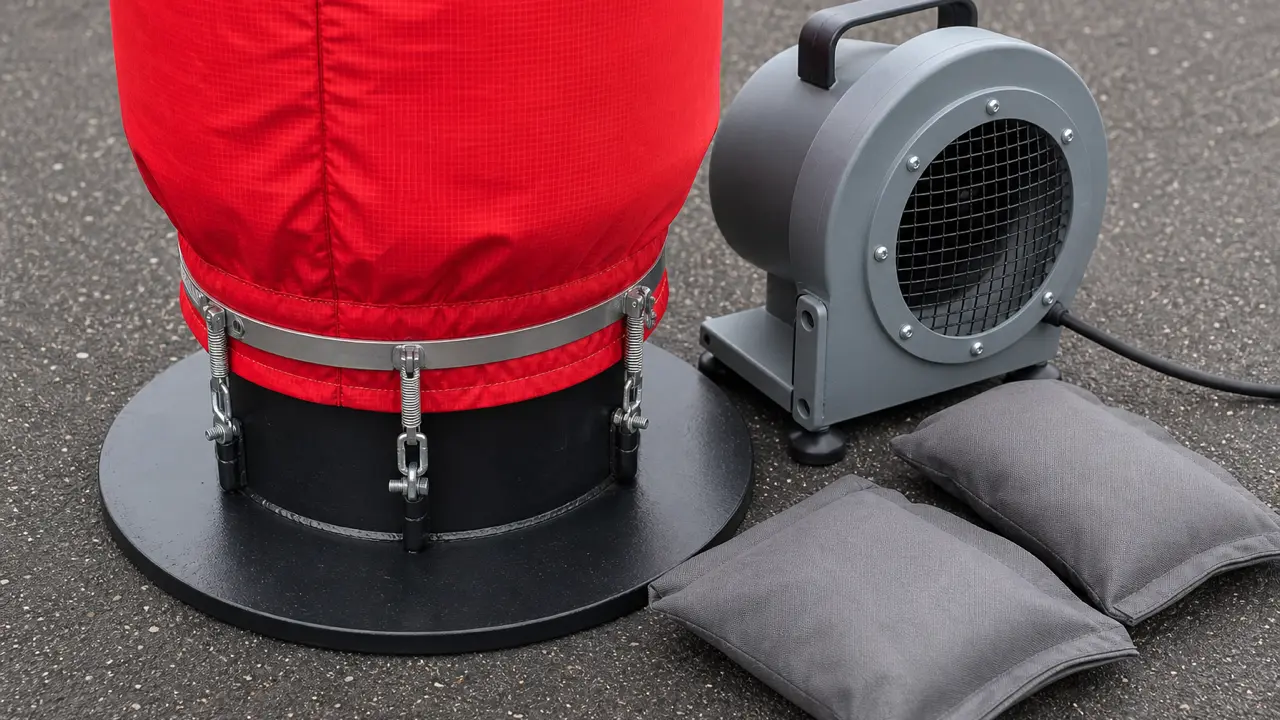
The blower is a continuous-duty motor, not an intermittent one. Typical pairings:
Do the arithmetic before you commit to run hours. A 0.75 kW blower running 10 hours a day draws roughly 7.5 kWh per day, about 225 kWh a month, per unit. Across twelve dealership locations that is a line item your finance team will notice, and it is the single easiest thing to reduce: cutting run time to peak traffic windows of five hours halves it without measurably reducing weekend reach.
Specify the electrical side for the destination market, not for the factory. Confirm voltage and frequency (230 V / 50 Hz versus 120 V / 60 Hz), an outdoor-rated enclosure with proper ingress protection, a thermal cut-out, and a cable length that reaches your actual power point rather than a theoretical one. In the EU, blowers ship under CE marking for the electrical assembly; for North America, confirm what listing the motor carries and how the unit is grounded. Ask for the specification in writing — this is where cheap fleets fail inspection.
Most air dancer failures are anchoring failures. Three methods, in order of how often they are the right answer:
Set a written wind policy and put it in the operator instructions: a take-down threshold in km/h, who checks the forecast, and where the deflated unit is stored. Air dancers are light-wind products. Running them through a storm is how a fleet turns into a liability claim. The same discipline applies across the wider range of advertising inflatables — the anchoring plan should be signed off before the first unit ships.
For air dancers for retailers specifically — dealerships, auto shops, and storefront locations — the rent-vs-buy math is straightforward: because the unit itself is inexpensive relative to a multi-weekend rental fee, air dancer rental only makes sense for a genuinely one-off event. Anyone running the same promotional inflatable display most weekends of a season should be pricing ownership, not repeat rental — the rental fees cross the purchase price faster than most first-time buyers expect. Run the same numbers through an air dancer ROI calculator before committing to either path — the breakeven point usually lands sooner than first-time buyers expect once you count the fourth or fifth weekend of rental fees.
You do not need agency-grade attribution to make this decision. You need a defensible cost-per-thousand-impressions estimate and a comparison set.
Build it in four steps:
That last point is the honest limit of the format. If the campaign needs to communicate detail, an inflatable advertising balloon or a printed arch carries far more legible artwork per square metre. Our guide to outdoor advertising inflatable formats compares the options by use case.
A commercially specified air dancer in daily outdoor use is a consumable, not an asset. Plan on the tube reaching end of life well before the blower does, and manage four failure points:
Order spare tubes with the initial shipment. Shipping one replacement body by air later costs more than carrying two in stock.
Vague enquiries get vague pricing. Include all of the following and you will get a comparable quotation from every air dancer manufacturer you approach:
On logistics: air dancers pack down small relative to most inflatables, and blowers are the dense part of the shipment. A mixed order of dancers, arches and balloons consolidates efficiently into a single 40 ft HQ container, which is usually the cheapest way to build a multi-location fleet rollout. Ask your supplier to quote the consolidated container rather than pricing each SKU as a separate shipment.
Operating cost is dominated by electricity and labour, not the unit. A 6 m dancer on a 0.75 kW blower at 10 hours a day uses roughly 225 kWh per month; add daily set-up and take-down labour and one replacement tube per service life, and you have a defensible twelve-month figure to divide into your impression estimate.
Buy factory-direct once you are past two or three units. Consolidating dancers, spare tubes, blowers and other promotional inflatables into one container order removes the per-SKU freight penalty and lets you hold spares locally.
Treat air dancers as light-wind products and set an explicit take-down threshold in the operator instructions, with a named person responsible for checking the forecast. The exact figure depends on height tier and anchoring method — confirm it with your supplier for the configuration you order, and follow it rather than the weather outside the window.