Search "advertising inflatables" and most results still assume a car dealership lot. That's fair — dealerships were the format's original proving ground, and air dancers in particular still live there. But the broader advertising inflatable category is a lot bigger than one product on one kind of lot. Arches, cold-air balloons, and custom cartoon mascots each solve a different visibility problem, and a growing list of retail formats outside the dealership are using them without much competition for attention.
This isn't a rehash of our air dancer breakdown for 12 storefront verticals — that guide covers where air dancers specifically fit. This one covers the other formats, and where they fit better than an air dancer would.
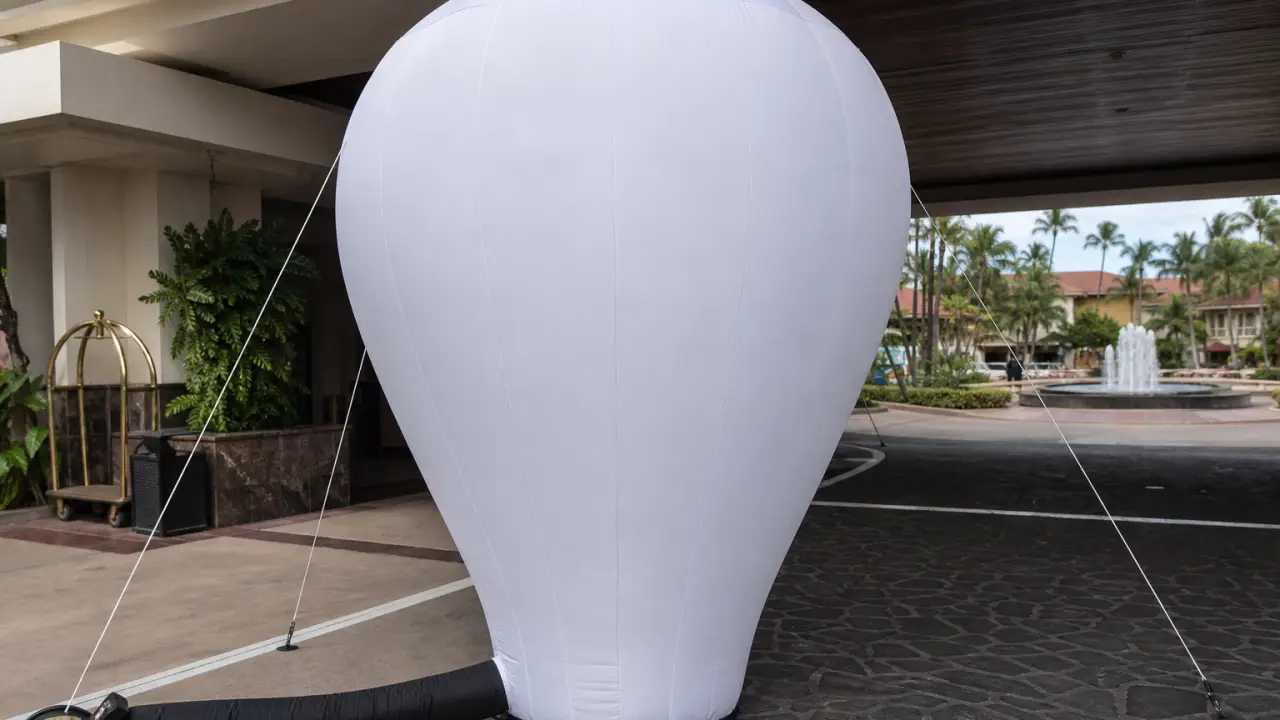
Air dancers sell constant motion at highway speed — already covered in depth elsewhere. Inflatable arches sell a threshold: a physical "the event is happening here, walk through" marker, which is why they work for entrances and check-in points rather than roadside visibility. Cold-air balloons (the giant helium-free displays that stay inflated with a continuous blower, not the party-balloon kind) sell scale — a 20-30ft branded shape is visible from a parking structure or a highway exit ramp in a way a storefront sign never will be. Custom cartoon mascots sell approachability — a branded character shape reads as an event or a kid-friendly promotion rather than generic advertising, which changes how people respond to it.
The format choice usually comes down to one question: are you trying to be seen from a distance (balloon, air dancer) or trying to mark a specific spot people walk toward (arch, mascot)?
Shopping malls and outlet centers — an inflatable arch at a seasonal sale entrance or a cold-air balloon on the parking structure roofline does what a banner can't: it's visible before a shopper has committed to which entrance to walk toward. Mall operators running seasonal promotions (back-to-school, holiday) get more use out of a rotating arch/balloon combo than a single fixed sign, since the same units move between entrances as the promotion calendar changes.
Hotel and resort lobbies — a branded arch at a porte-cochère or a mascot at a check-in desk during a themed weekend (a kids' club launch, a holiday package) gives a property a temporary event feel without a permanent buildout, at a much smaller footprint and cost than a resort-scale water feature installation.
Bank and credit union branches — branch openings and refinance promotion windows are short and seasonal, which makes a rented or owned arch/balloon combo a better fit than permanent signage that has to be replaced when the promotion ends.
Pet supply retailers — a mascot-format inflatable (a branded animal shape) at a strip-mall entrance draws exactly the foot traffic the store wants, and reads as friendly rather than as generic retail advertising the way a sign does.
Chain pharmacies — flu-shot season and back-to-school health screening promotions are short, recurring windows where an arch marking a temporary service station (a tent set up in the parking lot) needs a visible entry point more than it needs roadside motion.
Bowling alleys and family entertainment centers — birthday party season (spring/early summer) and holiday break are the two windows where a mascot or arch at the entrance signals "kids' event happening here" to drive-by traffic without a permanent structural sign.
The equipment sizing follows the same distance-vs-threshold logic across all six: a 10-16ft arch works for a walk-through entrance at typical foot-traffic speed, while a highway-visible cold-air balloon placement generally needs 20ft+ to register at driving speed from an off-ramp or parking structure. Mascot units run smaller (8-12ft is common) since their job is to be recognized up close, not seen from a distance.
Run schedule matters as much as sizing. Mall and bank placements tend to be seasonal-promotion windows (a few weeks, several times a year), while hotel lobby placements are event-specific (a single themed weekend). None of these are the "runs most operating hours year-round" pattern that fits a dealership lot — which is exactly why sizing and inflation setup (battery-portable vs fixed blower) should be spec'd around the actual placement pattern rather than defaulting to a dealership-style continuous-run unit.
The way to compare an inflatable placement against a static sign or banner isn't unit price — it's cost per day of active visibility over the promotion's actual run length. A seasonal mall promotion running four weekends a year gets far more use out of a unit that can be moved between entrances and stored the rest of the year than out of a permanent fixture sized for one location. For a full breakdown of the underlying cost math (container loading, MOQ, and the visibility-per-dollar comparison against traditional signage), see our outdoor advertising inflatables guide to formats, use cases and ROI.
Convenience stores and auto parts retailers face the same drive-by visibility problem as dealerships, just at smaller scale and tighter budget — a single air dancer at a convenience store entrance or an arch marking a limited-time promotion at an auto parts storefront captures the same attention-per-dollar logic that works for dealership lots, scaled down to fit a smaller footprint and a lower per-location budget. These formats rarely need the multi-unit setups larger retail chains use; one well-placed piece per location is often enough given the smaller lot size these businesses typically operate from.
For a one-time launch event specifically (rather than ongoing signage), see our grand opening inflatable playbook, which covers which combination of arches, air dancers, and balloons to deploy for a single high-traffic launch day versus what's worth keeping up afterward.
Can the same arch or balloon be reused across different store locations or events?
Yes — that's the main advantage over fixed signage for multi-location retailers. A single arch/balloon set can rotate between mall entrances, branch openings, or seasonal promotion windows across a calendar year, which is where the cost-per-day math improves significantly over a location-specific permanent sign.
Do cold-air balloons need a permanent power hookup?
Most run on a continuous blower that needs standard power, though portable battery-blower configurations exist for short events (a few hours) similar to the battery-powered air dancer units used for real estate open houses. For placements running a full promotional weekend or longer, a fixed power hookup is the more practical choice.
How do custom mascot shapes differ from off-the-shelf cartoon character inflatables?
A custom mascot is built from your brand's actual character design (a proprietary logo character, not a licensed one), which means longer lead time for the artwork and mold approval process than a stock design ordered off a catalog.
Whatever the format, the sizing and placement questions are the same as they are for a dealership lot: how far away does it need to be seen, and how many hours a day is it actually running. Get in touch and we can match a spec to your specific location and promotion calendar.