
Advertising balloons are one of the highest-impact, lowest-cost attention tools in outdoor promotion — but only if you buy the right type. The single biggest budget mistake B2B buyers make is choosing between cold-air and helium without matching the format to the actual campaign.
This guide breaks down the two families of inflatable advertising balloon, how to size them for real visibility distance, and exactly what to specify so your first order arrives ready to deploy.
Every advertising balloon falls into one of two categories, and they solve different problems.
A cold-air balloon is kept inflated by a continuous electric blower (110V/220V). It sits on the ground, a rooftop, or a base frame, never lifts off, and stays up as long as the blower runs. There is no gas to buy, ever. This is the workhorse for cold air balloon advertising at retail openings, dealerships, exhibitions, and rooftop campaigns.
A helium advertising balloon floats. It reaches altitude a cold-air unit physically cannot, giving you long-distance visibility above buildings and tree lines. The trade-off is a recurring cost: helium leaks slowly through PVC and must be topped up or refilled, and large units consume a lot of gas per fill.
| Factor | Cold-Air Balloon | Helium Balloon |
|---|---|---|
| Lift source | Electric blower (continuous air) | Helium gas (buoyant lift) |
| Mobility / placement | Ground or rooftop, fixed; needs power | Floats overhead; reaches altitude, no power needed aloft |
| Cost model | One-time unit cost; minimal running cost (electricity) | Unit cost + recurring helium per fill/top-up |
| Reuse | Reusable indefinitely; deflate, fold, redeploy | Reusable, but each deployment needs fresh gas |
| Best use | Repeated/long-run campaigns, rooftops, custom-shape figures | High-altitude visibility, short-burst events, skyline reach |
Rule of thumb: if the campaign repeats or runs for days, cold-air almost always wins on total cost. If you need to be seen from a kilometer away over rooftops for a one-day event, helium earns its gas bill.
Size is dictated by viewing distance, not by aesthetics. A balloon that looks huge on the factory floor can disappear against a city skyline.
For a rooftop advertising balloon, factor in the building height itself — a 5 m balloon on a 15 m roof effectively performs like a 20 m skyline marker. Always spec the balloon to the elevated position, not the ground.
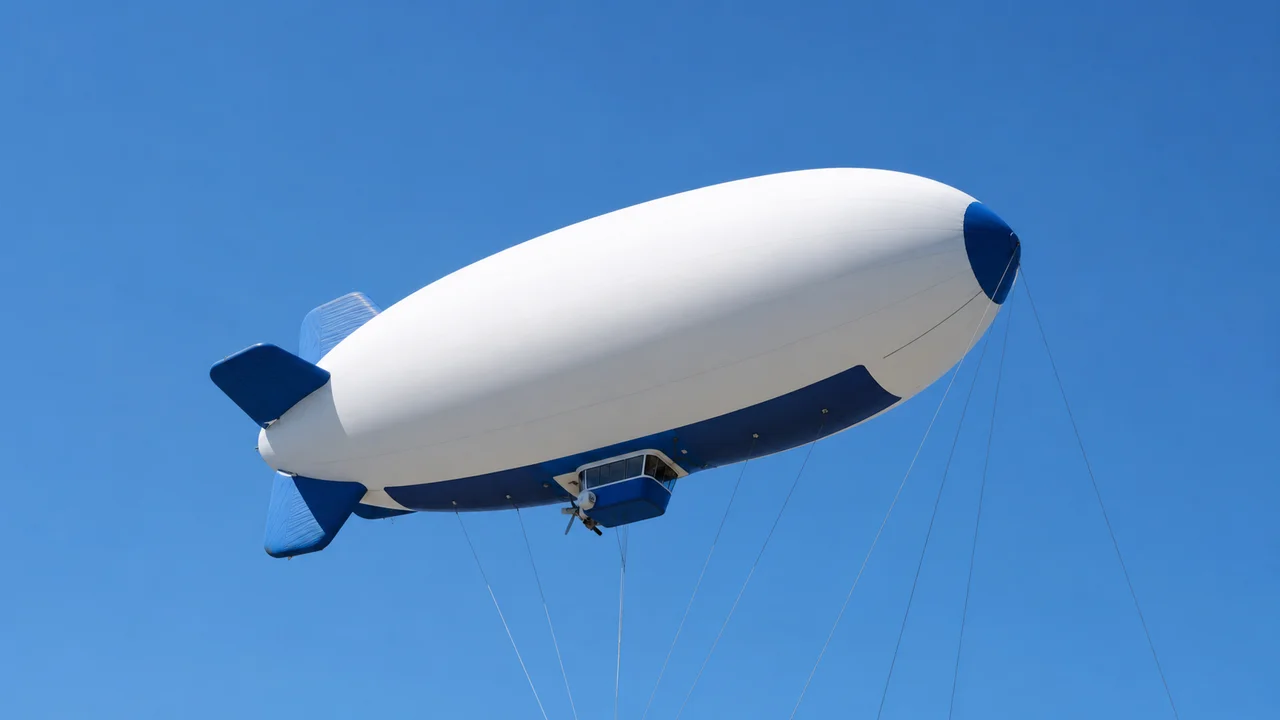
The format you choose drives both visibility and how literally you communicate the brand.
If you want movement and roadside attention rather than altitude, pair balloons with inflatable air dancers outdoor marketing, or frame an entrance with an arch — see our inflatable arches buyer's guide.
A balloon is a flying billboard, so print quality is the campaign. Three production methods dominate:
Supply vector artwork (AI/EPS/PDF) with fonts outlined and Pantone references locked. Remember the balloon is curved — your supplier maps flat art onto a sphere or blimp, so the visual center must be specified. For a full rundown of file formats and color expectations, follow our custom-branded inflatables artwork specs before you sign off on the proof.
Most field failures are anchoring failures, not product failures. A balloon is a sail; wind load rises sharply with size.
Always agree a wind limit (commonly bring units down above 6-8 m/s / Beaufort 4-5). Order spare tethers and a repair kit with every unit — PVC is field-repairable, and a patch kit saves a campaign day.
Cold-air balloons carry almost no regulatory burden — they're grounded, blower-fed, and treated like any signage. Helium is where compliance matters:
None of this applies to a grounded cold-air figure — another reason cold-air is the default for repeatable, low-friction campaigns.
The real cost comparison isn't the purchase — it's cost per deployment over the product's life. A commercial-grade PVC balloon survives many seasons if stored dry and clean. A cold-air unit redeployed 20+ times across a year drives cost-per-event toward near-zero, since there's no consumable. A helium unit is equally durable but carries a gas cost every single time it flies.
For most B2B resellers and event companies running repeated activations, a small fleet of reusable cold-air balloons delivers far stronger ROI than treating each event as a one-off helium fill. Buy quality PVC and proper seams up front; the unit pays for itself across its second and third campaign.
Everything above assumes a single buyer ordering for one campaign or one location. A distributor or reseller building out an advertising-balloon product line for resale faces a different set of questions — wholesale pricing tiers, distribution margins after landed cost, and what marketing support a supplier should provide to help move inventory. Our wholesale distribution guide for advertising inflatables in Latin America covers that side of the decision in depth, including bulk pricing tiers and container consolidation for mixed-SKU distribution orders.
To get a clean first order, give your supplier these details up front:
Lock these and your custom inflatable balloon arrives campaign-ready, not as a problem to solve on site. Browse sizes and shapes in our Inflatable Balloons category to scope your spec.
Browse Commercial Inflatables →
Related guide: Air Dancer Inflatable Costs, Setup & ROI — blower wattage and daily power draw, anchoring methods, service life, and a working cost-per-impression framework.