
Bounce house wholesale pricing confuses a lot of first-time importers because the number a factory quotes is never the number that determines your actual cost per unit landed at your warehouse. Understanding the pricing structure — not a specific price list, which changes constantly with material costs and order volume — is what lets you evaluate a quote intelligently and negotiate from a position of knowledge rather than guessing. This guide breaks down how bounce house wholesale pricing is actually structured for importers sourcing factory-direct from China.
A factory's FOB (Free on Board) quote covers the unit itself, packaging, and loading onto the vessel at the origin port — it does not include ocean freight, import duty, customs brokerage, or inland delivery to your facility. Buyers who compare FOB quotes across factories without normalizing for these downstream costs frequently pick the "cheaper" factory and end up with a higher landed cost once freight and duty are added, especially if that factory ships from a different origin port with a different freight lane cost.
Build your comparison on landed cost per unit — FOB price plus your realistic freight, duty, and handling — not the FOB number alone. For the fuller mechanics of how duty and landed cost calculations work for US-bound shipments specifically, see our USA import guide; the same landed-cost logic applies with different duty rates and paperwork for other markets.
Wholesale pricing on bounce houses is tiered by order volume, and the tier breaks matter more than the raw quantity. A factory's pricing typically steps down at container-load thresholds — a partial container (mixed with other buyers' cargo, or LCL) carries a real per-unit freight penalty versus a full container load (FCL), and factories price accordingly. Ordering just below a tier threshold to save a small amount on unit price while missing the FCL freight efficiency is a common false economy — run the full landed-cost math, not just the quoted unit price, before deciding where to land in the tier structure.
MOQ interacts directly with this pricing structure: a factory's minimum order quantity is usually set near the point where a production run becomes efficient for their line, and pricing below that MOQ (if a factory will even quote it) carries a real premium. See our MOQ reality check for realistic minimums by product category.
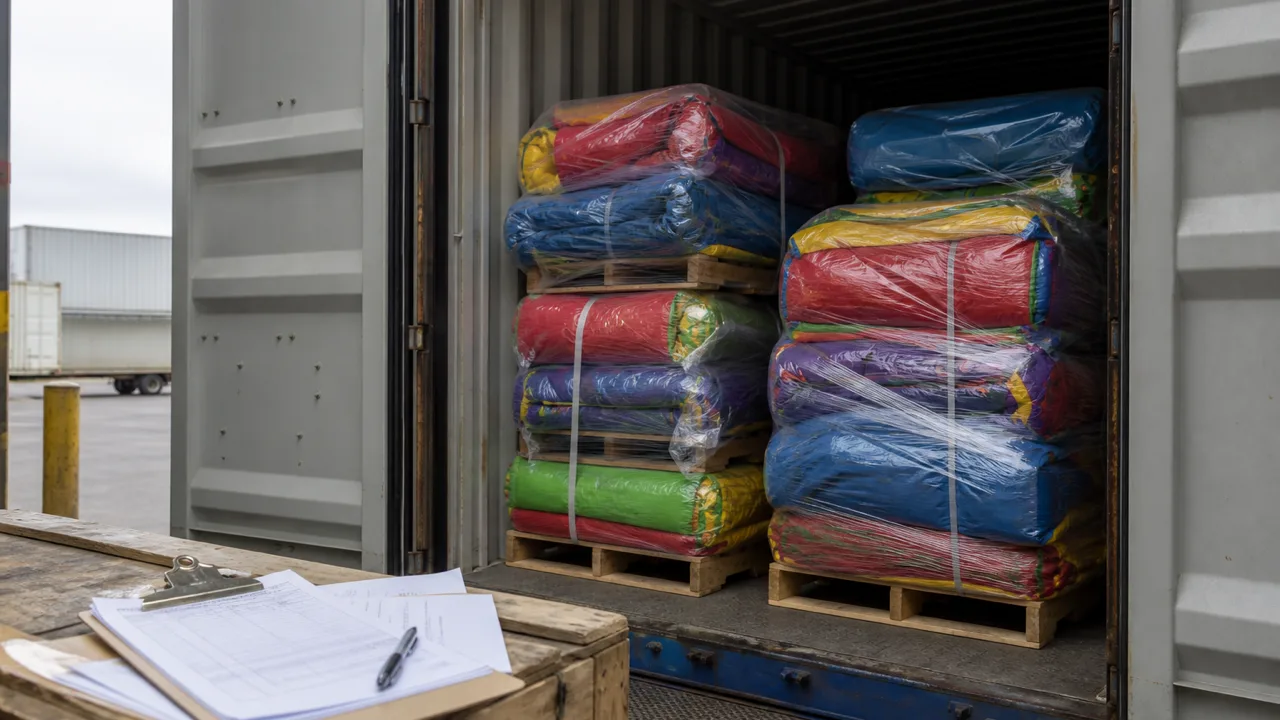
Committing to a full container rather than a partial load is the single strongest lever available to most buyers — it improves both the factory's unit price and your freight efficiency simultaneously. Standardizing on stock colorways instead of custom prints for a first order, and locking a production slot during a factory's slower season rather than peak season, are the next most effective levers. Payment terms also factor into quoted price — a factory quoting against a letter of credit versus a wire transfer schedule may price slightly differently to account for their own cash-flow risk.
Confirm what your quoted lead time actually includes before treating price and speed as independent variables — rushing a production slot to meet a tight launch date often reverses some of the pricing leverage you'd otherwise have. See our lead time breakdown for a realistic production timeline to plan against.
The fastest way to get quotes you can genuinely compare is to send every factory the same spec sheet: target unit dimensions, material grade, stitching spec, print requirement (stock vs custom), destination port, and target quantity. Vague requests ("send me your bounce house pricing") get vague, non-comparable answers back, because each factory fills in the blanks differently. A tight spec sheet also shortens the back-and-forth before a factory can give a real number, which matters if you're working against a launch date.
Bounce house wholesale pricing is a structure, not a fixed number — FOB price, freight tier, MOQ, material grade, and print complexity all move independently, and landed cost is what actually determines your margin. Request a spec-based quote with your target volume, material grade, and destination port, and compare landed cost across factories rather than the headline FOB number.
Browse the full inflatable bouncers category for current stock specifications and OEM options.
For related buying considerations, see our wholesale pricing and supplier checklist for Latin American buyers, our bounce house rental cost guide, and our complete guide to where to buy commercial water slides and bounce houses.