The single most common reason small distributors and first-time importers stop talking to Chinese factories is a sentence they read on someone's blog: "MOQ is 100 pieces." It scares people off before the first email is sent. The truth on our production floor is very different. We ship orders of three units, of one unit, of mixed-SKU containers built around a boutique rental company's spring inventory. The 100-piece MOQ is a myth that comes from people who only ever quoted advertising balloons or who got brushed off by a trading company padding margins.
Here is what realistic minimum order quantities actually look like in 2026, broken down by product category, plus how to negotiate them and when a suspiciously low MOQ should make you walk away.
| Category | Realistic MOQ | Why |
|---|---|---|
| Stock catalog bouncers / slides (no changes) | 1-3 pieces | Patterns already cut, artwork on file, runs alongside other orders |
| Stock design, custom color or logo only | 3-5 pieces | One artwork file change, one fabric swap, otherwise standard |
| Fully custom OEM (new mold, themed artwork) | 5-20 pieces | New pattern engineering and digital print plates need amortizing |
| Complete water park module | 1 system | The system itself is the unit — anchors, slides, platforms ship as one build |
| Advertising inflatables (air dancers, arches, replicas) | 10-50 pieces | Small unit cost means volume is needed to justify setup and shipping |
| Inflatable tents (event, military, medical) | 1-2 pieces | High per-unit value covers tooling and welding hours on its own |
| Mechanical games (bull rides, surf simulators) | 1-2 pieces | Motors, controllers, and safety wiring are project-based, not batch |
Notice what is not on that list: a single number. MOQ is not a factory-wide policy, it is a per-product engineering and economics calculation. A factory that quotes you the same MOQ for a four-meter bouncer and a forty-meter water park is not paying attention.
If you are buying from our stock catalog bouncer line, the MOQ is whatever fits the production schedule that week — usually one to three units. The patterns are already digitized, the artwork files live on the cutting plotter, and operators have run the same model dozens of times. Adding three units to an existing eight-unit run for another distributor costs us almost nothing, so it costs you almost nothing in MOQ pressure either.
The math shifts the moment you ask for a new shape. A fully custom OEM bouncer — say, a themed castle no one has built before — requires pattern engineering (4 to 12 hours), a sample build, digital print plate setup, and operator training on the assembly sequence. Spreading that fixed cost across one unit makes the per-piece price absurd. Across five to twenty units it becomes reasonable. That is the entire reason custom MOQs exist; it is not arbitrary gatekeeping.
Advertising inflatables sit at the higher end of the MOQ range for the opposite reason. An air dancer or a 3-meter product replica has a low unit value, so the fixed costs of artwork, sewing setup, and ocean freight per CBM only amortize once you cross 10 to 50 pieces. A factory quoting you MOQ 5 on custom air dancers is either losing money on your order or planning to recover it somewhere else.
At the other extreme, an inflatable tent ships comfortably as a single-unit order because one 8m x 8m event tent already represents enough fabric, welding labor, and per-unit margin to justify a dedicated production slot. Same logic for mechanical bull rides — the mechanical integration is project-based labor, not assembly-line batch work.
Three real constraints set every MOQ:
None of these constraints care about how many "pieces" you order. They care about hours, cubic meters, and total invoice value. That is why the smartest small buyers do not negotiate piece counts; they negotiate around the constraints themselves.
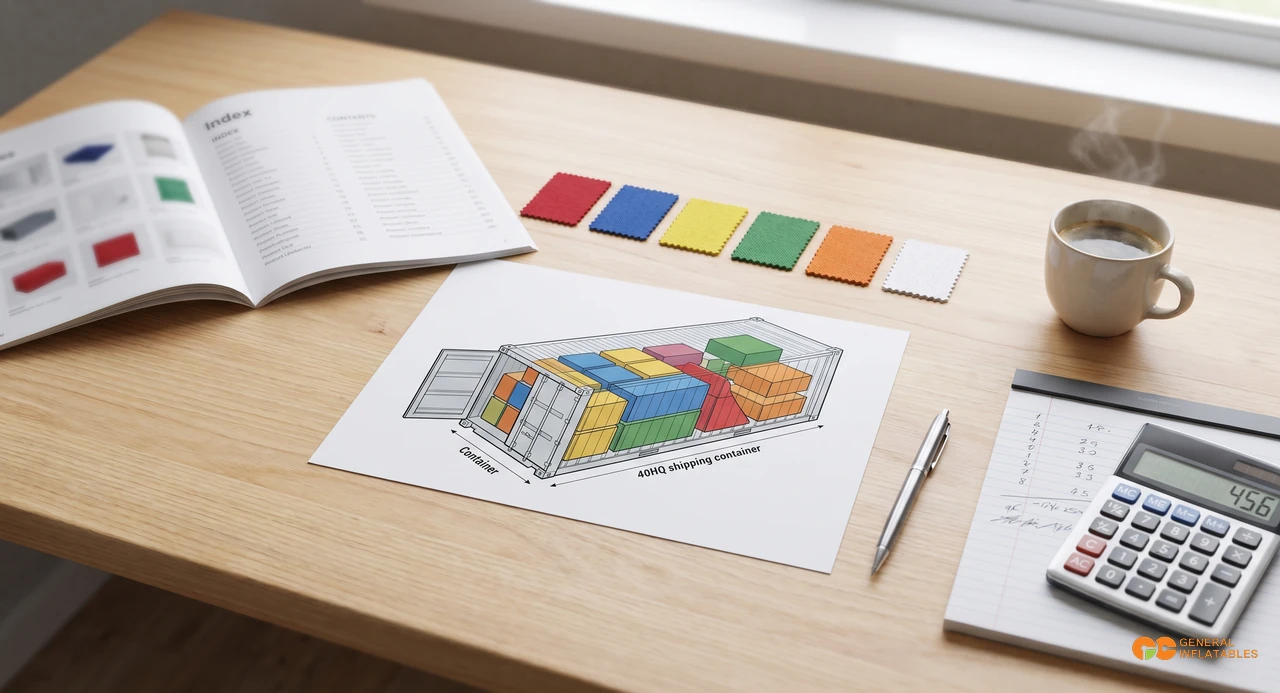
The single most useful trick we teach new distributors: stop thinking in pieces, start thinking in containers. A 40HQ can hold roughly eight different inflatable products — a mix of bouncers, combos, slides, and a couple of advertising pieces — and still hit the production efficiency threshold the factory needs. We routinely build mixed-container orders where no individual SKU exceeds three units but the container is full.
The math on this gets specific fast. Our notes on how to maximize a 40HQ container with mixed inflatable SKUs walk through the CBM-per-product ratios you need to plan around. A typical boutique distributor order looks like: two stock bouncers, two combos, one slide, one advertising arch, and a couple of replacement blowers. Nobody is at MOQ on any single line, but the container is at 85% utilization and the factory is happy to run it.
This is also why working directly with the factory matters more than the per-piece price. A trading company will not co-load your three bouncers with another buyer's two slides because they do not control the production schedule. A factory will. If you are still learning the basics of how factory-direct sourcing actually works versus going through a trading agent, the MOQ flexibility difference is one of the clearest signals.
Not all low MOQs are good news. If a "factory" offers you MOQ 1 on every product, including fully custom designs, ask harder questions. The usual explanations are not flattering:
A real factory will tell you why its MOQ is what it is. If the answer is detailed and product-specific, you are talking to the production team. If the answer is "MOQ 1 on everything, no problem," you are talking to a sales agent who will figure it out later.
When you do need MOQ flexibility on a specific custom project, the levers that actually work:
What does not work: arguing about it. MOQ is a math problem, not a negotiation tactic. Show the factory how the math works on your side and they will show you how it works on theirs.
If you are a startup rental company with capital for three bouncers and one combo, you are not too small for factory-direct. You are exactly the buyer the realistic MOQ structure was built for. The 100-piece myth comes from people who never asked the right questions or who got quoted by the wrong supplier. Ask for per-product MOQ, plan a mixed container, and pick a factory that will explain its numbers to you. Once your supplier is locked in, pair your MOQ plan with realistic inflatable production lead times so your container is booked and your season opens on schedule.
We routinely build mixed-SKU containers for boutique distributors — combining bouncers, slides, and combos to hit production efficiency at any volume. Browse our combo inflatable line and request a mixed-container quote for your target SKU list.
For related buying considerations, see our industry glossary of sourcing and construction terms.