
Two water slide quotes can look comparable while buying very different projects. One includes a blower and an inflatable landing area but leaves site preparation to you. The other prices fiberglass flume sections while excluding the access tower, supports or water system. Comparing the equipment totals before resolving those gaps tells a small park very little.
This inflatable vs fiberglass water slide comparison is for land-based commercial installations. It compares a continuous-air inflatable slide with a fixed fiberglass slide, not floating obstacle modules or swimming-pool shells. The useful question is: which complete installation can your site, crew and opening schedule support?
Start with the site and the guests, not a preferred material. Record the usable ground area, access routes, intended rider group, operating dates, power supply, water source and discharge arrangements. Separate the slide footprint from the space needed for queues, landing, staff access and maintenance.
Tell each supplier whether the land must return to another use after the season. Describe any limits on ground penetration, foundations or construction access. A removable attraction still needs an approved layout and an appropriate anchoring plan; a fixed attraction needs a site that can accommodate its proposed support and service requirements.
Set the same service target for both proposals: the intended audience, available opening hours and queue conditions you want evaluated. Ask suppliers to explain their capacity assumptions. Two lanes, equal heights or similar photographs do not establish equivalent rider capacity.
Our standard inflatable water slide range provides a starting point for the inflatable option. Ask for the exact model drawing before allocating space.
A commercial water slide comparison should identify every interface between equipment and site work. Mark each item as supplier-supplied, locally supplied or excluded, with one named party responsible for checking the interface.
| Project item | Inflatable proposal: confirm | Fiberglass proposal: confirm |
|---|---|---|
| Slide and access | Inflated dimensions, climbing access, lane liners and containment included in the model. | Flume layout, entry platform, stairs, railings and support structure included in the quote. |
| Ground connection | Site-specific anchoring or ballast design, attachment hardware and suitable ground protection. | Support loads, foundation design responsibility, fixing details and installation access. |
| Landing system | Matched splash basin or run-out, drainage and the approved exit arrangement. | Specified run-out or pool entry, construction scope and connection to the flume. |
| Water and power | Required blower, electrical supply, water feed and any treatment or recirculation equipment. | Specified flow, pumps, pipework, treatment equipment and electrical/control scope. |
| Handover | Inflation and installation checks, operator training, manuals and spare-parts list. | Assembly inspection, commissioning, operating settings, training and as-built documents. |
For fiberglass slides, an exit is a design choice, not an interchangeable accessory. WhiteWater's slide guide distinguishes run-out lanes and pool entries. Obtain the exit specified for your proposed ride rather than assuming an existing pool can accept it.[1] Apply the same discipline to an inflatable: do not shorten a landing area or substitute a different basin without the manufacturer's review.
If you are considering a water combo with combined play and slide features, list those additional activities explicitly. It is a different operating brief from a standalone slide.
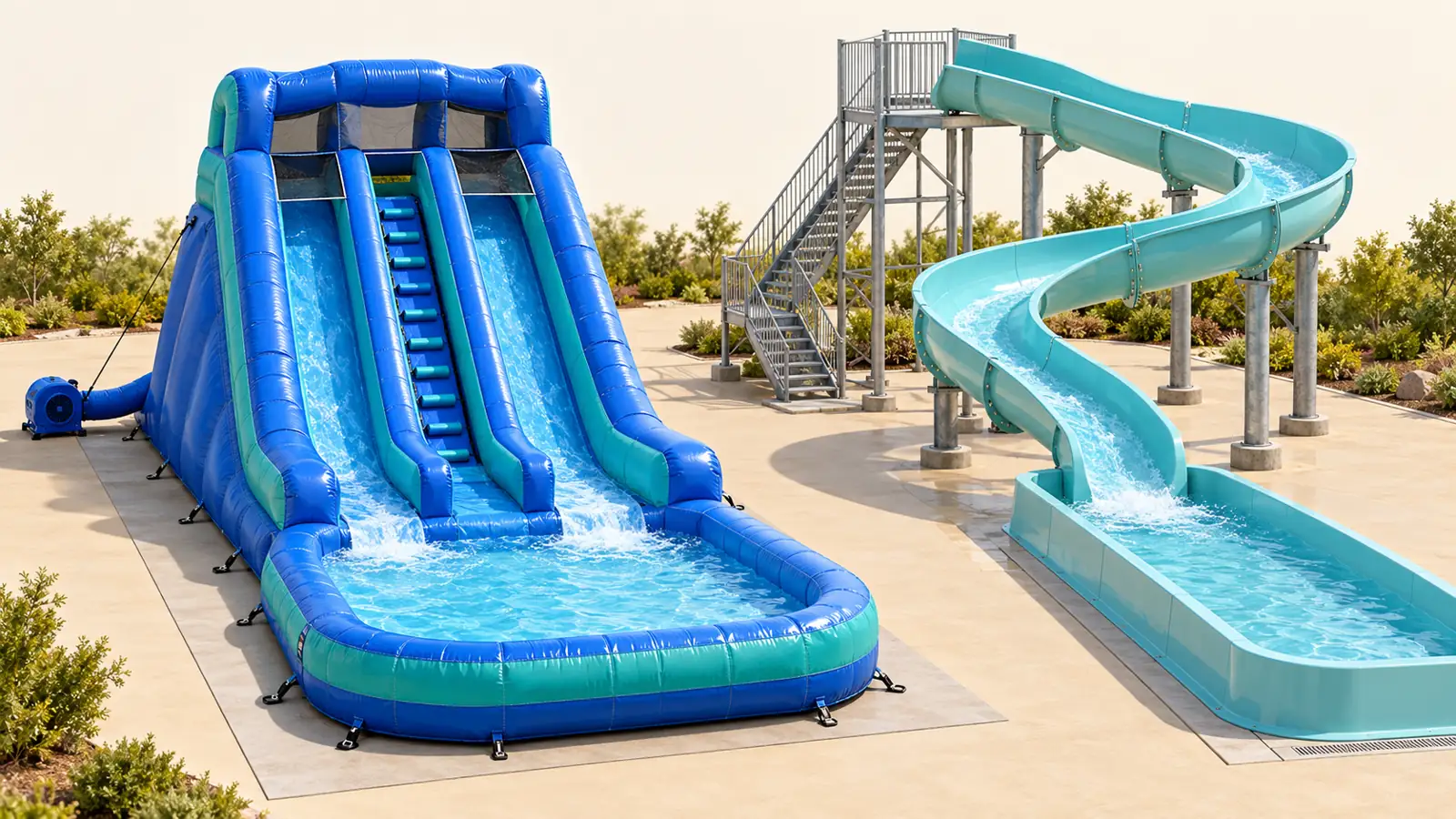
For either material, request a general arrangement drawing identifying access, dispatch, landing, exits and equipment connections. Confirm rider restrictions, operating limits and the instructions used to establish them. Match reports and inspection records to the actual model and configuration, rather than accepting a supplier's general brochure.
For the inflatable option, obtain the blower specification, operating pressure range and anchoring instructions. For the fiberglass option, obtain support and connection details, operating water settings and assembly/commissioning requirements. Confirm who checks work performed by local contractors.
Ask the supplier and your local approval or inspection body to identify requirements for the proposed ride and its location. Material alone does not determine the applicable rules, and a mark on an electrical accessory is not evidence for the complete installation. UK HSE guidance for play inflatables, for example, explicitly limits its scope and directs operators to equipment instructions and inspection arrangements.[2]
The inflatable water slide site and installation checklist develops the inflatable side of this review. Keep that technical assessment separate from the two-option purchasing decision.
Compare the routine from arrival to the first permitted rider, and from the last rider to secure closure. For an inflatable, include deployment where required, anchoring checks, inflation, water setup, inspections, draining and drying. For a fixed slide, include the specified ride-surface, access, water-system and control checks. Fixed installation does not remove daily work.
WhiteWater's maintenance guide calls for ride-surface and joint checks, along with verification of water flow and landing-water conditions against the operating manual.[3] These are examples of the tasks to request from a fiberglass supplier, not a universal maintenance schedule.
Record crew numbers, task duration, storage needs and shutdown conditions from the proposed equipment documentation. Include who authorizes reopening after an interruption and how replacement parts reach the site. Use those inputs to assess your usable operating window; do not assume either material guarantees more open hours.
Attach the same project brief to both requests. Require a response under these headings:
Our RFQ guide for obtaining comparable inflatable quotes explains the general specification fields. Here, the extra step is reconciling the two construction approaches: add locally supplied work to each proposal and flag anything still unpriced or unresolved.
Consider an inflatable where seasonal removal or changing use of the ground is important, and where your team can meet its anchoring, power, inspection and drying requirements. Consider fiberglass where the site supports the specified structure and services, and where a fixed ride layout fits the long-term operating plan.
Pause either purchase if the landing arrangement, site connections or opening checks remain unassigned. The strongest proposal is the one with a complete scope, model-specific evidence and a daily routine your team can deliver. Compare commercial totals after those conditions are met.
Not automatically. Compare the complete operating layout, including access, anchoring or supports, landing and service routes. Have the proposed installation reviewed rather than matching only the advertised dimensions.
Only if the proposed manufacturer-approved design and site review support that connection. Neither a pool's presence nor its size alone confirms a suitable landing system.
The one that meets the common project brief with clear exclusions, verified interfaces and an operating routine you can support. A lower equipment-only total is not a complete-project comparison.
Planning the inflatable option? Send your site plan, intended rider group and opening schedule so we can discuss a model and identify the remaining site requirements.
[1] WhiteWater, Water Slide Guide: exit configurations. [2] UK HSE, play inflatable safety guidance and scope. [3] WhiteWater, Water Parks Maintenance Guide. Manufacturer examples do not replace the instructions for the selected equipment.