
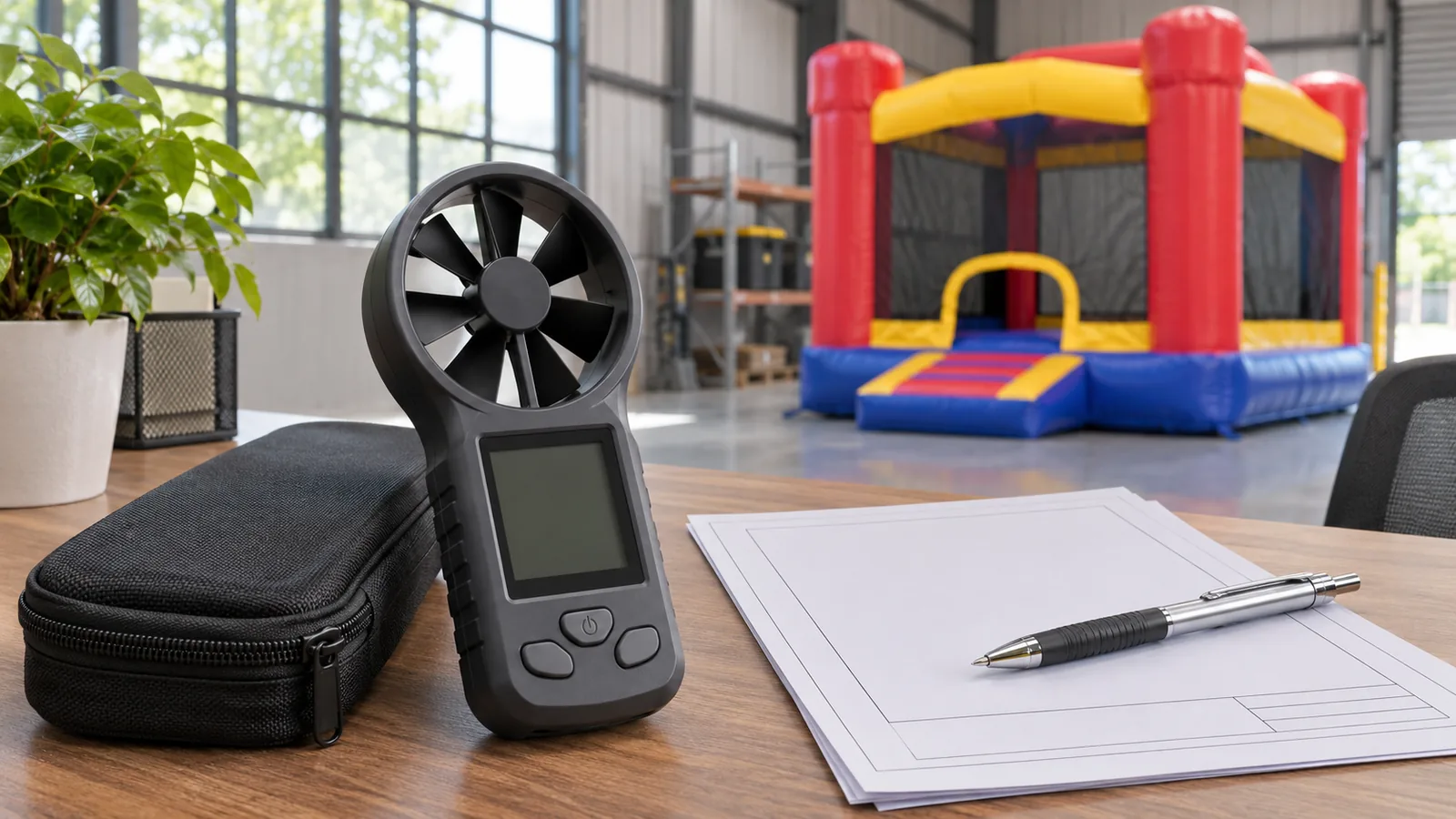
A wind meter can display a convincing number while leaving important purchase questions unanswered. What accuracy applies to that reading? Does the maximum value survive a power cycle? Does the supplied document cover the instrument being delivered? Those details matter more than a long feature list.
Choosing an anemometer for commercial inflatables starts with a defined measurement requirement and ends with one documented specification. For rental companies and event operators, this guide covers the questions to settle before ordering an instrument, rather than the procedures for measuring wind or deciding whether an attraction can operate.
Identify the measurement you need: outdoor wind speed. An instrument intended to assess blower airflow or internal inflation pressure answers a different question. Keep the inflatable’s operating instructions and your applicable site requirements available when defining the purchase.
The UK HSE guidance for play inflatables, within its stated scope, calls for an anemometer for outdoor wind measurements and says weather apps cannot substitute for local measurements. That explains the equipment need; it does not establish one worldwide instrument specification.
For a fleet of commercial inflatable bouncers, have the responsible person identify the required units, documentation and recording arrangements. Give those requirements to the instrument supplier before comparing models.
These three terms answer different questions. A larger maximum range does not automatically provide better measurement accuracy, and an extra decimal place is not evidence of a smaller measurement error.
| Specification | What it describes | What to confirm |
|---|---|---|
| Range | The interval covered by the stated specification. | Does the accuracy statement apply across the quoted range? Is a wider displayed range specified separately? |
| Resolution | The smallest displayed increment for a measurement. | Which increment applies in your chosen unit? |
| Accuracy | The manufacturer’s stated measurement performance, subject to its conditions. | What complete expression, limits and applicable model or serial range accompany it? |
Keep the original units and conditions when transferring specifications into a comparison sheet. If a quotation abbreviates the accuracy to a single percentage, request the complete technical document. Instrument uncertainty must not be treated as extra permission to operate above an inflatable’s limit.
Ask what each display mode represents and what resets it. A maximum display, an average and a frozen reading are different features; none alone establishes that the instrument stores a dated measurement history.
The Kestrel Basic user guide provides a useful reading example. Its MAX and AVG values reset when the unit is powered down. HOLD freezes the measurements. The guide also distinguishes model features: the Kestrel 1000 has no backlight. A feature shown elsewhere in a shared manual therefore needs a model-specific check.
If your purchasing requirement includes records, ask separately about timestamps, storage, retrieval and export. Confirm the averaging period and the manufacturer’s description of maximum capture where relevant. Do not assume that “MAX” means every brief peak will be captured, or that a display refresh specification describes the entire measurement process.
Request the applicable manual and the exact documents included with the offered instrument. A certificate of conformity and an individual calibration report may contain different information. Read their scope rather than deciding from the document names alone.
The manufacturer-issued Kestrel Certificate of Conformity illustrates why applicability matters. These are document-reading examples, not a brand recommendation or confirmation that a particular meter meets your requirements.
| Document detail | What to carry into the enquiry |
|---|---|
| Model and serial applicability | The certificate identifies the 1000–3550 range. Its closing applicability note lists the covered series and requires serial numbers higher than 2262687. |
| Wind-speed accuracy expression | It uses the largest of 3% of the reading, the least significant digit, or 20 ft/min. Reporting only “3%” drops conditions. |
| Shared specification table | Confirm which functions belong to the actual model; a series document does not give every listed feature to every instrument. |
For any calibration report offered, ask which instrument and measurement it identifies, the test date, covered points or range, results and stated uncertainty. Keep traceability wording accurate: NIST-traceable standards do not mean NIST has approved the instrument. Obtain service advice for the actual model and application instead of adopting a universal recalibration interval.
Check display readability, available units, power supply and the stated environmental conditions. Ask for the conditions behind any water-resistance or temperature claim. An IP designation is not an unlimited promise against exposure or damage.
Confirm the supplied case, battery arrangements, manual language and access to repair or calibration services in your destination market. Ask which service requires returning the instrument and what documentation accompanies it. Keep these purchasing questions separate from maintenance instructions.
When planning wider inflatable accessories and spare-parts sourcing, list the wind meter as a distinct instrument requirement. Do not assume that a general accessories package includes one.
Use the blank checklist below to connect the quotation, technical files and proposed delivery. Mark unanswered items as pending. Retain the instrument’s own identity alongside your equipment identification records so its documents remain traceable.
Before accepting a substitute model, revisit the same fields rather than carrying over the previous quotation’s answers. Ask the supplier to identify any changed functions, documentation or service arrangements. Keep the confirmed version with the order so receiving staff can compare the delivered item against an agreed reference.
| Purchase field | Supplier confirmation / document reference |
|---|---|
| Exact model, version and applicable serial range | To be confirmed |
| Range, resolution and complete accuracy conditions | To be confirmed |
| MAX / AVG / HOLD, resets and any dated records | To be confirmed |
| Included documents, identity and measurement scope | To be confirmed |
| Delivery contents, environmental limits and destination service | To be confirmed |
For other equipment requirements, use the commercial inflatable accessories enquiry route. Wind meter availability is not established by that listing; this guide is not an Inflatablecn offer to supply instruments.
The purchasing result should be an identified instrument with understood specifications and applicable documents. It does not replace the inflatable’s instructions, competent supervision or the separate decision about whether equipment may operate.