
Most European buyers now hold two documents for an inflatable order: a CE-related declaration and an EN 14960 test report. Since 13 December 2024, a third layer applies to consumer products placed on the EU market — Regulation (EU) 2023/988, the General Product Safety Regulation (GPSR).
GPSR does not replace CE marking or EN 14960. It answers a different question: who in the EU is accountable for this product once it is on the market, and how can a market surveillance authority trace it back to a batch? That answer has to be built into the order before production, not after the container arrives.
This is a working checklist for EU GPSR compliance on inflatable imports — the fields, the named operator and the batch trail an importer, distributor or private-label brand has to build into the order before production.
GPSR is a general safety framework for consumer products. It applies where no sector-specific EU rule covers the same risk, and it works alongside rules that do — for example the Toy Safety Directive for products classified as toys.
For inflatables, the scope question is about intended use and sales channel, not about the product category name:
Do not assume that "commercial" removes the obligation. If your listing markets the product to private buyers, GPSR applies regardless of the build.
GPSR requires an economic operator established in the EU to take responsibility for the product. In practice that can be:
Two practical consequences for importers:
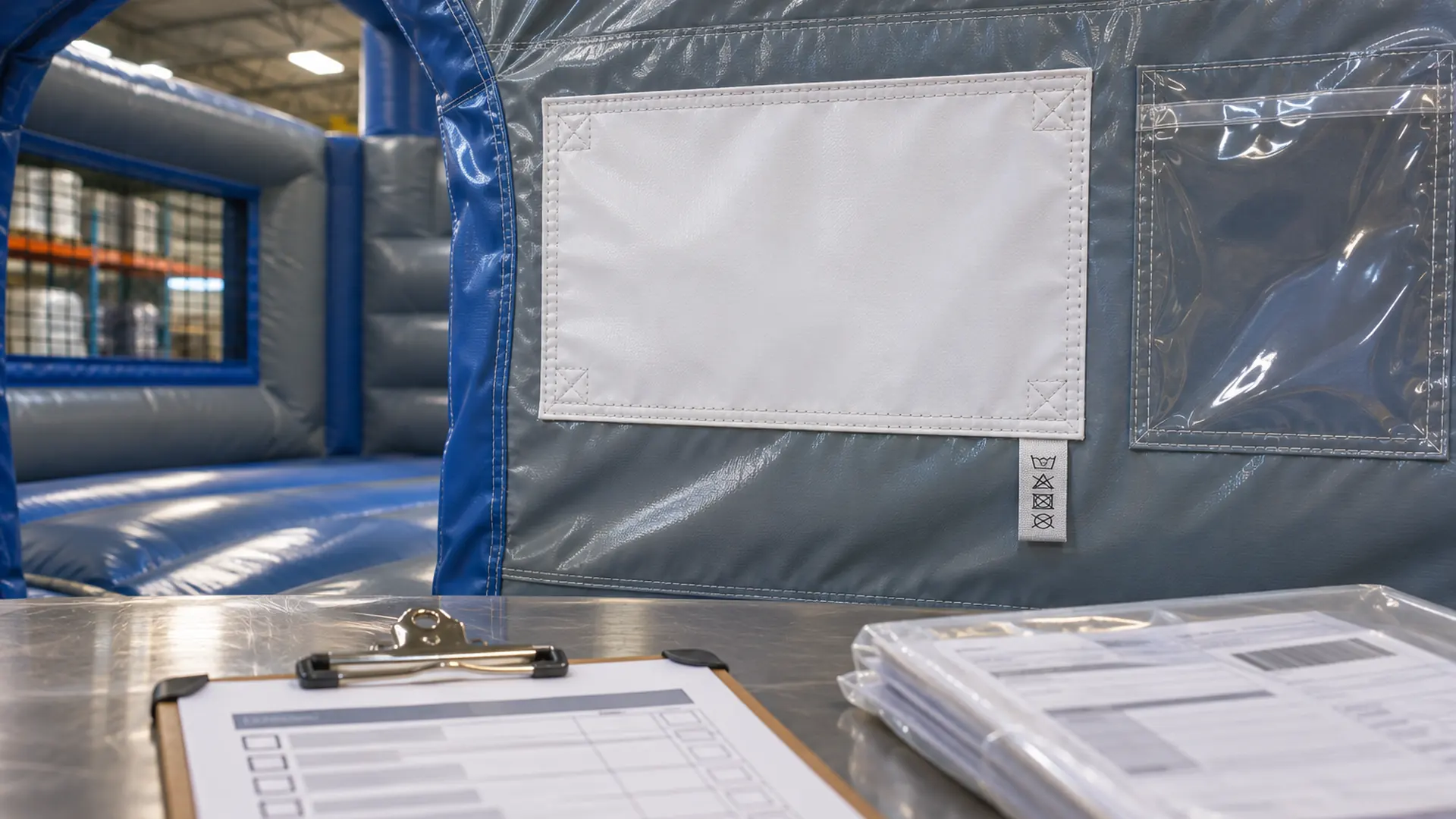
The responsible person's name, registered trade name or trademark, postal address and email address must appear on the product, on the packaging, or on a document accompanying the product. For a distributor shipping to sub-buyers, "accompanying document" usually means the invoice or packing list, but it has to travel with the goods.
For inflatables, the label is usually a sewn or printed panel. Agree the panel content with the factory before production — reworking labels after shipment is expensive and often means rework on every unit.
The label or accompanying documentation should carry:
Keep the manufacturer and the responsible person clearly distinguished. A label that lists a Chinese factory address and calls it the EU responsible person is a defect, not a shortcut.
Traceability is the part most first orders get wrong. The requirement is not simply "print a serial number" — the reference has to be consistent across the unit, the packaging, the commercial documents and the test report.
Build a match table before production:
| Field | Unit label | Packaging | Invoice / packing list | Test report |
|---|---|---|---|---|
| Model code | ||||
| Size / revision | ||||
| Batch or serial range | ||||
| Responsible person details | ||||
| Material batch reference |
If the model code on the test report does not match the model code on the unit, the report does not support that shipment. This is the same consistency logic that applies to customs and EU import documentation, extended to the market-surveillance side.
Distance selling is explicitly covered. If you sell inflatables through a website or marketplace into the EU, the listing must clearly show:
Marketplaces have their own compliance checks and will remove listings that do not display this information. For a brand selling direct, this is a template change, not a production change — but it has to be done before the first sale, not after a complaint.
GPSR formalises incident handling. Where a product presents a risk, the responsible operator must notify through the EU's Safety Business Gateway and cooperate with the authority. Recalls and safety warnings are published through Safety Gate.
Two operational requirements follow:
The obligations are administrative, so they belong in the PO, not in a later email thread. Add:
That set is narrow enough to negotiate and specific enough to be checked. It also protects the factory — a documented label requirement removes the guesswork about which address goes where.
None of these are hard to fix at the order stage, and all of them are expensive to fix once stock is in the EU. For products that also carry chemical restrictions, our REACH compliance guide covers the material side, and the regional compliance checklist shows how the EU pack differs from the US, Japanese and Australian sets.
GPSR is not another certificate to file. It is a set of fields on a label, a named EU operator, and a batch trail that matches your commercial documents. Importers who write those into the PO at the quotation stage get compliant units at no extra cost. Importers who leave it to the factory discover the gap when a marketplace or a distributor asks for the responsible person and there is nobody to name.
Start with the product scope: our commercial bouncers and inflatable castles ranges show which builds are typically sold as consumer products and which are ordered for commercial operation, because that distinction decides which obligations apply.
Regulatory summary for procurement planning. Confirm current obligations against the official text of Regulation (EU) 2023/988 and your national implementing rules before relying on it for a specific shipment.