If you want to import inflatables to the EU and sell to rental operators, event companies or distributors, the hard part is rarely the product. Manufacturing a durable commercial bouncer or slide is well understood. The real barrier is compliance and correct declaration at the border: CE marking, EN 14960 conformity, the right HS code, and clean customs paperwork. Get those right and your container clears smoothly. Get them wrong and you face delays, re-inspection costs, or refused entry. This guide walks the EU import process end to end.
The European market is one of the most demanding for inflatable play equipment. Buyers expect documentation, and customs authorities and market surveillance bodies actively check it. The product you ship matters far less than whether it carries the correct conformity markings and arrives with a paper trail an inspector can follow. Treat compliance as the entry ticket, not an afterthought.
The CE mark is a manufacturer's declaration that a product meets the relevant EU directives and harmonised standards. For a commercial inflatable, a credible CE mark bounce house claim must be backed by a Declaration of Conformity and a technical file demonstrating conformity to EN 14960.
Responsibility matters here. The CE mark is affixed by the manufacturer, but once a product is placed on the EU market the importer carries legal obligations too. As the importer of record you must verify that the manufacturer has done the conformity assessment, that the Declaration of Conformity exists, and that technical documentation is available on request. You cannot simply rely on a logo printed on a label — you must be able to produce the file behind it.
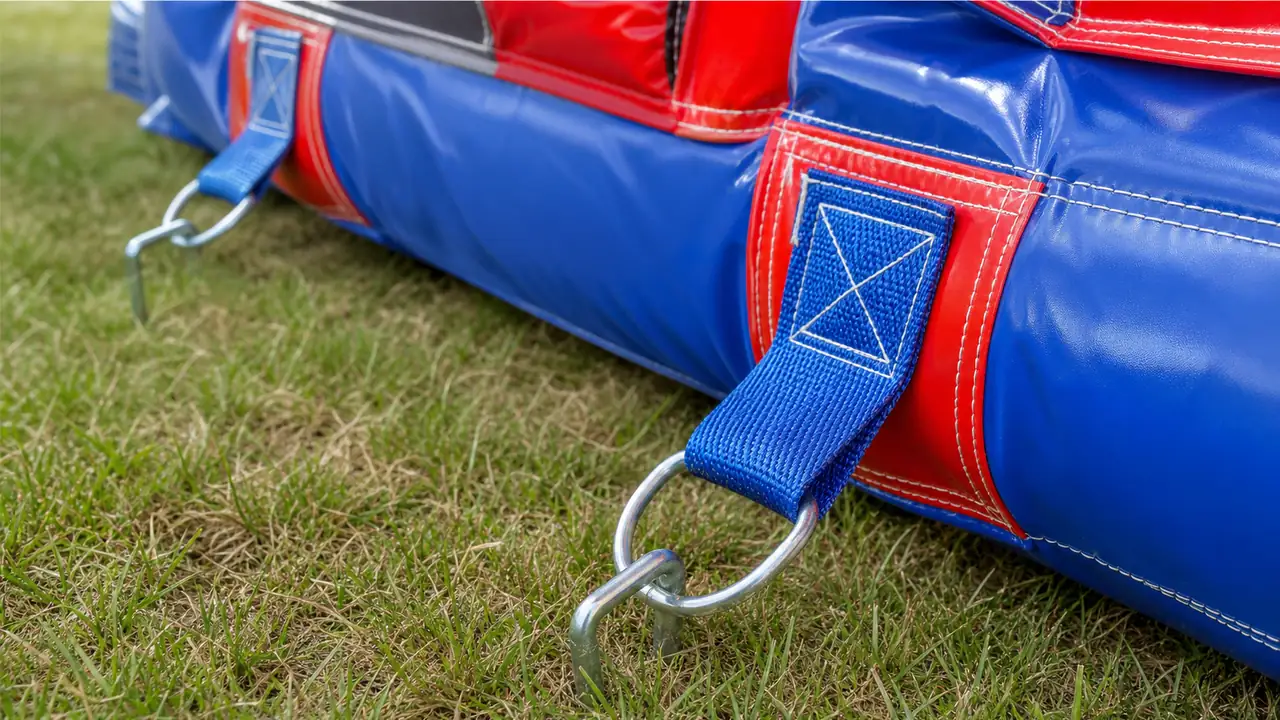
EN 14960 is the European standard for inflatable play equipment. It is the backbone of any EU conformity claim for bouncers, combo units and inflatable obstacle courses. EN 14960 compliance covers the points an inspector or a serious buyer will check:
If you are sourcing from China, confirm with the factory that test reports reference EN 14960 specifically, not a generic safety claim. Standards differ by region, and the gap matters — our breakdown of EN 14960 versus ASTM F963 safety standards explains why a unit built for the US market may not satisfy an EU inspector without changes.
Every product crossing the EU border needs a commodity code. The inflatable HS code determines the duty rate, so declaring it correctly is both a legal requirement and a cost-control decision. Commercial inflatable play structures generally fall under the toys and games headings (Chapter 95), but the precise eight- or ten-digit code depends on construction and intended use.
Confirm the exact code with your customs broker before shipment and make sure the supplier's commercial invoice describes the goods consistently with that classification. A mismatch between the invoice description and the declared code is one of the most common triggers for customs queries. Duty is calculated on the customs value (typically the CIF value at the EU port), so your Incoterms — whether you buy FOB or CIF — also affect the figure on which duty and VAT are assessed.
Smooth inflatable customs clearance EU comes down to a complete, consistent document set. Have these ready before the vessel arrives:
Engage a customs broker early. The cost of brokerage is small against the demurrage and storage charges that accumulate when a container sits at port waiting for a missing document.
Import VAT is charged in addition to duty and is calculated on the customs value plus duty plus inland costs to the point of entry. The rate is set by the country of import and varies across the EU. The important point for cash flow: in most member states a VAT-registered importer can reclaim import VAT through their normal VAT return, so it is recoverable rather than a permanent cost — but you must finance it at the point of clearance. Some countries also offer postponed VAT accounting, which lets you account for import VAT on the return instead of paying it upfront. Check the rules in your country of import with your broker or accountant.
Commercial inflatables ship well by sea because they compress and pack densely. A full container is almost always the most economical route. Bouncers and slides palletise or bale efficiently, and a 40ft HQ container carries a large mixed order — useful when you are building a distributor's opening range or a rental fleet.
The main gateways are Rotterdam, Hamburg and Antwerp, which between them serve most of Northern and Central Europe with strong onward road and rail links. Choose the port closest to your distribution base to cut inland haulage. Larger, bulkier items such as commercial inflatable water slides need careful load planning to maximise cube, while compact games and bouncers fill the gaps. Our core range of commercial inflatable games is designed to container-load efficiently for export.
Once cleared, your goods reach the market through a few common channels: selling directly to rental operators and event companies, supplying regional distributors who hold stock and resell, or running your own e-commerce and trade-show presence. Distributors give you reach and local language support but expect margin; direct sales keep more value but demand more logistics and after-sales effort. Many importers blend the two — direct to anchor accounts, distributors for fragmented regions.
Whichever model you choose, your compliance file becomes a sales asset. Operators in the EU are liable for the equipment they put in front of the public, so being able to hand over a clean Declaration of Conformity and EN 14960 reports shortens the sale and builds trust.
Importing inflatables into the EU is a process you can systematise. Lock down CE marking and EN 14960 conformity with your manufacturer, confirm the HS code and duty position with a broker, prepare a complete document pack, plan VAT financing, and book full-container freight to the port nearest your customers. The product is the easy part — the paperwork is what gets it sold. If you are weighing other regions too, our guide to importing commercial inflatables to the Middle East shows how the same discipline applies under different rules.
For related buying considerations, see our REACH compliance guide covering phthalates and lead limits and our German market event tent sourcing guide.