
The size printed on a commercial inflatable water slide listing, such as 10 m × 4 m × 6.3 m, is the size of the inflated unit. It tells you whether the slide fits in the truck and through the gate. It does not tell you whether it fits the site. The ground you actually need is larger on every side, and the gap between the two numbers is where most installation problems start.
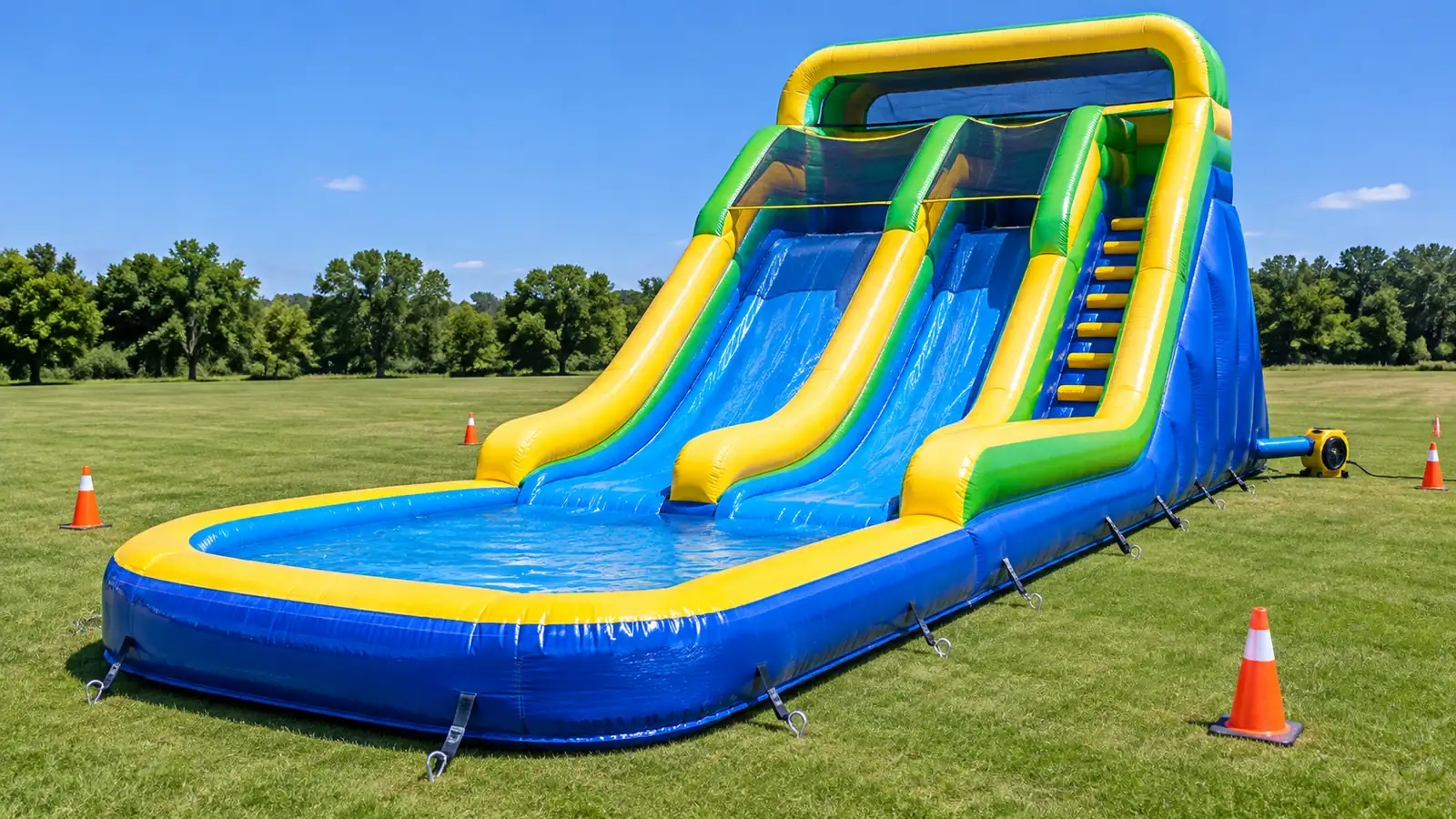
This guide sets out the size bands we see across commercial dual-lane water slides, explains how dimensions are quoted, and shows how to convert a listed size into a footprint you can mark out on a lawn, a campsite pitch or a water park deck.
Manufacturers quote three numbers, normally in the order length × width × height, measured with the unit fully inflated:
Listings for export markets often show both metric and imperial figures. A unit listed as 10 m L × 4 m W × 6.3 m H appears as 33 ft × 13 ft × 21 ft. Those conversions are rounded, so when space is tight, work from the metric figure. When you compare two quotes, check that both give the overall height or both give the platform height. Mixing the two is the most common reason a "taller" slide turns out to be the same product.
These bands come from the listed dimensions of dual-lane commercial units in our water slide range. They are not formal categories, but they line up with how operators actually use the slides.
| Band | Listed size (L × W × H) | In feet | Typical use |
|---|---|---|---|
| Compact | 7.6–8.2 m × 3–3.7 m × 4.3–5.5 m | 25–27 ft × 10–12 ft × 14–18 ft | Party rentals, school and church events, sites with gate or garden access limits |
| Mid-size | 8.5–10.3 m × 4–4.3 m × 5.5–6.3 m | 28–34 ft × 13–14 ft × 18–21 ft | Festival and corporate rentals, campsites, the core fleet unit for many operators |
| Large | 11 m × 5.5 m × 6.7–7.3 m | 36 ft × 18 ft × 22–24 ft | Large public events, water parks, seasonal fixed installations |
Two patterns stand out. Width grows more slowly than height until the large band, where the pool widens to carry the extra speed of a taller drop. And height is the number that moves a unit into a different operating category, which matters for wind limits, staffing and the rules covered below.
To plan the site footprint, start from the listed size and add clearance on each side for a specific reason. Typical planning allowances look like this:
Treat these as starting allowances, then confirm them against the applicable safety standard and the manufacturer's operating manual. Some markets and some insurers set larger zones.
Worked example. Take the 33 ft farm-theme water slide, listed at 10 m × 4 m × 6.3 m. With 2 m at each side, 2 m at the rear and 2 m at the front, the marked-out area becomes 14 m × 8 m, or 112 m². The listed size covers only 40 m². In other words, a slide that "is 10 by 4 metres" needs close to three times its own area to operate properly. Run this calculation before you confirm a booking or sign a site lease, not on the morning of the event.
A flat site matters more for a water slide than for a dry bouncer. Water runs to the low point. On a slope the splash pool fills unevenly and the anchors on the downhill side carry more load. Aim for level ground, or set the slide so that the pool sits on the flattest part of the site with the stair at the higher end.
The anchor perimeter usually sits just outside the listed width and length, so it needs to be inside your side and rear allowances. Remember that a wet slide is much heavier during operation than when it is delivered, because of the water held in the pool. Ground stakes, sandbags or water ballast have to be specified for that operating condition, and hard surfaces need ballast rather than stakes. Our article on commercial water slide installation and commissioning covers pump selection, wet anchoring and the handover checklist in detail.
Height is the dimension regulators and insurers look at first. Taller units catch more wind, need more anchor points and can require more than one supervisor. The rules differ by market. EN 14960 in Europe and ASTM guidance in the US treat height, wall height and run-out differently, so a slide that is acceptable in one market may need changes for another. We compare the rules in our guide to inflatable slide height limits by market.
For planning purposes, if a site has regular wind exposure, an open hilltop, a beach or a coastal campsite, a mid-size unit is often the more practical choice than a large one, even when the space is available.
Packed size and weight rise with each size band. A compact unit can often be moved by two people with a hand truck, while large slides usually ship as more than one bag or on a pallet and need equipment or a larger crew at the site. Exact packed dimensions and weights depend on the material, the theme and whether the pool is a separate section, so ask the factory to state them on the quotation for each model.
For import orders, packed volume decides how many units fit in a 20 ft or 40 ft HQ container and whether you can mix slides with bouncers and accessories in the same shipment. Ask for packed volume per unit before you finalise quantities, because it changes the landed cost per unit far more than small differences in unit price.
Before you compare quotes, ask each supplier to confirm the following for the exact model:
A supplier who can answer all eight in writing is quoting a real product. A quote that gives only "10 × 4 × 6 m" is a starting point, not a specification.
A practical next step is to send the factory your site measurements together with the model you are considering. A supplier who has the full specification can tell you within a day whether the slide fits, which size band suits the site better, and what packed volume to plan for in the container.