
Few attractions pull a crowd like an inflatable dunk tank. It is loud, it is wet, and it turns spectators into paying participants within seconds. For international B2B buyers sourcing crowd-pullers for schools, charity events, and carnivals, this is one of the most reliable revenue-per-square-metre products on the market. This guide explains exactly what the product is, how the mechanism works, what materials to specify, and how to order it factory-direct.
An inflatable dunk tank is a large inflatable water pool or tank with a seat mounted above the water and a throwing-target trigger mechanism to one side. A volunteer sits on the seat above the water. Players line up and throw balls at the target board. When a throw hits the target squarely, the trigger releases the seat, and the person drops straight down into the water below. The seat is then reset, the volunteer climbs back up, and the next round begins.
This is the classic dunk tank game you see at carnivals and fairs: simple to understand, impossible to walk past, and endlessly repeatable. Unlike many attractions, the appeal is social — the crowd wants to see the teacher, the manager, or the local celebrity go under.
The buyer profile is broad, which is part of why this product ships in such volume across our commercial inflatable sports range:
The economics are straightforward. As a dunk tank for events, revenue comes per throw or per ticket, the unit is reusable across hundreds of events, and a single attendant can run it. That makes ROI fast and repeatable without inventing any headline price.
Traditional dunk tanks are rigid steel-and-acrylic units. They are heavy, they rust, and they take real effort to transport and assemble. An inflatable version rewrites that math:
Build quality is where a serious buyer earns their margin. Specify the following when you send an RFQ:
The water tank and pool walls should be 0.9mm reinforced PVC tarpaulin, double- or triple-stitched and heat-welded at the seams that hold water. This is the same commercial-grade material used across our commercial water attractions, chosen for its tear and abrasion resistance under the constant wet use of an inflatable water dunk.
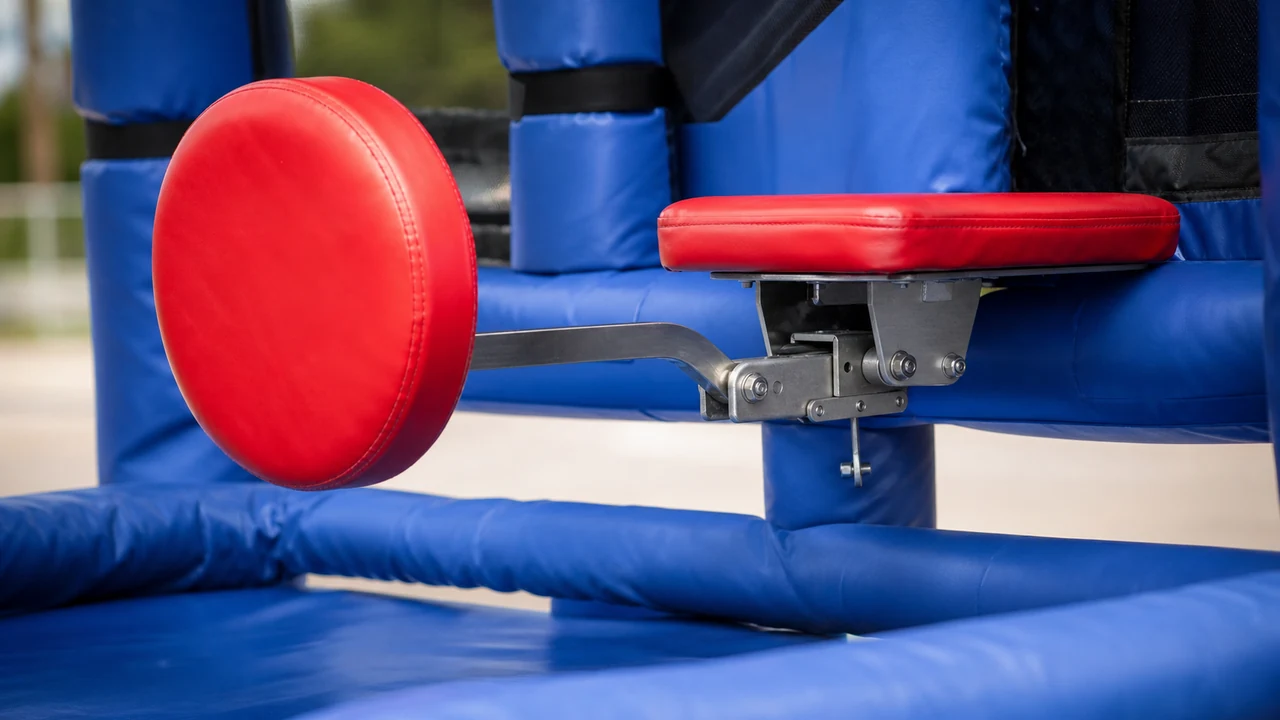
This is the heart of the product. A quality unit uses a clearly visible target board, a lever mechanism that releases the seat on a clean hit, a hinged or drop seat on a reinforced frame, and a simple reset so the attendant can re-arm it in seconds between rounds. Ask for the mechanism to be a serviceable assembly, not a sealed part.
The seat frame must be reinforced where it meets the inflatable body so it holds an adult's weight without deforming the tank. Confirm rated water capacity and, critically, a proper drainage point so the tank empties cleanly at the end of the day. Ask for safety padding around any hard mechanism parts — the lever, the frame, and the target support — so participants and the seated volunteer are protected.
A dunk tank is safe when it is operated to the manufacturer's rated values. Cover these points in your operator briefing:
A dunk tank is often grouped with the wider interactive and competition category, but it is a distinct product defined by its dunk-and-water mechanism. If your buyers also want throw-and-hit or head-to-head units, point them to our interactive competition games — but be clear that this specific attraction is about the water drop, not a scoreboard. For a fuller overview of that adjacent category, our guide to inflatable interactive and competition games covers the throw, score, and race formats that sit alongside the dunk tank. It sits at the crossover of sports-style play and water fun, which is exactly why it converts so well at mixed-audience events — much like the inflatable sports games for corporate events that many of our rental clients run in the same fleet.
When you move to a purchase order, confirm these commercial points:
Sourced correctly, an inflatable dunk tank is a compact, durable, high-turnover asset that earns across schools, fundraisers, carnivals, and corporate days for years. Specify the right PVC, a serviceable mechanism, and the OEM branding your market wants, and you have a product that pays back fast.
Request an inflatable dunk tank quote and OEM options
For related buying considerations, see our inflatable haunted house buyer's guide, our guide to inflatables for pumpkin patches and agritourism farms, and our year-round seasonal promotional inflatables calendar.