
Nothing pulls a crowd at a rental event, corporate team-building day or family entertainment centre faster than two people going head-to-head. That is exactly what inflatable interactive games deliver: short, competitive, one-on-one or two-player matchups that turn spectators into a queue. For rental operators and FEC buyers, these units are high-turnover, high-visibility assets — a single bungee run can cycle dozens of matches an hour with minimal staffing. This guide covers the core categories, the impact-grade materials that keep them earning, the safety gear that comes with them, and the footprint, throughput and shipping realities you need before you place an order.
Unlike a long inflatable obstacle course buyer's guide setup or a maze-style bunker field, interactive competition games are compact, self-contained duel units. They win on repeat play, not on a single timed run.
"Interactive" in the commercial catalogue means a game where two or more players compete directly against each other on one inflatable base. The staples are:
These all belong to the wider commercial inflatable sports range, but they behave very differently from arena-style products. If you want cover-based, multi-team combat layouts instead of duel units, that is a separate category — see our guide to inflatable battle arenas & combat bunkers.
Interactive games take punishment that bouncers never see: bodies pulling against bungee anchors, sticks striking padded pods, players crashing onto landing zones hundreds of times a day. The build spec that survives this is 0.9mm (roughly 1000D) PVC tarpaulin on all high-stress surfaces — walls, pedestals, anchor points and landing beds. Lighter 0.55mm material is fine for a low-traffic inflatable's decorative panels, but it will not hold up at the stitch lines where a bungee cord loads the anchor.
Look for double- and quadruple-stitched seams at all stress points, reinforced webbing straps at cord anchors, and welded (not just sewn) air-holding chambers. For a full breakdown of tarpaulin weights and where each grade belongs, our notes on PVC tarpaulin grades explain what to specify. Most competition units are constant-airflow (blower stays on) rather than sealed air-tight, which means a small puncture won't end the day — the blower keeps the structure firm while you patch.
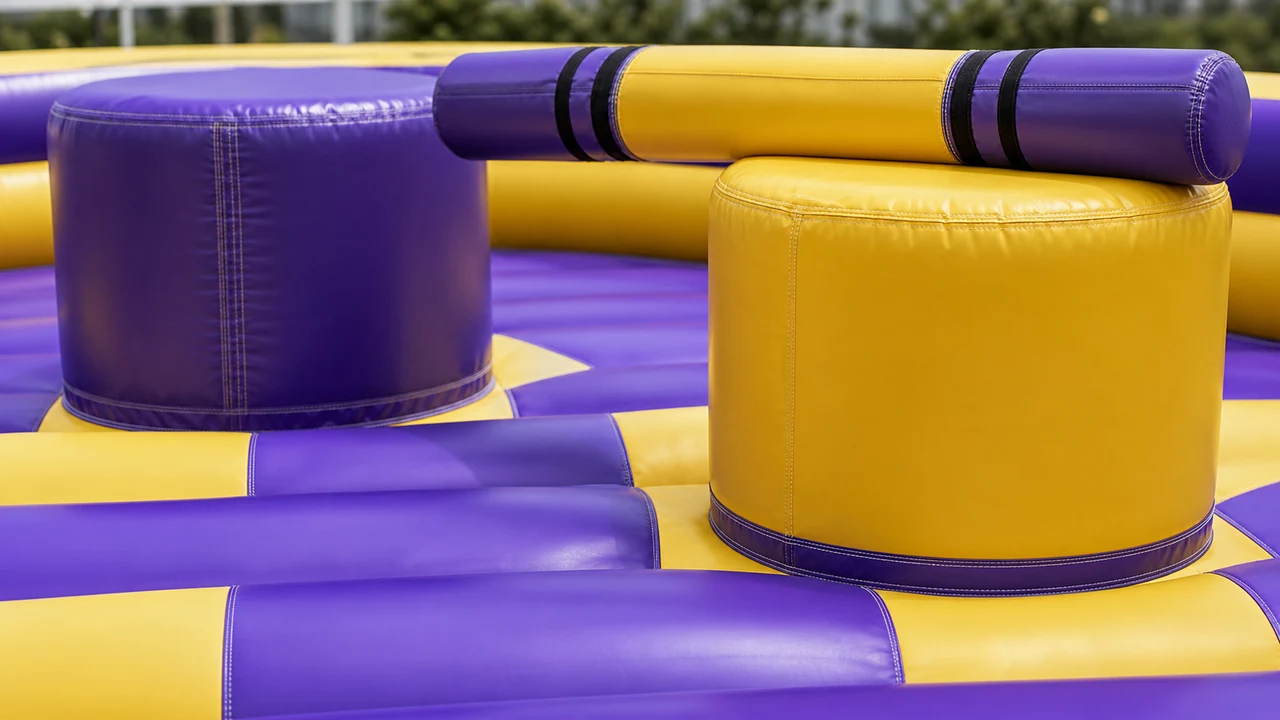
A serious supplier ships the game as a complete kit, not just the inflatable shell. When you quote, confirm the following are in the box:
Every unit should ship with a commercial blower (or two), a repair kit, ground stakes and/or sandbag anchor points, and a carry/storage bag. For export buyers, insist on recognised certification — EN 14960 (Europe), ASTM F2374 (North America) and TÜV or RPII operator documentation. These are your ticket to insurance and to renting into schools, councils and corporate clients.
Compact size is a big part of why these games earn well. A typical bungee run needs roughly a 10–15 m long by 4–5 m wide clear run; a gladiator joust or wrecking ball sits in about a 5–6 m square. Ceiling height matters for indoor FEC installs — joust podiums and swinging sticks want 3.5 m-plus clearance.
Throughput is the number that drives ROI. A duel game runs a 30–60 second match, so one staffed unit can cycle 40–60-plus matches per hour. Two players active plus a queue of spectators means high engagement per square metre — far denser than a walk-through attraction. Constant-airflow builds also mean fast turnaround: 3–5 minutes to inflate, similar to deflate and roll for the next booking. That quick setup is what lets a single rental crew run several games across one event day.
For wholesale and export, most factories set a low MOQ on interactive games — often a single mixed container of assorted units rather than dozens of one model, which suits operators building a varied fleet. Deflated and rolled, a bungee run or joust packs down tight; a 40ft HQ container will typically take a strong mix of competition units, and combining smaller games with larger inflatables optimises the load. For the maths on stuffing a container efficiently, see our breakdown of 20ft vs 40ft HQ container loading.
OEM and ODM are standard: custom colourways, printed sponsor or brand logos, sizing to your venue, and market-specific certification packages. Confirm your FOB or CIF terms up front, and budget lead time for printed custom work versus stock units. Order spare cords, patches and blowers with the first shipment — they cost little in the container and save an air-freight emergency later.
Explore our commercial interactive games range
Inflatable interactive games are among the most reliable earners a rental or FEC operator can add: compact, impact-built, quick to turn around, and endlessly re-playable. Get the material grade, the accessory kit and the certification right at the sourcing stage, and a well-chosen mix of bungee run, gladiator joust and wrecking ball units will pay for its container many times over.