The German-speaking market is one of the strongest and most disciplined markets in the world for commercial inflatables. Between the summer Volksfeste and Stadtfeste circuit, the Freizeitpark sector, school and community events, and a mature rental industry, demand for a well-built aufblasbare Hüpfburg or a full aufblasbarer Wasserpark stays high year after year. For an importer, rental operator or event company in Germany, Austria or Switzerland, the question is rarely whether the demand exists — it is where to source stock that meets German safety expectations at a margin worth building a business on.
This guide is written for exactly that buyer: a DACH-market operator sourcing kommerzielle aufblasbare equipment factory-direct from China. It is a regional entry point covering product range, certification, customization and import logistics. For category-specific depth on individual product lines, we link to dedicated guides along the way.
Most German buyers start with a domestic reseller because it feels safer. The trade-off is margin and choice. A local distributor has already added their markup, works from a fixed catalogue, and rarely offers real customization. Buying direct from the manufacturer changes the economics: you capture the reseller's margin yourself, you select from the full production range rather than a curated shortlist, and you can specify colors, themes and branding for your own market.
The concern buyers raise is quality and compliance — and that concern is legitimate. The answer is not to avoid China; it is to work with a factory that builds and documents to European standards from the start. When the certification and the material specification are correct, factory-direct sourcing gives a DACH operator both the better cost base and the compliance paperwork insurers and event authorities expect.
A healthy rental or events inventory for the DACH market usually spans a few core categories. The classic aufblasbare Hüpfburg — bounce castles, or Hüpfburgen — remains the workhorse for children's events, Stadtfeste and private bookings. Alongside them, an aufblasbare Rutsche (inflatable slide) and combo units add height and repeat appeal. For the summer season, an aufblasbarer Wasserpark and airtight water play units open a completely separate, high-demand revenue stream. Rounding it out are obstacle courses, interactive games and other aufblasbare Spielgeräte that keep an operator bookable across age groups and event types.
A supplier that produces the full commercial inflatable games range in-house lets you consolidate orders and mix categories into one shipment. Within that, the inflatable castles and Hüpfburgen line and the airtight water play range are the two categories that most often anchor a DACH inventory.
This is the single most important point for any German-speaking buyer, and it is where a serious factory separates itself. In the DACH market, EN 14960 — the European standard for inflatable play equipment — is the baseline, and TÜV inspection is what German buyers, insurers and public-event authorities treat as proof. Whether you are booking a unit into a Stadtfest, satisfying a GS/Prüfung requirement, or answering an insurer, you will be asked to document compliance.
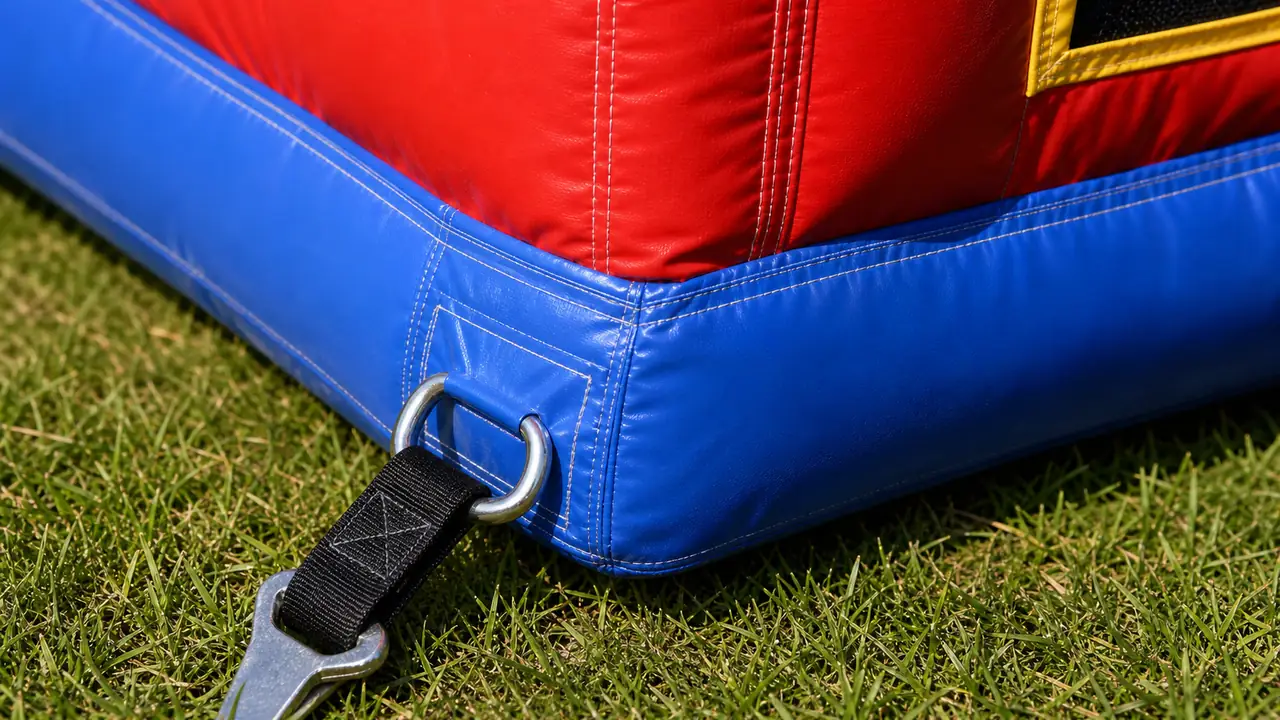
The practical implication is that certification cannot be an afterthought bolted on later. The factory has to design and build to EN 14960 from the outset — correct anchor points and anchorage counts, adequate wall heights, proper netting and containment, correct blower sizing and clearly documented user numbers — and then support TÜV inspection with the right paperwork. A manufacturer that already exports to Europe will have this workflow in place. If you are new to the compliance side, our TÜV certification guide walks through what German buyers need to request and verify before an order ships.
One of the biggest advantages of buying direct is OEM and ODM. For a DACH operator, that means an aufblasbare Hüpfburg in your own brand colors, themed to local tastes, printed with your company logo and contact details, and sized to the pitches and venues you actually work. Custom themes help a rental fleet stand out at a crowded Volksfest, and branded units turn every booking into visible advertising. A capable factory will handle artwork, color matching and structural changes as standard rather than as a rare exception.
Sourcing at wholesale scale is where the margin case is won. Most factories work to a workable MOQ and let you build a mixed 40ft HQ container across categories — castles, slides, water units and games in one shipment — which is the most cost-efficient way to import. Understand your FOB versus CIF terms: FOB puts you in control of freight and EU customs clearance, while CIF hands more of the logistics to the supplier. Typical production lead times run around 25 to 45 days depending on volume and customization, so plan orders against the German season — stock needs to clear customs and be inspected well before the summer peak.
Factor EU customs, duties and VAT into your landed-cost model, and confirm that the compliance documents travel with the goods. This is the difference between a smooth clearance and a unit stuck at the port during your busiest weeks. For a category-level view of what to check when building a castle order specifically, the inflatable castle buyer's guide goes deeper on specification and selection.
Consumer-grade inflatables will not survive a rental season, and they will not pass a German inspection. Commercial aufblasbare Spielgeräte are built from heavy-duty 0.55mm to 0.9mm PVC tarpaulin, with reinforced, double-stitched and welded seams at every stress point, and a B1 fire rating where the venue or event authority requires it. These are the specifications that let a unit run day after day, tolerate rough handling and repeated setup, and hold up to the scrutiny that comes with commercial and public use in the DACH market.
Put together — correct EN 14960 build, TÜV-ready documentation, commercial PVC, OEM flexibility and efficient container logistics — a factory-direct relationship gives a German-speaking buyer a durable advantage: better margin, wider selection, full compliance and equipment that earns its keep across many seasons.