Inflatable castles sit at the premium end of a rental fleet's lineup. Parents booking a themed birthday will pay more for a princess turret than a plain bouncer, schools want recognisable shapes for spring fairs, and resorts use multi-zone castles as anchor attractions for family weekends. Castles are also where new operators most often over-buy, mis-size, or commission artwork that lands them in trademark trouble. This guide maps castle format, theme mix, sizing tiers, construction spec, and fleet economics the way a rental consultant would lay them out before you cut a purchase order.
The three formats that dominate rental inventories look similar from the kerb but book very differently. A bouncer is an open-floor jumping unit — four mesh walls, a flat jumping bed, minimal decoration. It is the workhorse of low-budget bookings and school recess. An inflatable castle adds structural walls, turrets, crenellations, and a printed or appliqué theme — most commonly princess, pirate, or generic medieval — to create the enclosed, story-driven play environment parents associate with a "real" themed party. A combo unit pairs a castle or bouncer base with an attached slide, climbing wall, or basketball hoop module; combos extract more entertainment value per booking hour and typically command 30-50% higher rental rates than equivalent-footprint bouncers.
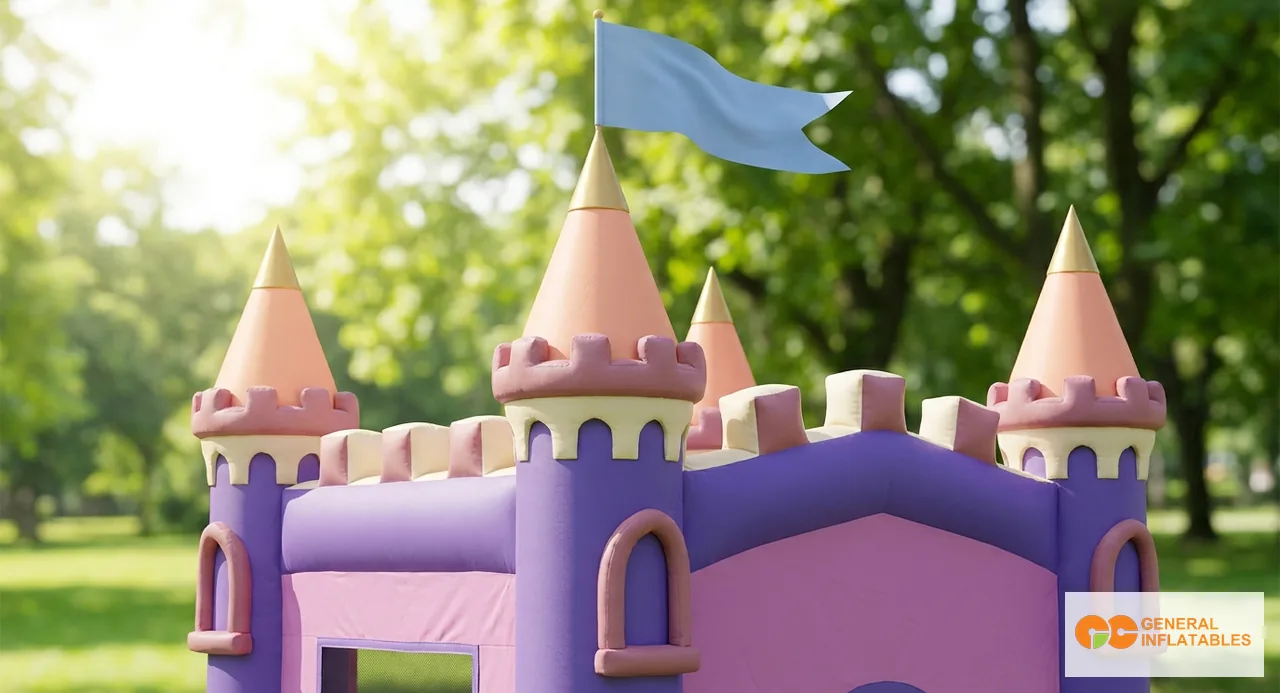
When you browse a manufacturer catalogue of commercial inflatable castles, the format shows in the silhouettes: tall vertical walls, corner turrets, often a front archway, and a roofline that reads as "castle" from across a park. That visual signature is what makes the format premium-bookable, and what drives the construction differences below.
Five theme families cover the majority of castle bookings. Classic princess castles — pink and pastel palettes, heart cut-outs, tall thin turrets — are the highest-demand single theme for the ages 4-7 girls birthday segment, which is the most repeat-booked party category in most rental fleets. Pirate and adventure castles — ship-bow front pieces, mast and sail elements, brown and red palettes — capture the ages 5-9 boys segment and book strongly for mixed-gender school events because the imagery reads as adventurous rather than gendered. Disney-style licensed-look castles have the broadest cross-demographic appeal but carry meaningful IP risk if the artwork uses recognisable licensed character names or copyrighted silhouettes — more on that in Section 6.
Medieval and generic castle designs — grey stone print, neutral banners, no character themes — are the multi-use workhorse: they fit corporate family days, church festivals, civic events, and overflow weekends when the themed units are already booked. Custom-themed seasonal units — Halloween haunted castles, Christmas snow palaces, sponsor-branded brand activations — fill the high-margin tail.
Castle sizing maps cleanly to event type, and getting the tier right is more important than chasing the biggest unit you can afford. Small kids party tier: 3-5 m wide, 4-6 m tall, 4-8 simultaneous riders, fits a typical suburban back garden or driveway. This is your highest-turn unit — short setup, easy transport in a single-axle trailer, three to five bookings per weekend in season. School event tier: 5-7 m wide, 6-8 m tall, 12-18 riders, designed for playground or sports-field deployment with a crew of two. Festival and large public event tier: 7-10 m wide, 8-12 m tall, 25-40 riders, requires a four-person setup crew, blower redundancy, and dedicated queue management.
Resort-grade installation tier: 10 m+ wide, multi-zone castles with attached slide towers, climbing walls, and themed entrance arches, designed for semi-permanent placement and 40+ riders. At this tier, sizing is inseparable from anchoring — turreted units catch wind dramatically more than open bouncers. Review anchor systems for tall structures before settling a footprint, because anchor count and stake length scale with turret height, not floor area.
Themed castles take more material stress than generic bouncers in three specific places: the turret apexes flex more in wind, the front archway carries traffic load every cycle, and printed graphics live under constant UV and abrasion. Material spec recommendations track the sizing tiers above. For a kids-party fleet, 0.55 mm 1000D PVC tarpaulin is the practical minimum — anything lighter cracks at the seams within two seasons. School and festival workhorses should specify 1100D, with reinforced panels at the turret bases and archway threshold. Resort installations operating year-round should go to marine-grade 0.9 mm PVC with UV-stable inks. Our PVC tarpaulin grades reference covers the denier, coating, and tensile thresholds for each tier in more detail.
Two construction details matter more for castles than for bouncers. First, seams should be high-frequency welded rather than sewn wherever printed graphics cross them — printed artwork on sewn seams cracks within one season as the needle holes telegraph through the print. Second, every castle in active rental rotation needs a field repair plan, because turret tips and archway corners are the first failure points; the field repair kit specifications we recommend for rental crews include heat-activated patches sized for turret geometry, not just flat-panel repairs.
The fleet-mix question every growing rental operator faces is whether to deepen a single format — say, six identical generic bouncers — or diversify across themes. The booking data points clearly toward diversification at the premium end. Parents booking a themed birthday will pay a 20-40% premium for theme match, and they will book around your availability if you are the only operator in town with the right princess or pirate unit. A diversified theme fleet also smooths weekend booking peaks, because different themes draw different customer segments who do not compete for the same Saturday slot.
The trade-off is inventory carrying cost and crew training. Themed castles take longer to set up correctly — turrets must inflate symmetrically, archways must align, theme pieces must face the photo angle — and crew turnover means recurring training overhead. A practical starter ratio for an operator scaling past one truck is two to three themed castles per five to seven generic bouncers. As you scale past three trucks, the themed-unit share can rise toward parity, particularly if you add Halloween and Christmas seasonal units.
Buyers commissioning custom castles need to think about intellectual property before artwork. Four rules keep commissions out of trouble. First, use original artwork or properly licensed designs only — a signed licensing agreement with the rights holder, not a verbal assurance from a designer. Second, avoid look-alike copies of trademarked characters; major film studios, comic publishers, and professional sports leagues actively enforce against inflatable look-alikes, and a single takedown letter can sideline a unit for the season. Third, commission "inspired-by" generic themes — a princess castle without a specific princess identity, a superhero castle with original silhouettes — for safest broad-market use. Fourth, plan four to six weeks for theme approval and artwork iteration on top of standard production lead time, since most rejections happen on the second or third proof.
If you are commissioning a custom or sponsor-branded castle for the first time, the custom-branded artwork specification workflow walks through the proof stages, file formats, and colour-management steps that keep an artwork project on schedule. Locking down your first custom unit pays back across every themed commission afterwards.
What's the difference between an inflatable castle and a bounce house?
The distinction matters when you are pricing rental tiers and writing a booking catalogue. An inflatable castle is themed architecture — turrets, crenellations, a drawbridge or archway entrance, and printed or appliqué artwork in a princess, pirate, or medieval style. A bounce house is the generic bouncing platform: typically rectangular, four mesh walls, a flat jumping bed, no story-driven theming. Both share the same core bouncing function and the same blower and safety hardware, but castles command premium rental pricing on themed-birthday and brand-activation bookings because parents and event planners pay for the photo backdrop and the story. Wholesale buyers stocking a balanced fleet keep castles for the premium themed slots and bouncers as the everyday rotation workhorses, often browsing the same commercial castle catalogue alongside generic bouncer SKUs to plan the mix.
How long does an inflatable castle last in commercial rental use?
A castle built for commercial rotation should give you 8-12 years of useful service life when fleet care is disciplined. Three factors set the upper end of that range. The base material has to be 1100D PVC tarpaulin or heavier with high-frequency welded seams at every panel join — sewn seams will telegraph print cracks and leaks long before the fabric itself fails. An annual deep inspection cycle catches turret-tip wear, archway abrasion, and blower-tube fatigue before they become structural failures, and a small repair budget allocated per unit each season keeps minor damage from compounding. Replacement is usually triggered by recurring repairs on the same panel, visible UV fade that hurts photo bookings, or a structural seam failure that no longer holds a patch.
What sizes are commercial inflatable castles available in?
Commercial castle catalogues group into four practical size tiers that match rental event types. Compact 3x3 m units suit ages 3-8 and hold 8-15 simultaneous users, ideal for backyard birthdays and indoor venue bookings. Standard 4x4 m units serve mixed-age bookings with 15-25 user capacity and are the highest-turnover SKU in most fleets. Large 5x5 m and bigger units accommodate 25-40 mixed-age users and anchor school fairs, community festivals, and corporate family days. Combo castles integrate a slide, climbing wall, or obstacle section into the castle footprint, extending booking value per setup. Choosing the tier by event type rather than chasing the largest unit you can afford keeps utilisation rates and transport costs balanced.
Can I custom-brand an inflatable castle with my company logo?
Yes, and the options scale with how much customisation you need. Logo placement is straightforward on the entry arch, the side panels, or a roof banner above the turrets, and most factories will accept vector logo files in standard print formats. Custom colour matching to a brand palette is available on stock moulds with a small additional setup fee. Full OEM work — a new mould, original silhouette, custom theme — typically carries a minimum order of 5-20 pieces depending on size and complexity, with a lead time of 25-45 days. ODM work, where you take a catalogue silhouette and swap in your branding and colours, runs at 3-5 piece minimums and 15-25 day lead times. The OEM vs ODM decision guide walks through which path fits which buyer scenario.
What's the wholesale MOQ for ordering commercial inflatable castles?
Minimum order quantities depend on how much customisation you ask for. Stock catalogue designs in standard colourways typically have a 1-3 piece MOQ, which makes them practical for first-time buyers testing a supplier or topping up a single SKU. Stock designs with custom colour matching to your brand palette move the MOQ to 3-5 pieces because the factory has to set up new ink batches. Full OEM custom themes with new artwork and tooling run 5-20 piece MOQs depending on size and complexity, since the mould and pattern work has to amortise across the run. Mixed-SKU container loading is the practical lever that lets growing fleets order smaller per-unit volumes — a single 40HQ container can carry six to twelve castles across multiple themes and sizes.
What certifications do commercial inflatable castles need?
The certification stack depends on your destination market but the core set is consistent. EN 14960 is the European standard for commercial inflatable play equipment safety and is the baseline document European insurance underwriters expect to see. ASTM F2374 is the equivalent standard for the Americas. EN 71-2 and CPAI-84 cover fire retardancy of the PVC material itself and are typically required for any unit going into indoor venues or public events. Material test reports — PVC coating weight, tear strength, UV resistance — should come from the factory with each shipment and form the basis for any insurance claim involving material failure. Annual third-party inspection is required for ongoing insurance compliance in most commercial rental markets; the spec sheet reading guide explains how to verify each certification line item before you sign off on a shipment.
For Spanish-speaking markets, castles are the top rental staple — see our dedicated castillos inflables sourcing guide for importing and wholesale into LatAm and Spain.
Tell us your target theme mix, event size, and venue type, and we will return a fleet proposal — castle list with theme variants, size tiers, material upgrades, and container shipping plan — typically within five business days.