Wet vs Dry Inflatable Combos: Year-Round Fleet Strategy
Every rental operator in a four-season market eventually hits the same wall: half the year your water slides sit in the warehouse, the other half your dry castles do. A properly engineered wet dry inflatable combo solves that idle-inventory problem — but only if you buy the right unit, switch it correctly, and build the surrounding fleet around it. This guide walks through the engineering, the ROI math, the seasonal switching SOP, and the fleet ratios we see working in the field.
1. Engineering Differences: What Makes a Unit Truly "Wet/Dry"
Plenty of suppliers slap a "convertible" label on a standard combo and call it done. A genuine dual-use bounce house has five engineering markers buyers should verify before signing a PO.
- Welded seams, not stitched, on every water-facing surface. Stitching wicks moisture into the substrate, and within two seasons you see delamination along the seam line.
- Slide-surface treatment differs by mode. Wet-capable slides use smooth, non-porous PVC for low-friction sliding under water flow; dry-only slides use textured grip surfaces. A true convertible uses a smooth surface and accepts both uses — operators just adjust the climbing-side grip pads.
- Drainage design with integrated bottom drains that can be plugged for dry operation. Cheaper "convertible" units omit drainage entirely, which traps residual water and breeds mold during winter storage.
- Anchor reinforcement rated for wet load. Water adds roughly 30–40% to effective dynamic load because sliding users transfer momentum differently on a wet surface. Anchor patches should be doubled and the D-rings rated accordingly.
- Blower compatibility with GFCI-protected outlets. This is the detail most first-time buyers miss: some 110V US-spec blowers won't run cleanly off a GFCI circuit, which is mandatory for wet operation. Confirm the blower in the quote is wet-rated or that the factory supplies a second wet-rated unit.
2. Seasonal Usage Pattern: Real Operator Data
The economics of a convertible only make sense if you understand your market's wet/dry split. Pattern data we collect from operators across regions shows four clear archetypes.
- Northern climates (Canada, UK, Northern EU): May–September wet operation drives about 60% of annual revenue; October–April dry covers the remaining 40%. Convertibles are almost mandatory here.
- Mediterranean and coastal (Spain, Italy, California): April–October wet at roughly 70%, November–March dry at 30%. Strong case for a wet-heavy fleet with convertibles filling shoulder seasons.
- Subtropical (Florida, Australia, UAE off-season): Year-round wet is viable, 90%+. Here, dedicated wet units win on cost; convertibles are less critical.
- Continental (Midwest US, Central EU): The most balanced split — 50% wet May–September, 50% dry October–April. This is where convertibles pay back fastest because both modes carry equal weight.
3. ROI Math: One Convertible vs Two Single-Mode Units
The investment case for a convertible combo inflatable rests on five variables, not just sticker price. For operators sizing a multi-unit order before committing capital, our inflatable combo wholesale guide breaks down how bouncer, slide, and climbing combos are priced and bundled at volume.
- Acquisition cost: A single convertible unit lands at roughly 75–85% of buying a new water slide plus a new dry combo separately. You're not saving 50% — you're saving 15–25% of the combined cost, plus everything else below.
- Storage footprint: 50% of two-unit storage. For operators paying commercial warehouse rates, this alone often justifies the upgrade within 18 months.
- Transport efficiency: One truck load per revenue event instead of two when the customer wants both modes (popular for full-day school carnivals that run dry morning, wet afternoon).
- Booking flexibility: You can confirm any event regardless of the 10-day weather forecast. In shoulder seasons (April, October), this single factor protects 10–15% of bookings that would otherwise cancel or get downgraded.
- Maintenance overhead: The honest trade-off — convertibles add roughly 15–20% to maintenance hours because of dual-mode inspection cycles and the additional surface care.
Break-even analysis in the field: a convertible needs about 30+ rental days per year across both modes combined to beat owning two dedicated single-mode units. Below that utilization, two specialized units are cheaper to operate.
4. Seasonal Switching SOP
The switch itself is where most operators lose money — either by skipping steps and damaging the unit, or by over-engineering the process. Two SOPs, refined from years of operator feedback:
Dry → Wet (spring transition, ~2 hours per unit, 2 crew):
- Inspect waterproof seam integrity end-to-end; pressure-test for leaks at working PSI for 20 minutes.
- Unblock drainage ports; install or verify drain plugs as needed for the target slide configuration.
- Switch to GFCI-protected blower, or verify the existing blower carries a wet rating.
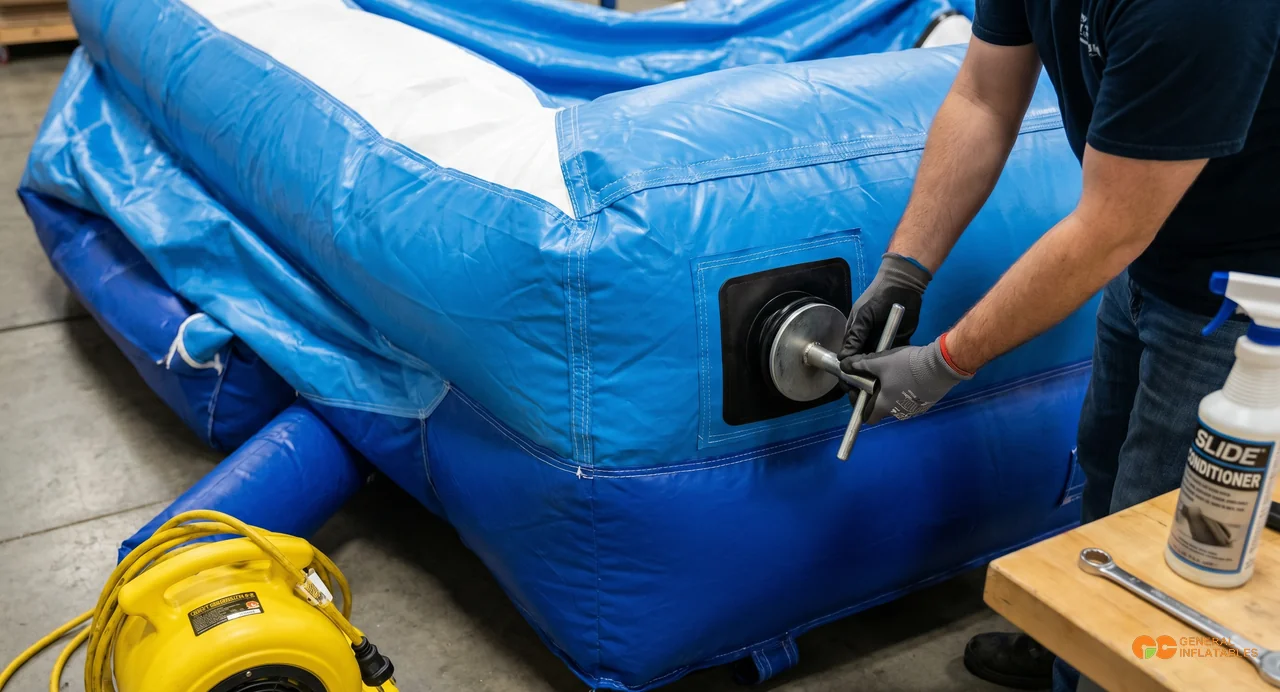
- Apply slide surface conditioner — UV protectant plus grip enhancer on climbing zones.
- Update insurance rider to "water amusement" classification before the first booking.
Wet → Dry (autumn transition, ~3 hours per unit, 2 crew):
- Deep-dry the interior — residual moisture is the #1 cause of mold during winter storage. Blow air through for at least 60 minutes after surface drying.
- Block drainage ports; install dry-mode floor liner if the model uses one.
- Surface-check for chlorine damage. Pool-water exposure is cumulative; a yearly check catches degradation before warranty expires.
- Switch back to standard blower.
- Notify insurance to drop the water-amusement rider — lower classification means lower premium for the dry season.
For a deeper look at protecting units through the off-season, our off-season storage SOP guide covers humidity control, fold patterns, and inspection cadence that pair directly with the wet-to-dry switch.
5. Fleet Composition Recommendations
Fleet ratios matter more than individual unit specs. A 5-unit starter fleet built for a balanced continental market should look like this:
- 2 convertible combos — your shoulder-season workhorses, booked across both modes.
- 1 dedicated water slide — peak summer overflow when convertibles are all booked wet.
- 1 dedicated dry bounce castle — the winter party staple that keeps revenue flowing November–March.
- 1 obstacle course — year-round demand, with sub-segments that can swap between modes for variety.
Mature fleets at 20+ units should hold the ratio at roughly 40% convertible, 30% dedicated wet, 30% dedicated dry. The split optimizes peak-season capacity — when July hits and every wet unit is booked out, you don't want your fleet too heavily weighted toward convertibles that have to absorb dry-mode requests they could be filling at premium wet rates. Operators expanding the wet side typically start with a dedicated water combo unit sized to their largest typical venue.
6. Buyer Checklist for Wet/Dry Convertibles
Before signing the PO on any all-season inflatable, walk through this five-point verification. If the factory hesitates on any of these, walk away.
- Confirm welded (not stitched) seams in every water-contact zone — request photo evidence of the seam construction process.
- Verify drainage port count: minimum two ports for any unit over 4 meters in footprint, positioned at opposing low points.
- Confirm the factory supplies both blower types (or one verified dual-rated blower) inside the quoted price, not as an add-on.
- Request a 24-hour pressure-loss test report for wet-mode operation — a credible factory runs this routinely.
- Read the warranty fine print: many warranties exclude chlorine exposure damage. Get coverage for treated-water use in writing before payment.
For operators still finalizing the dry-mode workhorse side of the fleet, our commercial bounce castle buyer guide covers the dry-only spec details — floor weight, vinyl gauge, jumper capacity — that complement the wet/dry decision framework above.
A year-round inflatable rental business isn't built on individual unit purchases — it's built on a fleet plan that maps engineering, ROI horizons, and seasonal demand into one rotation strategy. Get the convertible-to-dedicated ratio right, and the inventory works twelve months instead of six.
Designing your year-round fleet rotation?
We help rental operators spec convertible inflatables with the right drainage, seam, and surface treatments matched to their target market's wet/dry split. Browse our water slide catalog and request a fleet composition proposal sized to your seasonal pattern.
Planning to buy inflatables for your rental business or event?