
An inflatable bungee run is a head-to-head competition game where two or three players sprint down parallel inflatable lanes while tethered to an elastic bungee cord. Each racer tries to plant a marker as far down the lane as possible before the cord snaps them back to the start. The velcro sticky wall — also called a jump-and-stick wall — pairs a small trampoline or launch pad with a velcro-faced inflatable wall: players wearing a full velcro suit bounce up and stick to the wall in whatever pose they land. Together these two units are the classic novelty-competition pairing found in rental fleets, family entertainment centers and corporate event kits worldwide.
This guide covers both formats, the mechanical systems that make them work, construction and materials, safety supervision, and the sourcing details B2B buyers need — MOQ, container loading and OEM branding.
The standard two-lane bungee run is a long inflatable base — typically 8 to 12 metres — split by a raised centre wall so two competitors race side by side without colliding. Each player clips into a padded waist harness connected to a heavy-duty elastic bungee cord anchored at the start end. As they run forward, resistance builds; the goal is to reach further than your opponent and slap or plant a velcro marker strip on the lane before the cord pulls you back onto the cushioned base.
Three-lane versions exist for higher-throughput venues that want to run more players per cycle. The inflatable walls, cushioned floor and centre divider absorb the snap-back, so the pull-back is fun rather than jarring. For operators, the appeal is throughput and repeat play: a single race lasts 20 to 40 seconds, so a two-lane unit can cycle dozens of players per hour with strong queue turnover.
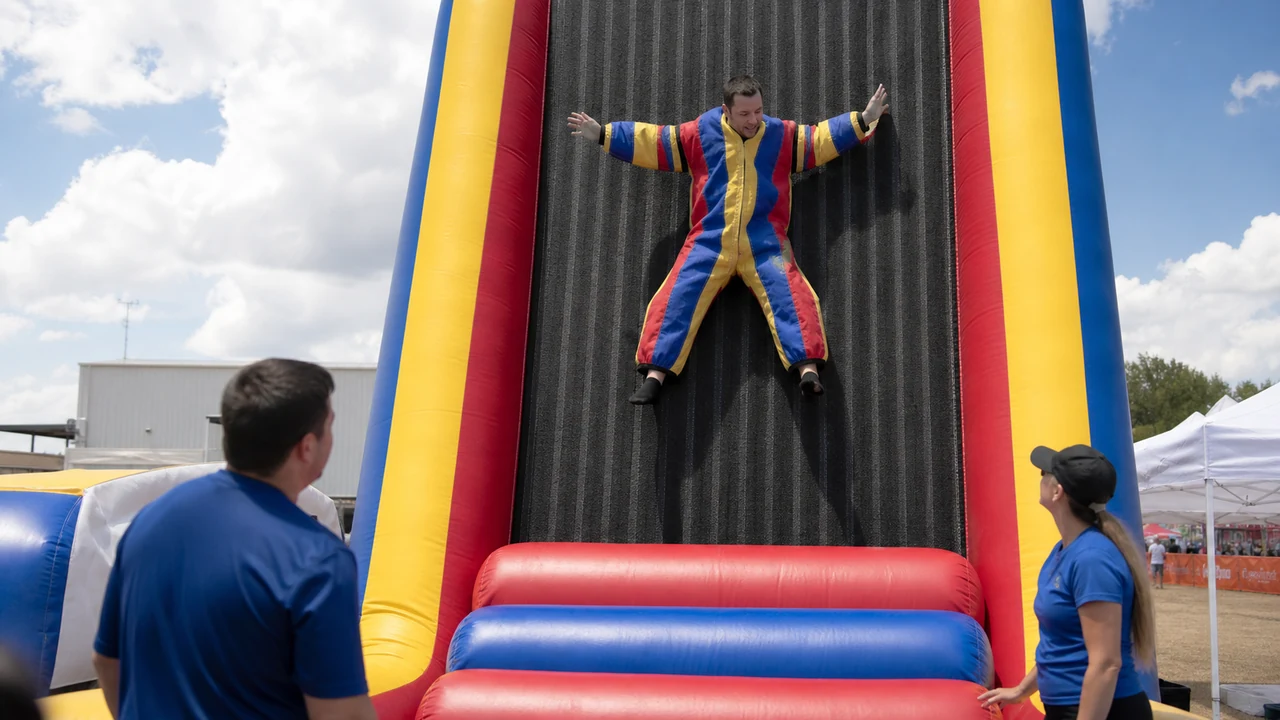
The inflatable sticky wall flips the format from racing to comedy. A padded launch platform — either a low trampoline bed or a sprung jump pad — sits in front of a tall inflatable wall faced with industrial loop velcro. Players zip into a one-piece velcro suit (the hook side), take a running bounce, and throw themselves flat against the wall. Whatever pose they land in, they stick — starfish, upside-down, mid-leap. It photographs brilliantly, which makes the velcro jump wall a magnet for social sharing at activations and brand events.
Most walls offer two or three landing zones so multiple players can compete for the highest or most creative stick. Suits are supplied in a range of sizes so venues can serve children through adults from the same unit.
Both units are built for commercial daily-rental duty, not backyard use. Core specifications buyers should confirm:
The bungee run and velcro wall are staples of any commercial inflatable sports range, sitting alongside obstacle courses, jousting pedestals and gladiator platforms. They belong specifically to the interactive competition games category — units built around head-to-head play rather than free bouncing. For a broader look at how these fit a rental catalogue, our overview of inflatable interactive and competition games maps the full lineup.
Buyers assembling a competition-focused fleet often pair the bungee run and velcro wall with elimination-style games. If you are weighing your options, compare the format against inflatable wipeout and big baller eliminator games, which serve larger groups and longer play cycles. For corporate and team-building bookings specifically, our guide to inflatable sports games for corporate events shows how novelty competition units drive engagement at brand activations.
Both games are supervised attractions and should never run unattended. Core operating rules:
The core buyers are rental and event operators who need high-utilisation, photogenic units: FEC operators building indoor competition zones, event and activation companies serving corporate clients, school and community fun-day suppliers, resort and holiday-park recreation teams, and regional distributors stocking a rental catalogue. The shared advantage is fast play cycles and low staffing — one attendant can run a two-lane bungee run, keeping labour cost per player low and ROI strong across a season.
These units ship well because they deflate to a compact roll. A two-lane bungee run and a velcro wall each pack into a heavy-duty carry bag with its blower. For sourcing:
Because the games are modular and low-maintenance, they suit both operators buying a first competition unit and distributors building a full rental line. Wear items — cords, harnesses and suits — should be ordered with spares to keep utilisation high through peak season.
The inflatable bungee run and velcro sticky wall remain two of the most reliable earners in a novelty-competition fleet: simple to run, fast to cycle and endlessly shareable. Confirm the 0.9mm PVC spec, blower rating, harness and velcro quality, and your OEM branding needs before ordering.