Inflatable Wipeout & Big Baller Games: Revenue Per Hour, Wipeout vs Big Baller & OEM Buyer's Guide
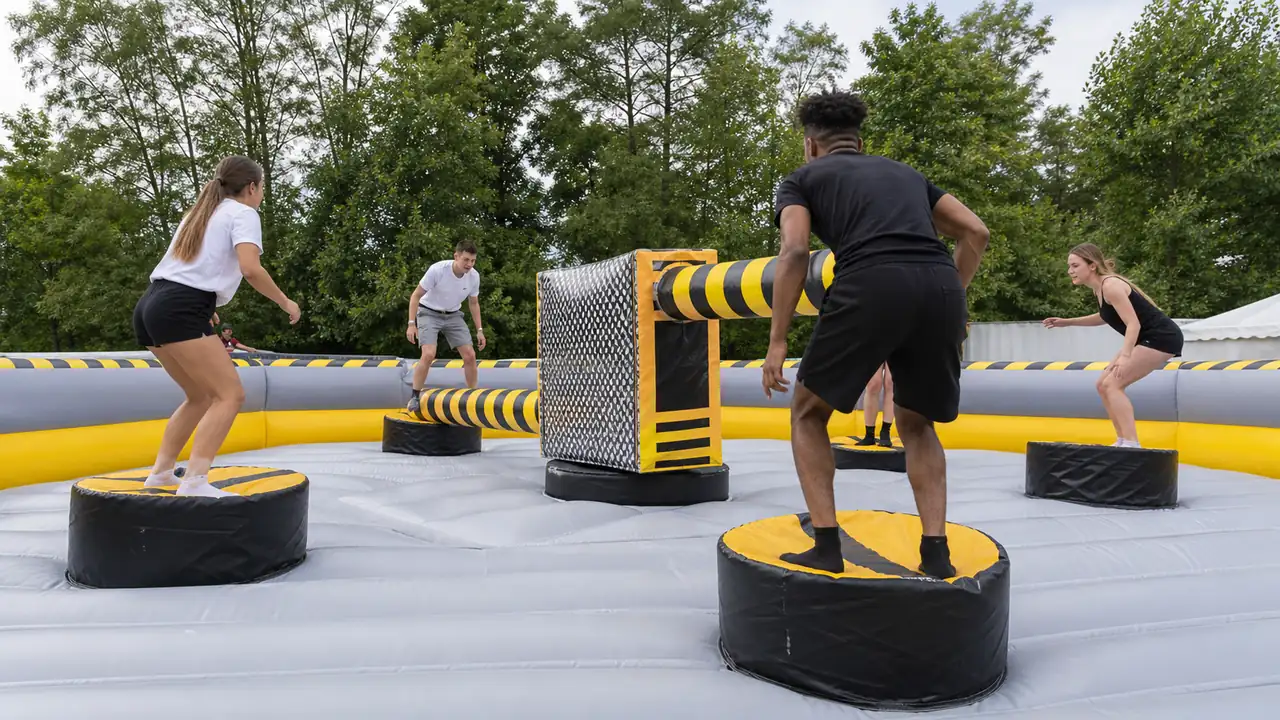
An inflatable wipeout game is a supervised "last person standing" attraction built around a rotating sweeper arm that spins across a ring of inflatable podiums, knocking contestants off into a soft-fall landing. The big baller variant swaps the arm for a row of four giant red inflatable balls that players leap across without falling into the water-free pit below. Together these are the marquee eliminator formats for FECs, festivals, corporate activations and TV-style events — a category that draws crowds, spectators and repeat play like few other inflatables.
This guide covers the core formats, the mechanical rotating unit, base and material specs, safety requirements for a higher-risk supervised ride, and the export terms buyers need — MOQ, container loading, FOB/CIF and OEM/ODM.
The three core formats
Most factory catalogues build this category from three closely related products. Understanding the differences helps you match the ride to your footprint and staffing.
Rotating sweeper / meltdown arm. A central mechanical boom rotates over four or six inflatable podiums. Contestants stand on the podiums and jump or duck as the arm sweeps past; anyone knocked off drops onto the inflatable landing. Speed is operator-controlled, so the same unit runs gentle for kids and fast for adults.
Big baller leap. A row of four oversized red inflatable balls sits above a soft inflatable base. Players run and leap from ball to ball, trying to cross without slipping into the gap. It is pure physical comedy — huge spectator appeal and very fast throughput.
Wipeout combo. A larger platform that integrates the sweeper arm and the big baller run in a single inflatable base, replicating the full "total wipeout" TV course. This is the highest crowd-draw option and the best fit for FECs and large festivals with the space to install it.
The sweeper arm is what separates a wipeout game from a standard inflatable — it is a genuine mechanical ride, not just stitched PVC. The rotating unit is powered by an electric geared motor mounted in a protected central hub. Key points buyers should confirm:
Motor and gearing. A low-RPM geared electric motor drives the boom smoothly; the reduction gearing delivers torque at safe rotation speeds rather than raw spin.
Speed control. A variable-speed controller lets the operator dial rotation up or down between rounds. This is the single most important operational feature — it is how one unit serves mixed age groups safely.
Padded arm. The sweeper boom is wrapped in foam and PVC so contact is a soft push, not an impact.
Emergency stop. A clearly marked cut-off lets the attendant halt rotation instantly if a player stumbles.
Confirm the motor voltage matches your market (many export buyers need dual-voltage or a specified 110V/220V build) and that a spare motor and controller ship with the unit or are stocked as OEM parts.
Base, podiums and material construction
The inflatable structure is built from 0.9mm reinforced commercial PVC tarpaulin — double- and quadruple-stitched at stress seams, with heat-welded air-holding chambers. The specification set that matters:
Base and podiums. 0.9mm PVC platform with four to six raised podiums for the sweeper format, sized so players have stable footing between sweeps.
Big baller balls. Four giant balls in high-visibility red, anchored to the base so they hold position while absorbing impact and rebound.
Soft-fall landing. A continuous inflatable landing surface fills the gaps and surrounds the ride so every fall lands on cushioned PVC, never on the ground.
Continuous-airflow blower. These units use continuous-airflow blowers — the base stays inflated during operation, with one or more blowers sized to the platform. Buyers should confirm blower count, wattage and market plug type.
Anchoring. Heavy-duty D-ring anchor points around the perimeter for stakes on grass or ballast/water weights on hard surfaces.
Safety: a supervised, higher-risk ride
This is not a bounce house you can leave unattended. A wipeout or big baller game is a higher-risk attraction and must be run as a staffed, supervised ride at all times. Build these requirements into your operating plan:
Trained operator plus spotters. One attendant controls speed and the emergency stop; additional spotters watch the fall zones and help players out.
Speed matched to riders. Start slow, brief every group, and only increase arm speed for confident adult players.
Clear soft-fall zones. Keep the inflatable landing free of obstructions and never exceed the rated rider count per round.
Pre-use checks. Inspect seams, blower operation, anchor tension and the motor hub before each session.
Standards alignment. Reputable factories build to recognised inflatable standards such as EN 14960 and ASTM; confirm which apply to your import market and request the documentation.
The crowd-draw and spectator value make this category a strong performer across several buyer types:
FECs and trampoline parks — a permanent headline attraction that drives ticket upsells and social sharing.
Event and TV-activation companies — the go-to "total wipeout" experience for brand activations and televised game formats.
Rental operators — high day-rate hire units with strong repeat demand for festivals and corporate fun days.
Resorts and hotels — a premium guest activity that anchors a family entertainment programme.
Distributors — a differentiated, higher-margin line versus commodity bouncers.
Because the format thrives on competition and spectators, it also fits neatly into the team-building programmes described in our guide to inflatable sports games for corporate events.
Revenue potential for rental and event operators
A big baller inflatable earns on a ticket or timed-session basis, and the spectator draw is what pushes revenue per hour above a standard bouncer or slide — bystanders watching a game in progress convert into the next paying group faster than a unit without an audience component. Event rental pricing for wipeout and big baller units typically commands a premium day-rate over comparable-size inflatable water games because the format doubles as entertainment for both participants and onlookers, which operators can price into corporate and festival bookings specifically.
The trade-off is supervision cost — this category needs a trained operator running the motor and managing turns throughout the booking, which is a real labor line that should be built into the day-rate rather than treated as free. For the utilization and payback math that applies to any attraction-grade inflatable investment, see our rental fleet ROI guide. If you're weighing a wipeout-format unit against a water-based alternative like bumper boats for the same rental fleet slot, our wipeout vs big baller vs bumper boats comparison for USA operators breaks down the revenue and staffing differences between formats.
MOQ, container loading and OEM/ODM
These are large, motorised units, so export logistics matter. Typical terms from a factory build:
MOQ. Low minimums — a single unit order is usually accepted, with better pricing on mixed-format containers.
Container loading. A standalone big baller or sweeper packs into a 20ft container; a full wipeout combo plus blowers, spares and accessories is better suited to a 40ft HQ container. Confirm packed dimensions and weight before booking.
Trade terms. FOB from the loading port or CIF to your destination — request both so you can compare landed cost.
OEM/ODM. Custom branding on the balls, podiums and arm, bespoke colourways, market-specific voltage, and fully custom platform dimensions are all standard ODM options for buyers ordering to spec.
On ROI, the numbers favour this category: high per-play throughput, strong spectator conversion, premium hire rates and long service life from 0.9mm PVC and a serviceable motor mean utilisation stays high across a multi-year asset life. Spec the motor, speed control and spares carefully, plan the staffing, and a wipeout game becomes one of the highest-earning inflatables in your fleet.