Rental operators and FEC buyers building out a water-attraction lineup often ask the same question in different words: which of the big three — bumper boats, wipeout/sweeper-arm games, or big baller — actually earns the most per square foot of arena space? Each is a spectator-driven, higher-ticket attraction, but they differ meaningfully in install time, footprint, maintenance frequency, and how the revenue actually accrues. This guide puts the three side by side.
A bumper boat is a motorized, ride-ticket attraction — riders pilot individual inflatable boats in a contained pool, colliding by choice rather than by game mechanic. See our bumper boat sourcing guide for construction and specs.
A wipeout game is a mechanical rotating-arm attraction: a motorized sweeper arm knocks participants off a raised platform into a landing surface, run as a timed elimination game with spectators watching from around the perimeter. A big baller unit is a similar mechanical-game format — participants navigate or balance against a moving element, also spectator-driven and typically run as timed rounds. Both formats live in the same product family; see our wipeout and big baller buyer's guide for the detailed format breakdown.
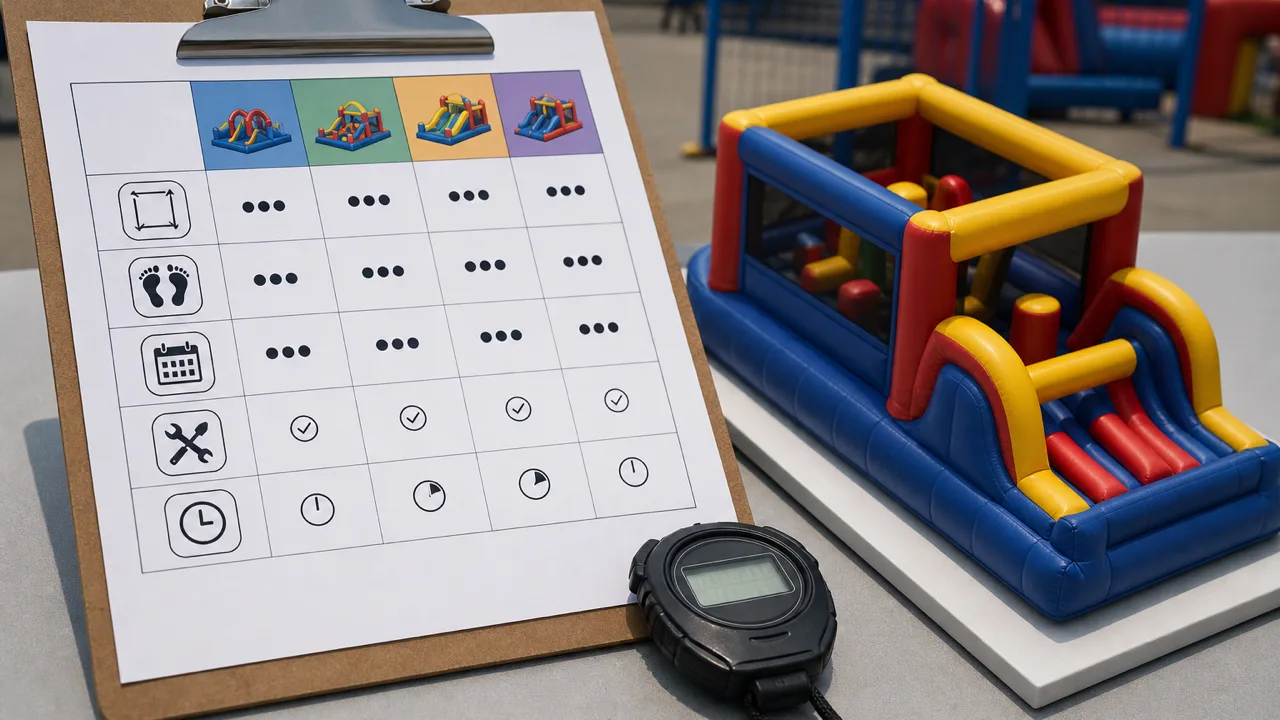
The table below gives the quick scan; the sections after it explain the reasoning behind each row.
| Bumper Boats | Wipeout | Big Baller | |
|---|---|---|---|
| Install time | Longest | Moderate | Moderate |
| Water required | Yes — filled arena | No | No |
| Typical footprint | 10–15 m arena | Platform + clearance ring | Platform + clearance ring |
| Maintenance frequency | Highest | Moderate | Moderate |
| Revenue mechanic | Per-ride ticket | Per-round, multi-participant | Per-round, multi-participant |
| Spectator draw | Moderate | High | High |
| Typical entry capital | Highest — needs a full fleet | Lower — one unit is a complete attraction | Lower — one unit is a complete attraction |
Bumper boats need a filled water arena, pump station, and liner before the first boat goes in, which makes install time and footprint the largest of the three. Wipeout and big baller both set up dry — inflate, anchor, mount the motor — and share a similar platform-plus-clearance footprint, though exact dimensions vary by model. Maintenance follows the same pattern: bumper boats carry a water system on top of the motor and hull upkeep that all three formats share, so they see the highest overall maintenance frequency of the group.
Bumper boats earn per individual rider on a timed cycle, so revenue scales with boat count and utilization — more boats in the water means more simultaneous riders, but also more capital and maintenance committed upfront. Wipeout and big baller earn per timed round with several participants competing at once, which means a single unit can generate meaningful throughput without the multi-boat capital commitment a bumper boat program requires. For operators with a smaller initial budget, wipeout or big baller typically reaches payback faster because the entry cost is lower and one unit is a complete attraction, whereas a viable bumper boat program needs a full fleet and arena to work commercially.
Where bumper boats win is longevity of spectator engagement — riders stay in the water for extended sessions rather than a short timed round, which suits venues where dwell time (and the food-and-beverage spend that comes with it) matters as much as ticket revenue itself.
Bumper boats carry the highest ongoing maintenance burden of the three: motor and battery upkeep, hull inspection, and water system management all run in parallel. Wipeout and big baller units avoid the water-system maintenance line entirely, which meaningfully lowers their total cost of operation even though the core mechanical drive system needs comparable servicing attention to a bumper boat's propulsion units. For operators weighing total operating cost rather than just purchase price, this maintenance gap is often the deciding factor between the formats.
For the utilization-rate and payback-period math that applies across any attraction-fleet investment, see our rental fleet ROI guide.
Family entertainment centers (FECs) with limited indoor-adjacent outdoor space typically start with wipeout or big baller — the dry setup and smaller footprint fit more easily alongside existing attractions, and the lower entry capital makes it easier to test demand before committing further budget. A venue that later validates strong attendance can add a second mechanical unit or graduate to a bumper boat arena once there's room and revenue data to justify it.
Waterparks and resort properties that already run water infrastructure are natural bumper boat candidates — the marginal cost of adding a contained arena is lower when filtration, water treatment staff, and pool maintenance routines already exist on site. Pairing a bumper boat arena with a wipeout or big baller unit nearby gives repeat guests two distinct reasons to visit the same zone, which is where a mixed lineup earns more than either format alone.
Traveling carnivals and seasonal fairs lean toward wipeout and big baller almost by default — both formats break down and transport more easily than a bumper boat arena's water infrastructure, and the faster setup matters when a show only has a day or two at each stop. A touring bumper boat program is possible but requires a portable liner system and a water source at every stop, which adds real logistics overhead most touring operators avoid unless bumper boats are the headline attraction.
Bumper boat fleets are typically ordered as a set — 6 to 8 units per arena is the common commercial configuration, plus a matching liner and pump system, which means the order is sized to the arena from day one rather than scaled up unit by unit. Wipeout and big baller units are usually ordered individually or in pairs, since each unit is a standalone attraction rather than part of a fleet — this lower per-order commitment is part of why they're the easier entry point for a venue testing a new attraction category.
Production lead time runs comparably across all three formats once a factory has a proven design on file, since the differentiating cost driver is the water arena and liner fabrication for bumper boats, not the boats themselves. Confirm liner dimensions against your actual site survey before ordering — a liner cut to the wrong arena diameter is a costly rework that a wipeout or big baller order never risks.
For USA-based rental and event operators specifically, three factors shape which format actually earns its keep. Insurance and liability costs differ meaningfully between the three — a bumper boat program with water and multiple simultaneous riders typically carries a higher liability premium than a single-unit wipeout or big baller attraction, which is worth pricing into your comparison alongside the equipment cost itself. Seasonal demand concentration also differs: bumper boats are largely a warm-weather, outdoor-water-access attraction, while wipeout and big baller units run indoors or outdoors regardless of water access, giving them a longer viable booking season across fairs, corporate events, and indoor FEC installations. State fair and festival circuit operators specifically favor wipeout and big baller for their smaller trailer footprint and faster load-in/load-out between multi-day bookings, compared to the water fill/drain cycle a bumper boat installation requires at each new venue.
Bumper boats, wipeout, and big baller all earn well in the right venue, but they aren't interchangeable investments — bumper boats need more capital, more space, and more maintenance, in exchange for longer per-session engagement; wipeout and big baller reach payback faster on a smaller footprint with a lighter maintenance line. Match the format to your available capital and footprint rather than picking based on spectacle alone.
Browse the inflatable boats category or the mechanical games category for current specifications.