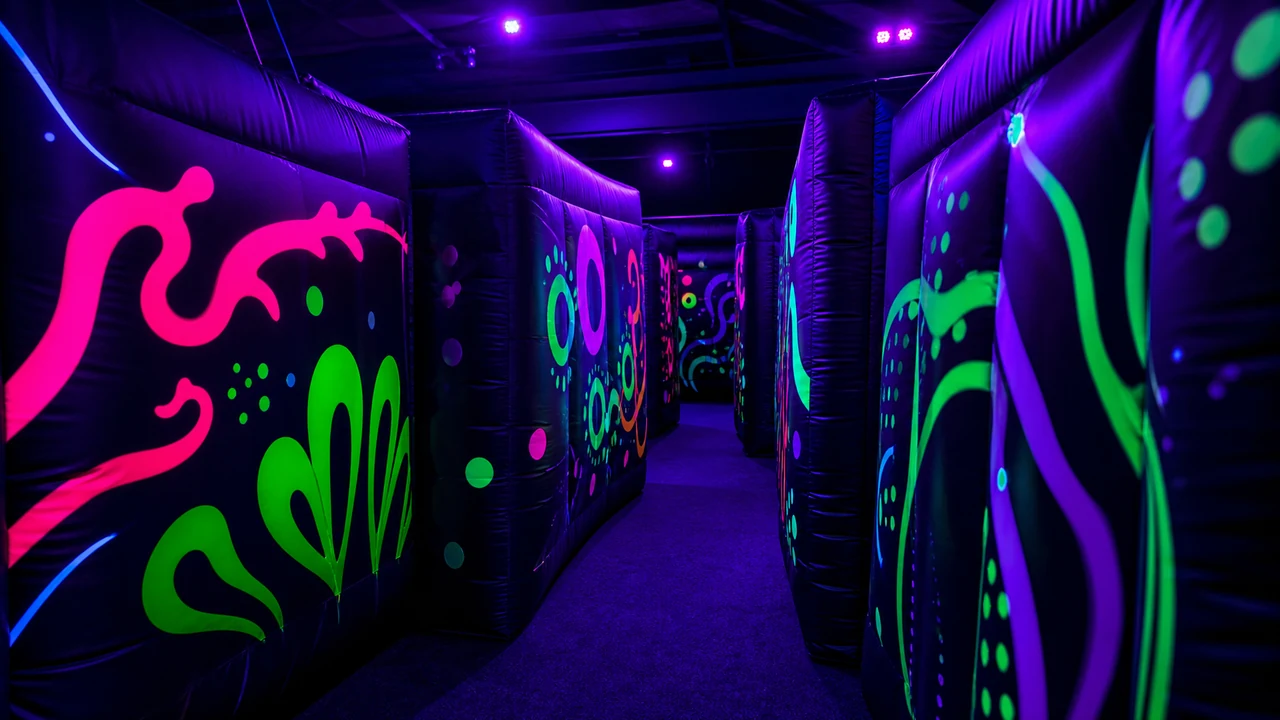
An inflatable maze is a large walk-through attraction built from air-filled walls and internal partitions that form a puzzle path of turns, dead-ends, tunnels and multiple entries and exits. The inflatable fun house takes the same footprint and adds soft obstacles, climb-overs and pop-up barriers, turning navigation into an interactive play zone. Both are high-capacity, low-supervision attractions engineered for continuous throughput at fun centers, schools, fairs and resorts.
Unlike a race-style challenge, a maze is exploratory and navigational rather than timed. If you are comparing formats, the linear sprint experience is a different product entirely; this guide focuses on the walk-through maze and fun house that reward wandering, not speed.
Buyers often lump these together, but the operating model is different. An obstacle course is a linear race down a fixed lane with a clear start and finish; participants move fast and clear the unit quickly. A maze is a dwell-time attraction: guests enter, explore, get pleasantly lost and take their time. That changes capacity math, attendant positioning and the wow factor you sell to your audience.
If your program needs a competitive, timed challenge instead, review our inflatable obstacle course buyer's guide for the linear-race sibling. Many operators run both side by side to cover competitive and exploratory play in one rental package.
All three share the same structural DNA, so a single OEM tooling investment can produce your full range. Operators building a mixed play area often pair a maze with multi-play funland zones to keep younger guests engaged while older kids explore the labyrinth.
The structure lives or dies on wall quality. Commercial-grade mazes use 0.9mm reinforced PVC tarpaulin for both outer walls and internal partitions, double- and quadruple-stitched at high-stress seams. Key build specs to demand from any factory:
Typical footprints run from compact 8 x 8 m school units to giant 15 x 15 m attractions, with wall heights of 2 to 2.5 m to block sightlines from outside while staying supervisable from above. Confirm every unit ships with a repair kit, blower, anchors and a carry bag.
A maze is low-supervision, not no-supervision. The design goal is that one or two attendants can manage a full unit safely. Build your operating procedure around a few essentials:
The throughput and low labor cost make mazes attractive across the export market:
Operators expanding a rental fleet often add a maze alongside inflatable combo units that pack a bouncer, slide and climbing wall and classic bouncers. For fundamentals on the entry-level end of a fleet, our commercial inflatable bouncer wholesale guide covers sourcing basics that apply to mazes too.
The financial case for a maze is dwell time versus labor. Because a single unit can hold many guests at once and needs minimal staffing, cost per guest served stays low while ticket or rental revenue keeps flowing. A fun house combo lifts perceived value and repeat entries, and a UV-glow conversion lets the same footprint earn premium rates at evening events. Across a season, high daily throughput and a long service life on 0.9mm PVC make the maze one of the stronger returns in a commercial inflatable fleet.
For export orders, sample or small-batch MOQ is available, with better pricing at volume. A compact school maze can share a 20ft container with other units; giant mazes and fun house combos typically ship in a 40ft HQ container, and folding layout matters for maximizing cube. Pricing is quoted FOB or CIF to your port.
Full OEM and ODM service covers custom footprints, wall graphics, brand colors, UV-glow theming and packaging. Explore the complete commercial inflatable games range to see how a maze fits alongside the rest of a walk-through attraction lineup, then send your footprint and theme brief for a tailored quote.