
A commercial inflatable bouncer is the simplest unit in the entire inflatable category — a rectangular bouncing platform with mesh safety walls, a single entry step, and a continuous-airflow blower. There is no themed turret, no slide tower, no obstacle architecture. Just a clean jumping surface engineered for repeated impact loads. For wholesale buyers entering the market from Southeast Asia, Africa, or Latin America, the bouncer is the workhorse SKU — the unit that books out every weekend, recovers cost fastest, and carries the broadest age appeal across your rental customer base.
This guide breaks down how to spec, source, and stock bouncers as a distributor or rental fleet operator. We will distinguish bouncers from themed castles, segment by use case tier, recommend a starter fleet mix, and walk through material standards, custom branding MOQs, container loading math, and the certifications international buyers should confirm before placing a PO. Wholesale buyers can browse the full commercial inflatable games catalog to see the SKU range across bouncers, castles, slides, and combos.
The single most common question new wholesale buyers ask is whether to lead inventory with bouncers or with themed castles. The answer is almost always both — but in different ratios. A bouncer is generic, lower per-unit cost, and has higher rental turnover because it appeals to every event type: birthday parties, school field days, community fairs, corporate family days. A castle is a themed premium SKU — princess turrets, medieval keep architecture, pirate galleon overlay — which commands a higher rental rate but appeals to a narrower demographic, typically kids ages 3 to 8 booked for themed birthday parties.
For most rental fleets, the optimal stock ratio is roughly 60% bouncers and 40% themed units. Bouncers do the volume; castles do the premium bookings. Buyers planning to focus on themed birthday inventory should review the themed castle product line alongside this guide, and the dedicated castle buyer guide article covers the theme-by-theme demand patterns we see across international distributors.
Not every bouncer is built to the same standard. The PVC weight, seam construction, blower port spec, and MOQ pricing all shift depending on the end-use environment. Wholesale buyers should specify which tier they are quoting before requesting prices — a Tier 1 backyard unit and a Tier 4 theme-park unit are built on different production lines with different inspection cycles.
For a new rental company placing a first container order, we recommend a balanced five-unit starter package rather than buying five of the same SKU. The mix is designed to cover every booking type your sales team will field in the first season:
A balanced five-unit fleet at typical international rental day-rates recoups its landed cost within 60 to 90 rental days — meaning a single busy season pays the fleet off and any second-season revenue is margin. For ordering strategy, container consolidation, and how to structure your first PO across mixed SKUs, the MOQ and ordering strategy article covers the negotiation levers most first-time importers miss. Once your bouncer rotation is booking out, the combo is the natural upsell, and our inflatable combo wholesale guide breaks down sizing and MOQ for the bouncer-plus-slide-and-climb units.
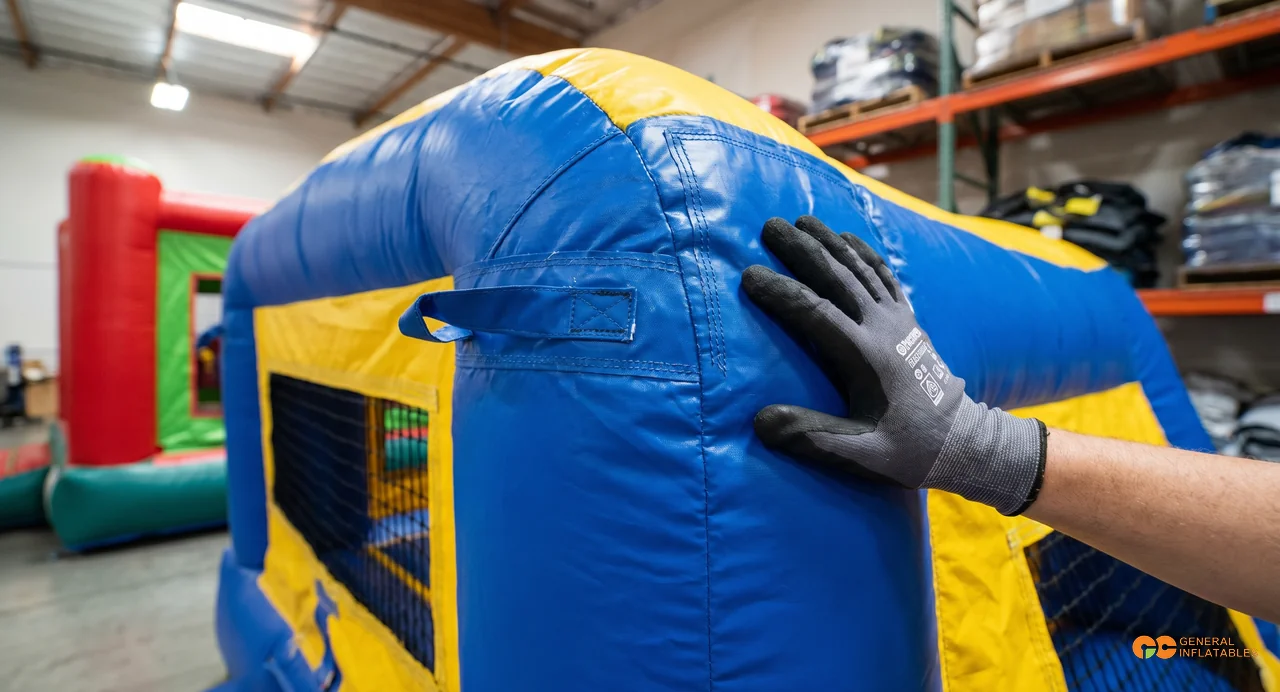
The body panels of a commercial bouncer should be 1000D to 1100D PVC tarpaulin, hot-air welded at all impact-load seams. Stitched seams are acceptable for non-load decorative trim, but never for the jumping floor or the base perimeter — stitching perforates the airtight membrane and creates premature failure points under repeated impact. The mesh safety walls should be UV-stabilized anti-tear netting rated for outdoor exposure; this is the component that fails first on cheap units.
Reinforced anchor straps should be sewn at all four corners and at the center of each long side, with D-rings rated for the unit's full inflated weight under wind load. The blower port is a standard cuff — confirm voltage spec at PO stage: 110V for North America, 220V or 240V for Europe, Africa, Southeast Asia, and most of Latin America. Mismatched voltage is one of the top three first-shipment complaints from new distributors.
Most international wholesalers want some level of branding on their fleet, both for customer recognition and to discourage gray-market resale. Branding options scale by MOQ:
Folded bouncers ship efficiently because they compress to roughly 1.2m x 0.8m x 0.6m per standard 4x4m unit. A 20HQ container holds 10 to 15 standard 4x4m bouncers depending on accessory load (blowers, repair kits, anchor stakes). A 40HQ holds 22 to 30 of the same SKU. Mixed-SKU loads — bouncers plus castles plus combos plus slides — are how experienced importers optimize freight cost per unit, since the different fold shapes pack into the container voids more efficiently than a single SKU.
For international buyers, certification is not optional — it is what your downstream rental customer or end venue will demand before signing a contract. Standard documentation included with every commercial bouncer shipment should cover EN 14960 (European standard for inflatable play equipment), ASTM F2374 (US standard for constant-airflow inflatable amusements), and EN 71-2 for fire retardancy of the PVC material. Material test reports for the PVC tarpaulin should accompany each container.
For rental fleet operators, an annual third-party inspection certificate is what most commercial insurance policies require before issuing liability coverage on inflatable bookings. Confirm with your supplier whether the units ship pre-certified or whether you arrange local inspection on arrival — this affects how quickly you can put new inventory into rental rotation after a container clears customs.
Bouncers are the backbone of a juegos inflables fleet, but Spanish-market buyers sourcing the full range should start with our juegos inflables sourcing pillar.
We ship balanced starter fleets — 2 standard bouncers, 1 large bouncer, 1 themed castle, 1 combo unit — with mixed-SKU container loading and consolidated lead time. Browse our slide catalog and request a starter fleet quote.