
Gladiator joust is one of the highest-throughput games in a rental fleet or fixed FEC lineup, and it's also one of the least written-about — most sourcing guides bundle it into a general "interactive games" roundup without covering the platform variants, padding requirements, or throughput math that actually determine whether it earns its floor space. This guide covers the format on its own: what's on the market, how it's built, and where it fits against adjacent games like battle arenas.
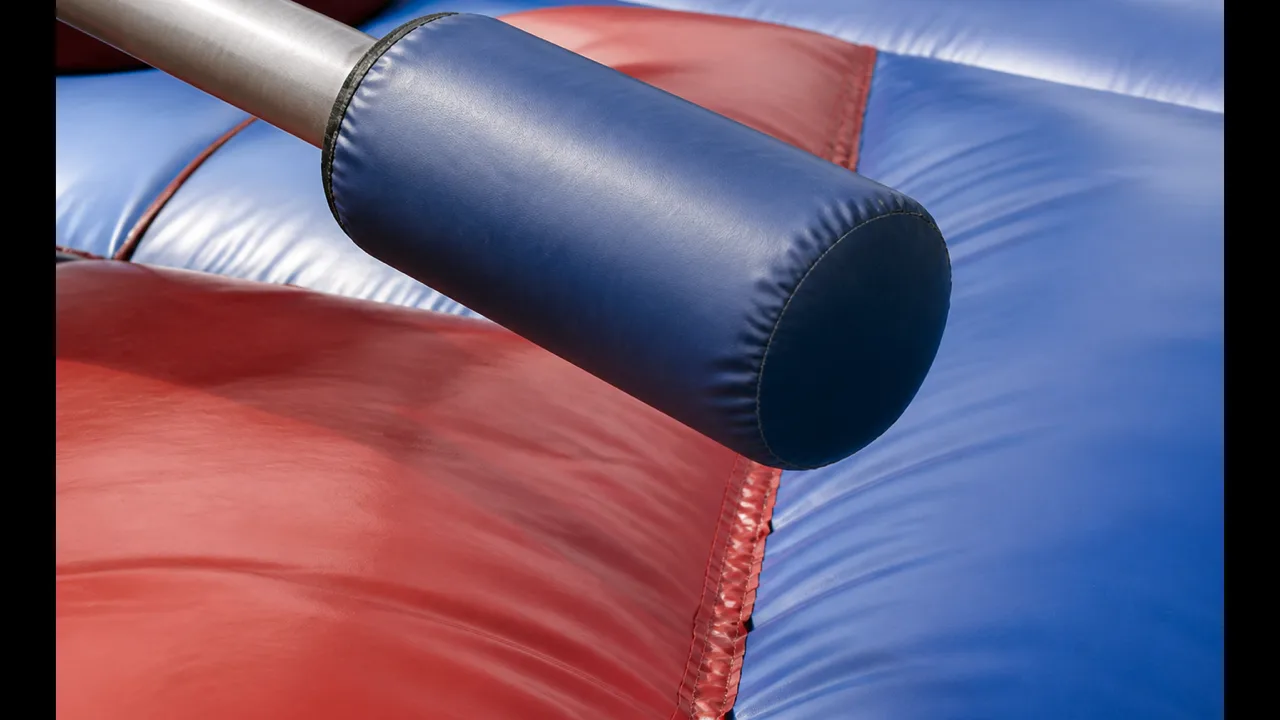
The core format is a raised, padded pedestal — typically 4-5m diameter, 0.6-0.8m off the ground — with two players standing on opposite low platforms or a single shared beam, each holding a padded foam jousting pole. The goal is simple: knock the other player off balance without stepping off your own platform. Two configurations dominate the current product range:
Both formats and the full interactive-games range sit under Interactive Games in our catalog.
The details that actually get checked at EN 14960 sign-off and by most event insurers:
A joust platform cycles two players every 60-90 seconds including the safety briefing — faster than almost any other interactive unit in a typical lineup, where single-rider mechanical games or obstacle courses run 3-5 minute cycles per guest. For a rental operator or FEC charging per-play or per-wristband, that throughput difference is the actual argument for stocking one, more than the novelty factor. It also means one attendant can reasonably run the unit at full capacity without a second staff member, as long as the queue line and safety briefing are handled at the platform edge rather than a separate station.
Joust platforms get bundled with battle-style games often enough that it's worth being explicit about the difference. A joust platform is a 1v1 balance duel on a fixed pedestal — no projectiles, no team play, no bunkers. Battle arenas and combat bunker setups (foam-ball or padded-weapon team combat inside a bunker course) are a different build entirely, with different space and staffing requirements. If you're sourcing team-combat formats instead, our battle arenas & combat bunkers sourcing guide covers that format specifically. For a broader look at how joust fits alongside other interactive and competition games in a mixed lineup, see our interactive & competition games sourcing overview.
Operators most often pair a joust platform with one other high-throughput game (a bungee run or a mechanical ride) rather than two slow-cycle units, since the whole point of stocking it is to keep the line moving during peak hours. It works indoors on a hard flat surface or outdoors on grass with proper anchoring, and it needs less footprint than most obstacle courses or mechanical rides — a real advantage for venues short on space. For mechanical-format rides that pair well alongside a joust unit in a mixed lineup, see Mechanical Games.
How many players can a gladiator joust platform handle per hour?
At a 60-90 second cycle per pair including safety briefing, one platform realistically handles 40-60 players per hour at steady walk-up demand.
Is a themed arena (like a volcano shell) worth the extra cost over a standard round platform?
For fixed-location FECs and venues where the unit doubles as a photo landmark, yes — themed shells drive walk-up interest on their own. For touring rental fleets moving units weekly, the standard round platform is easier to transport and set up, and the mechanical duel experience is identical either way.
Whether you're adding a first joust unit to a rental fleet or building out a fixed interactive-games zone, our team can walk through platform sizing, padding specs, and container loading alongside the rest of your lineup.