Family entertainment center operators buying inflatable play equipment run into a problem that generic product listings don't solve: the safety certification a piece needs depends on which market it's headed to, the right unit for a 3-year-old isn't the right unit for a 10-year-old, and neither number tells you whether the purchase actually pays for itself in a venue with fixed floor space. This guide walks through all three.
This isn't a soft play product catalog — our soft play equipment guide for indoor playgrounds and FECs already covers foam-pit construction and flame-retardant material specs in detail. This one covers the buyer-decision layer above that: which certification applies in which market, how to size equipment to age groups instead of guessing, and how to run the ROI math before committing floor space.
Europe requires EN 71 compliance (toy safety, covering mechanical, chemical, and flammability properties) for equipment marketed to children, while the US market requires CPSIA compliance (lead content limits, phthalate restrictions, and third-party testing for children's products) instead — these are not interchangeable certificates, and a supplier quoting only one doesn't automatically cover both markets. If you operate FECs in multiple countries or are sourcing for a distributor network spanning both, confirm which certification each specific unit carries before ordering, not just which certifications the supplier holds generally across their catalog.
A common and costly mistake is buying one unit sized for "kids" broadly rather than sizing to the actual age distribution of your venue's visitors. As a rough starting matrix: toddlers (ages 2-4) need lower step-in heights and softer wall angles found on smaller bounce castle models; ages 5-8 are the primary market for mid-size combo units combining a bounce area with a slide; and ages 9-12 are where taller obstacle course and climbing-wall units get real usage instead of sitting empty. Buying against your venue's actual age mix, rather than the single most popular unit at a trade show, is what prevents equipment from becoming a corner nobody uses.
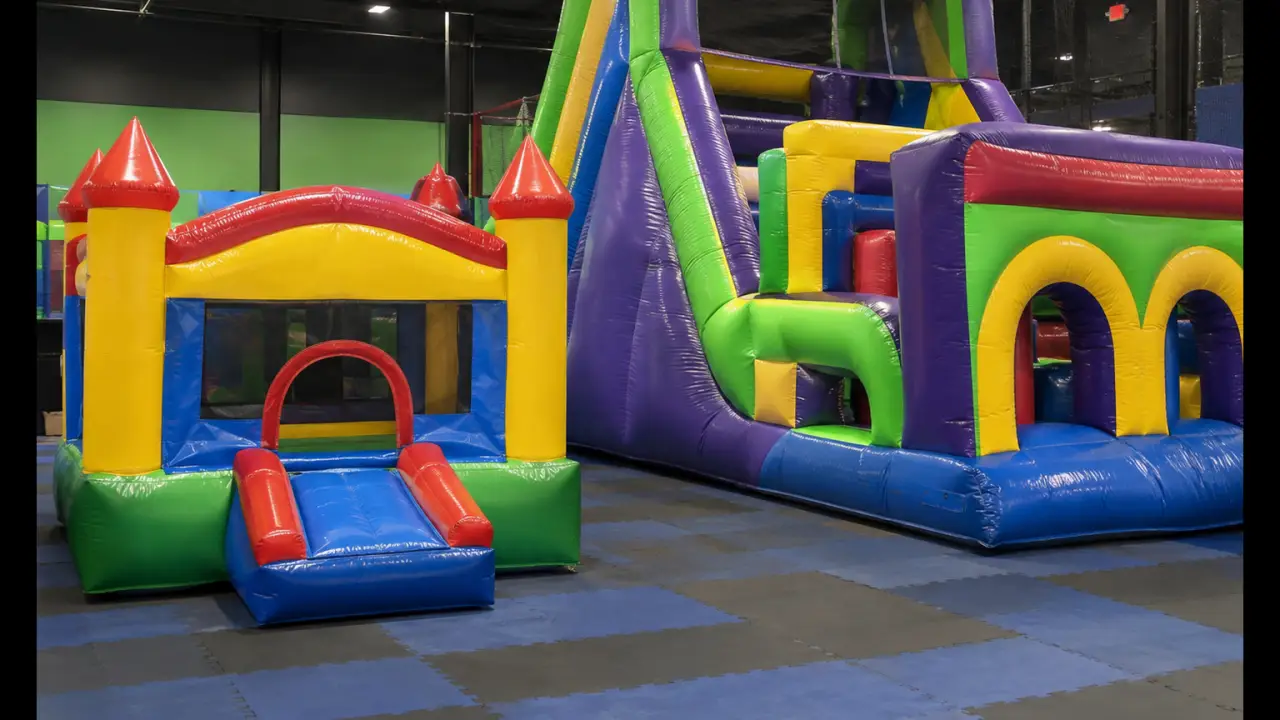
For a fixed-footprint FEC, floor space is the scarcest resource, and the right ROI question isn't "what does this unit cost" but "what does this unit earn per square meter per month compared to the alternative use of that space." Factor in expected daily throughput at your venue's typical visit duration, seasonal demand swings if your FEC isn't climate-controlled, and the unit's realistic replacement cycle (5-7 years under continuous commercial use is a reasonable planning assumption) before comparing quotes. A larger unit with higher upfront cost can still be the better ROI choice if its throughput-per-square-meter beats a cheaper, smaller alternative once occupancy is accounted for.
FEC buyers ordering multiple units for a new venue or a multi-location rollout should plan container loading around unit size early in the sourcing process, not after quotes are finalized — mixing toddler-size and larger combo units in the same order can improve container utilization meaningfully compared to ordering all-one-size, since the smaller units fill gaps around the larger ones' irregular shapes.
Unlike outdoor rental units that run for a few hours at a time, a fixed FEC installation runs blowers continuously through operating hours, which makes blower noise level and heat output genuinely relevant to venue comfort in a way it isn't for occasional outdoor use — ask suppliers for decibel ratings on their standard blowers, and confirm your venue's ventilation can handle the added heat load from multiple units running simultaneously in an enclosed space. A venue running five or six units at once on undersized blowers or poor ventilation will feel noticeably warmer and louder than the same equipment spread across a well-ventilated floor plan.
Can one inflatable unit be certified for both EN 71 and CPSIA at once?
Yes, a single unit can carry both certifications if it was tested and manufactured to meet both standards' requirements — confirm this explicitly with your supplier rather than assuming, since many units are certified for only one market by default.
How often should FEC equipment be replaced under continuous commercial use?
5-7 years is a reasonable planning window for continuous indoor commercial use, though actual lifespan depends on daily throughput, material grade, and maintenance consistency — budget replacement cycles into your ROI calculation rather than treating equipment as a one-time purchase.
Should a new FEC buy toddler, mid-size, or obstacle-course units first?
Match your first purchase to your venue's confirmed primary age group rather than the most visually impressive unit — a mid-size combo unit typically has the broadest appeal across a 5-10 age range if you don't yet have visit data to size more precisely.
Match the certification to your actual market, size to your actual visitor age mix, and run the per-square-meter ROI math before floor space gets committed — that sequence is what separates FEC equipment purchases that pay for themselves from ones that just look good on a showroom floor. Get in touch with your target market and venue size for a certification-matched, ROI-ready quote.
For related buying considerations, see our bounce house rental cost guide.