If you run an indoor playground, a family entertainment center, or a children's zone inside a mall, you already know that toddlers and pre-schoolers are a different customer than the kids who climb a 5 m obstacle course. Yet many operators try to serve the under-6 crowd with scaled-down versions of big outdoor equipment. That's a mistake. Inflatable soft play is its own product category, with its own safety logic, its own layout rules, and its own buying priorities—and getting it right is what turns a quiet corner into the most profitable square meters in your venue.
This guide covers how to spec inflatable soft play for indoor, low-age environments: the sub-categories, the materials that actually matter, fall protection, modular layout, capacity planning, and the cleaning regime that keeps a toddler zone open and compliant.
Soft play is not a single product. It's a family of low-height, soft-surface items designed so a toddler can fall, crawl, climb, and bump into things without getting hurt. The core sub-categories you'll be quoting on are:
Together these create what buyers often search for as toddler soft play or indoor inflatable play: a contained, soft, themed area rather than a single hero attraction. You can see how these combine into mixed-age layouts in our multi-play funland zones, which package several play elements into one footprint.
Because soft play is used by the youngest children—who mouth, lick, and lie directly on surfaces—material safety is the first thing a serious buyer verifies. Commercial soft play should be built from non-toxic PVC tarpaulin, typically 0.55 mm (about 610 gsm) for play surfaces and 0.9 mm (1000 gsm) at high-wear contact points and seams. Ask your supplier for phthalate-free, EN71-compliant material certification, especially for items a toddler will put in their mouth.
Indoors, flame retardancy is not optional. A soft play set installed inside a mall or enclosed FEC almost always has to meet a fire standard—commonly B1 (EN 13501) in Europe or NFPA 701 in North America. This is a tested, certified result, not a material you can assume. Before you order, confirm the documentation; our breakdown of fire retardancy standards and B1 certification explains exactly what to ask for and which paperwork your venue's fire marshal will want to see.
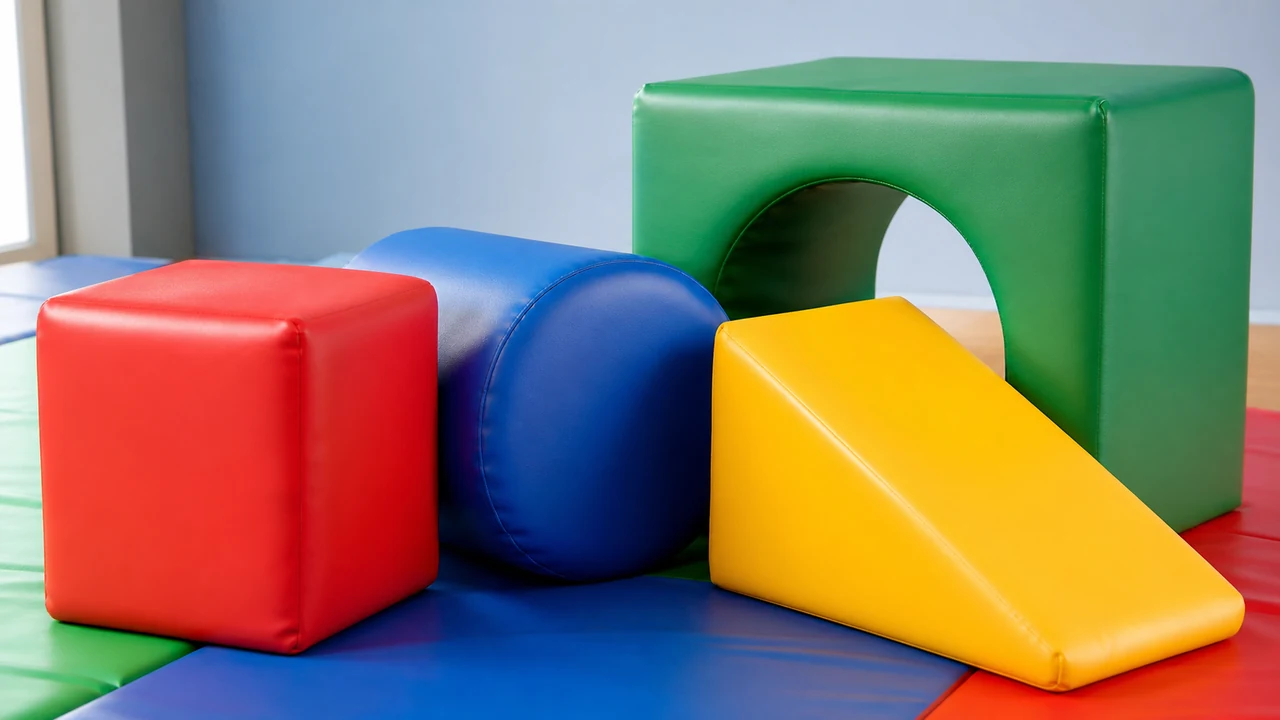
The whole safety model of soft play is built on one idea: keep fall heights low and surfaces soft. Where outdoor equipment manages risk with size and anchoring, soft play manages it with geometry. Look for:
This low-height logic is precisely why soft play is a separate purchase from a tall outdoor obstacle course or a large bouncy castle: those are sized and anchored for older, heavier, faster users, while soft play is engineered around a 1–5-year-old's body and reach.
The biggest commercial advantage of inflatable soft play is that it's modular. Blocks, mats, and shapes connect with hook-and-loop strips or zip joins, so you can lay out a 30 m² nook or a 200 m² hall from the same component family and reconfigure it whenever footfall patterns change.
When planning the space, work backwards from your floor:
If you're assembling a broader mixed offer, browse the full commercial inflatable games range to combine soft play with adjacent attractions for older siblings, so a whole family stays in your venue longer.
Soft play capacity is governed by floor area and weight, not by how many kids can physically squeeze in. Each soft-floor module has a rated load, and toddler bouncers have a low maximum user weight by design. Plan occupancy around usable area per child and post clear limits at the entrance. The same EN 14960 logic that governs larger inflatables applies here in scaled-down form—our guide to weight capacity and occupancy limits shows how max user numbers are actually calculated so you can set staffing and rotation accordingly.
Toddler zones get filthy faster than any other attraction—hands, feet, dribble, and the occasional spill all land on surfaces that other children then crawl across. High-frequency cleaning is therefore a core operating cost, not an afterthought. The good news is that smooth PVC wipes down quickly; the trap is using the wrong chemicals. Bleach, alcohol, and solvents degrade PVC coatings and shorten the life of your investment.
Use neutral cleaners and quat-based disinfectants safe for PVC, and run a documented daily routine—sweep, wash, disinfect, rinse, dry. Our cleaning and disinfection SOP lays out a schedule you can hand straight to staff. For high-traffic mall units, expect to wipe contact surfaces several times a day and do a full disinfect at close.
It's worth stating plainly, because the buying decision depends on it. Outdoor commercial inflatables—large slides, obstacle courses, big castles—are bought on size, wind rating, anchoring, and throughput of older users. Inflatable soft play is bought on material safety, low fall height, modular flexibility, and hygiene. One is about scale and ground anchoring; the other is about protecting the smallest users in an enclosed, climate-controlled room. Trying to substitute one for the other leaves you either over-built for toddlers or unsafe for them.
Because soft play is modular and theme-driven, it's one of the easiest categories to customize. As a factory-direct supplier we OEM soft play to brand colors, mascot shapes, and venue dimensions. Typical terms: low MOQ on standard modules, custom artwork and shapes on request, production lead time of roughly 15–25 days depending on volume, and efficient container loading—a full mixed soft play set ships compactly, with a single 40 ft HQ holding a large multi-room layout. We supply with full EN71 and flame-retardancy documentation so your set clears local inspection on arrival.
Soft play is the attraction that keeps the youngest visitors—and their paying parents—in your venue. Spec it as its own category, prioritize safe materials and easy cleaning, and build modularly so it grows with your floor plan.
Ready to plan a toddler zone? Tell us your floor dimensions and target age range, and we'll quote a modular soft play layout with full safety certification.
For related buying considerations, see our kids FEC buyer's guide.