
The maximum user number printed on a commercial inflatable is not a guess or a marketing figure — it is a calculated safety limit derived from the play area and the height of the people using it. Ignore it and you are not just risking injury; you are operating an unsafe unit and voiding your liability cover the moment something goes wrong.
Every bounce house, slide and combo unit has a finite play area and a finite amount of air pressure holding it rigid. Pack in too many users and three things happen at once: collision risk rises sharply, the floor pressure can no longer support the dynamic load, and seams and baffles take stress they were never rated for. Overcrowding is one of the most common root causes in inflatable incident reports, and almost all of it is preventable by simply respecting the posted figure. It is most tempting on large open units such as commercial inflatable castles, where the deck looks roomy and headcount creep is easy.
There is also a hard commercial reason. Operator insurance is written on the assumption that you run the unit within its manufacturer specification. Exceed the stated user number and most policies treat the claim as a breach — meaning an injury that should have been covered becomes a cost you carry personally. If you operate professionally, read our guide on commercial inflatable insurance for operators before you ever load a unit beyond its label.
EN 14960, the European standard for inflatable play equipment, does not assign a single arbitrary number. It works from the usable play area (the flat bouncing surface, excluding walls, towers and slide sections) and divides it by a required space allowance per user. The space allowance scales with user height, because a taller, heavier user needs more room and generates more impact energy than a small child.
The principle is straightforward: measure the clear play area in square metres, decide which user height band applies to your event, then divide. A unit run as a toddler attraction will legitimately hold far more users than the same unit run for teenagers, because each large user demands more space.
| User height band | Space allowance per user | Max users on a 16 m² play area | Max users on a 25 m² play area |
|---|---|---|---|
| Up to 1.0 m | 1.3 m² / user | 12 | 19 |
| Up to 1.2 m | 1.6 m² / user | 10 | 15 |
| Up to 1.5 m | 2.0 m² / user | 8 | 12 |
| Up to 1.8 m | 2.6 m² / user | 6 | 9 |
The values above are illustrative of how EN 14960 logic works, not a substitute for the figure on your own unit's data plate. The same physical inflatable carries several different maximums — one per height band — and the operator picks the correct one based on who is actually playing that day.
Buyers often confuse two separate limits. User count is about floor space and collision spacing — how many people can move safely at once. Weight capacity is about structural and pressure load — how much total mass the inflated floor and seams can support before the unit deforms or bottoms out against the ground.
You must satisfy both at the same time. A unit might allow eight 1.5 m users by area, yet if those users are unusually heavy or the unit also has a per-user weight cap, the lower number wins. When in doubt, the more conservative limit is the one you run.
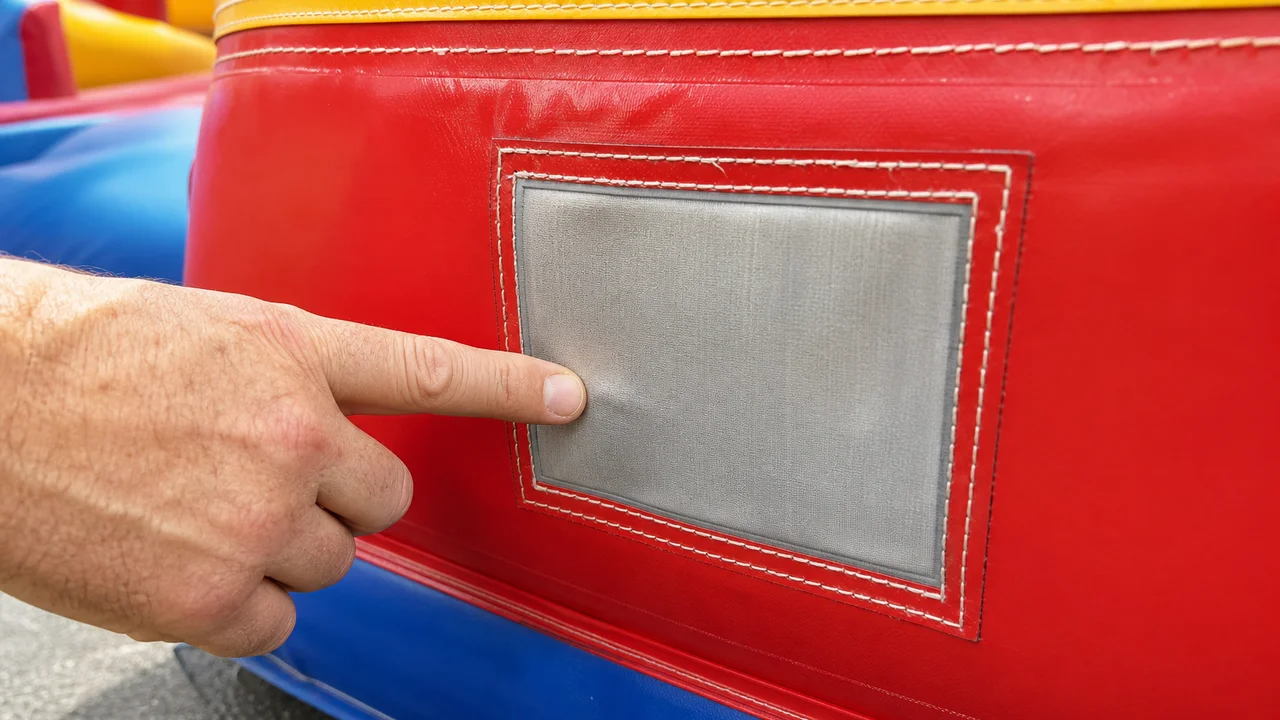
On a properly certified commercial unit, the user numbers live in two places: the durable data plate sewn or printed on the inflatable itself, and the accompanying spec sheet or operating manual. Look for a table that lists the maximum number of users per height band, the maximum individual user weight, and the recommended blower output. If a supplier cannot show you those numbers, the unit is not properly EN 14960 compliant — walk away.
If you are not sure how to interpret all the figures on a data sheet, our walkthrough on reading a commercial inflatable spec sheet breaks down every line. It is also worth understanding how the certification itself differs across markets — see EN 14960 vs ASTM safety standards, because a unit certified to one may state user numbers differently than the other. ASTM-based units, common in North America, express occupancy logic in similar floor-area terms but with their own allowances.
A posted limit only works if a person enforces it. The operator at the unit, not a sign, is the control. Practical enforcement that works in the field:
Exceeding the user number is rarely a single dramatic failure — it is a stack of compounding risks. In the short term you get more collisions, falls and pile-ups, which is where most overcrowding injuries come from. Under sustained overload the floor pressure drops, users bottom out against hard ground, and seams and internal baffles fatigue faster, shortening the working life of an expensive asset.
And the moment an incident occurs on an overloaded unit, the liability picture changes completely. Investigators and insurers will check the posted limit against witness counts. If you were over, the unit was being operated outside specification — your cover can be denied and responsibility shifts to you as the operator. The posted number is the cheapest insurance you own; enforce it every session.