"Obstacle course" covers a wide range of very different products, and a generic obstacle-course buyer's guide can't get into the specifics that actually matter once you're comparing quotes for a ninja-warrior-style unit specifically: the wall-to-wall span needed for a multi-station run, which stations need age-based fall-height ratings, and what certification actually applies to a climbing/balance obstacle versus a simple bounce unit.
This isn't a general obstacle course buyer's guide — our inflatable obstacle course buyer's guide covers sourcing fleets for school events and corporate team-building broadly. This one is a product-specific deep dive into the ninja-warrior-course format itself: station specifications, the ASTM F3034 standard specifically, and age-based sizing that a general obstacle-course guide doesn't cover in enough depth to actually spec an order against.
A standard inflatable obstacle course is typically a linear crawl-climb-slide sequence; a ninja-warrior-format course adds balance and grip-dependent stations (rolling logs, angled climbing walls, suspended rings or steps) modeled on the format popularized by televised competition, which draws a specific commercial audience — corporate fitness challenges, gym/box promotional events, and teen-and-adult party rentals that a standard course doesn't attract as strongly. Confirm which specific stations a quoted unit includes; "ninja course" isn't a standardized product name across suppliers the way "5-in-1 combo" is, so two quotes both labeled "ninja warrior course" can have meaningfully different station counts and difficulty.
ASTM F3034 is the standard specifically covering aerial adventure and challenge courses, including inflatable obstacle formats with elevated or balance-dependent stations — this is distinct from the general EN 14960 inflatable-structure standard, and a supplier who only cites EN 14960 hasn't necessarily addressed the fall-height and station-specific requirements F3034 covers. For any station with a meaningful fall height (climbing walls, elevated balance beams), confirm F3034 documentation specifically rather than accepting general inflatable safety certification as sufficient.
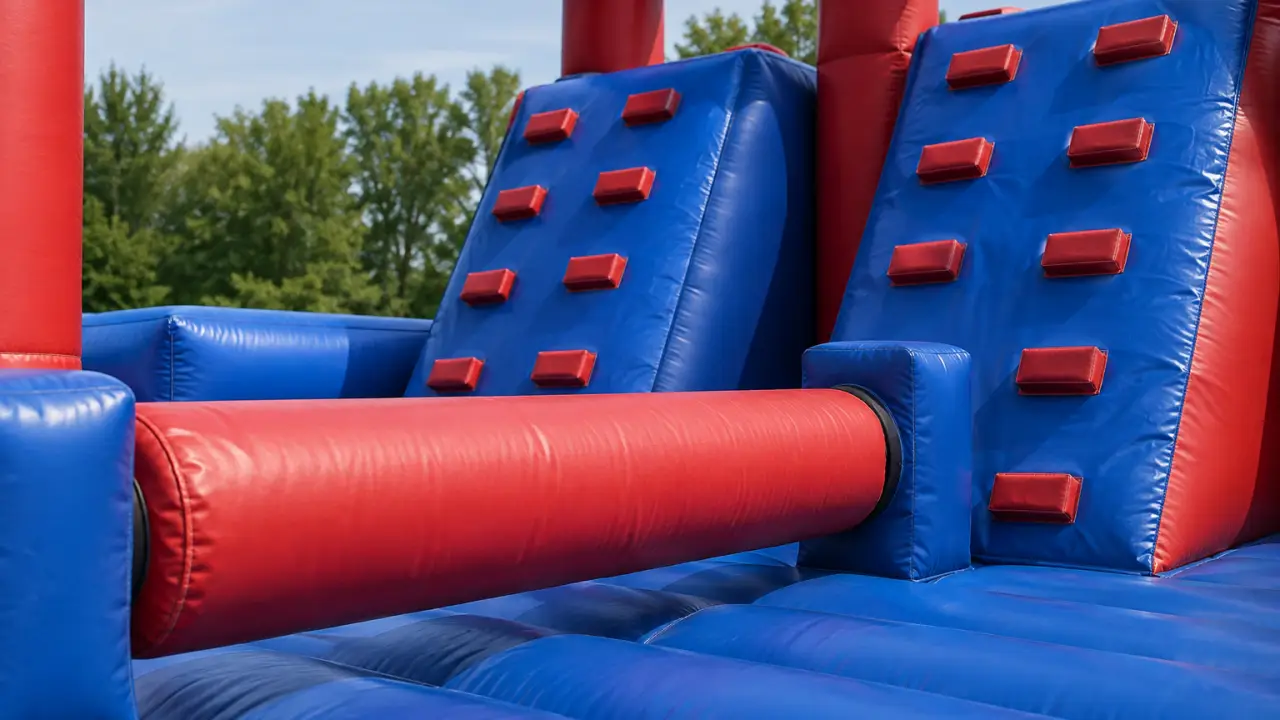
Grip-and-balance stations sized for teen/adult body weight and reach are a poor fit for a birthday-party booking skewing toward ages 6-9 — both from a safety-margin standpoint and because younger participants simply can't complete stations built around adult grip strength, leading to a frustrating (and short) rental experience. Rental operators serving a mixed booking calendar should consider a smaller-scale ninja course sized for ages 6-12 as a separate unit from a full-size adult/teen course, rather than trying to serve both markets with one unit sized for neither well.
A multi-station ninja course typically needs a longer, narrower footprint than a combo bounce unit of similar square footage — confirm the exact length dimension against your typical rental site access (gates, side yards) before ordering, since a course that fits a park field easily may not fit through a standard residential side gate for backyard rental bookings.
Most rental operators don't replace their standard bounce and combo inventory with ninja courses — they add one or two units to serve a specific booking segment (corporate events, teen parties, gym promotions) that a standard fleet doesn't capture well. Before committing fleet budget to a full-size adult ninja course, check your booking history for how often those specific event types actually come up; an operator whose calendar is mostly young-kid birthday parties may get better ROI from a smaller, kid-scaled course than a premium adult-format unit that sits unused most weekends. Interactive competitive-format units in our sports games category can also round out a corporate-event fleet alongside a ninja course.
Does a ninja warrior course need different insurance coverage than a standard bounce house?
Check with your insurer specifically — the balance and grip-dependent stations can carry a different risk profile than a standard bounce unit, and some rental insurance policies price or exclude "challenge course" style equipment differently from basic inflatables.
Can ninja course stations be ordered individually instead of as a full multi-station unit?
Some suppliers offer modular stations that can be combined or ordered separately, which is useful for operators wanting to start with a smaller footprint and expand — confirm modularity specifically with your supplier, since not all ninja course products are built to be modular.
What's a realistic price difference between a standard obstacle course and a ninja-format course?
The added stations, hardware (rollers, suspended elements), and F3034 testing typically put a ninja-format course above a comparably-sized standard obstacle course — get quotes for both against your actual station requirements rather than assuming a fixed price gap.
Confirm exactly which stations are included, get ASTM F3034 documentation for any elevated or balance-dependent station, and size to your actual booking age range before ordering — that's what separates a ninja course that books solid from one that sits unused because it doesn't fit your typical event. Get in touch with your target age group and footprint constraints for a spec-matched quote.